When does clinical technology improve charging site uptime?
auth.Marcus WattTime
Aug 23, 2026Click Count
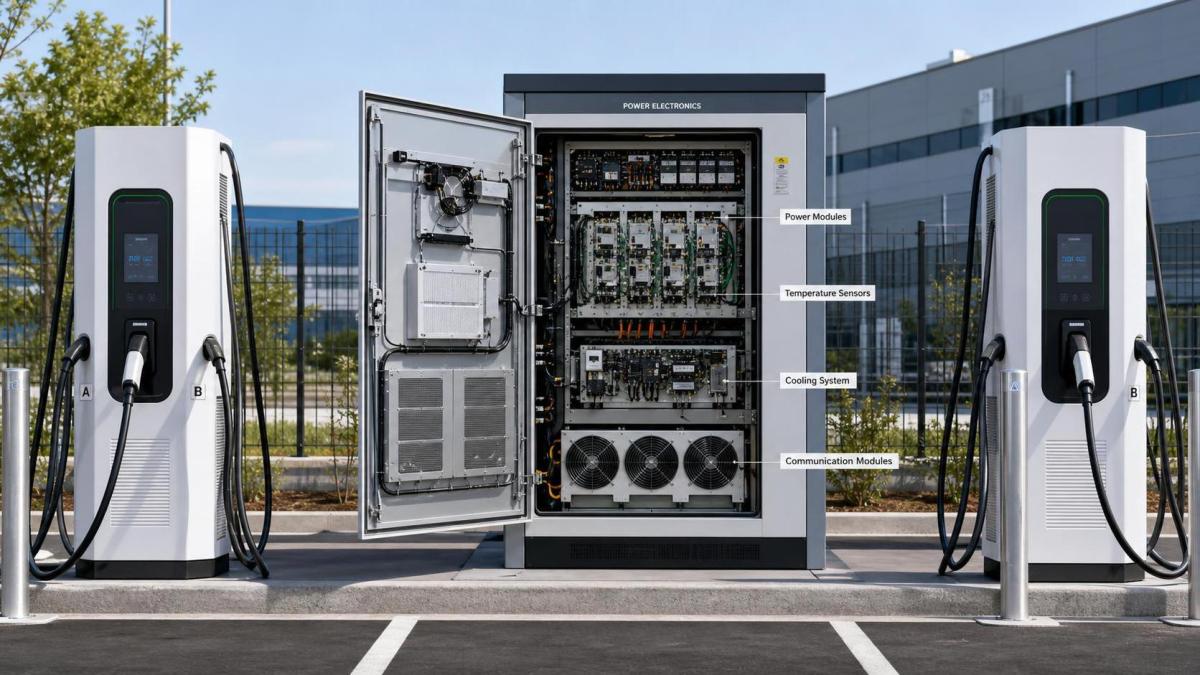
Clinical technology improves charging site uptime when it is deployed as a precision layer around the charger rather than treated as a generic software add-on. In practice, the gain appears when the site has recurring faults that are difficult to isolate by visual inspection alone: intermittent connector overheating, unexplained session drops, unstable communication between charger and backend, nuisance trips in protection devices, drift in metering accuracy, or thermal stress inside power cabinets that only becomes visible under sustained load. In those conditions, a clinical technology approach means instrumenting the charging site with finer-grain sensing, traceable diagnostics, event correlation, and disciplined control logic so that faults can be identified before they escalate into charger unavailability.
A useful distinction is between ordinary monitoring and clinical monitoring. Ordinary monitoring reports that a charger is online, offline, or in fault. Clinical monitoring tracks the physical and control-state signatures that precede those states. That may include temperature rise across contact points, fan speed deviation, coolant flow irregularity in liquid-cooled assemblies, DC bus voltage ripple, harmonic distortion on the AC side, insulation resistance changes, cable bend stress near the dispenser head, modem packet loss, and repeated retries in authentication or payment handshakes. Uptime improves when those signals are collected at a resolution that supports diagnosis instead of simply generating more alarms.
Where reliability gains usually start
The first place clinical technology earns its cost is at interfaces where multiple subsystems meet. A charging site is rarely limited by one component in isolation. The charger cabinet, transformer, switchgear, energy storage interface where present, communication gateway, cooling package, ground system, cable management assembly, and software stack all contribute to service continuity. Failures often originate at the handoff points: loose terminations after transport vibration, connector contamination during installation, firmware mismatch between controller and power modules, CT polarity errors in metering, or improper grounding that only causes nuisance behavior under wet conditions. Precision diagnostics are effective here because they reveal whether the outage is electrical, thermal, digital, or mechanical.
That matters during commissioning as much as during operations. Many sites begin with latent defects that do not trigger immediate failure. Torque values may be nominal at handover but drift after thermal cycling. A cooling loop may be filled, yet contain trapped air that reduces heat transfer under high ambient temperature. Ethernet continuity may pass, while shield bonding remains poor enough to invite intermittent noise-related communication faults. Clinical technology improves uptime when it captures baseline values during acceptance testing and then compares live behavior against those baselines rather than against a broad generic threshold.
Thermal instability is often the real fault chain
Charging equipment fails in ways that are frequently thermal before they are electrical. Contact resistance rises at a connector face, current remains within nameplate range, heat accumulates, the control system derates power, and repeated operation at elevated temperature shortens component life. Without clinical monitoring, this sequence can look like random power fluctuation or user-side interruption. With distributed temperature sensing, thermal imaging during load verification, and trend analysis tied to connector type and duty cycle, the site team can distinguish between a worn coupler, contamination on mating surfaces, inadequate cable strain relief, blocked airflow, or a cooling subsystem that is losing performance.
Ambient conditions shape this further. Coastal salt, dust from adjacent construction, freeze-thaw cycles, and solar gain on enclosures do not affect every cabinet equally. A charger with acceptable performance in mild conditions may enter repeated derating in a paved lot with reflected heat and limited airflow around the rear service zone. Clinical technology improves uptime in such settings because it maps thermal behavior to local conditions instead of assuming the charger operates in laboratory geometry. That can influence cabinet spacing, louver orientation, canopy design, filter maintenance intervals, and the decision to isolate heat-producing balance-of-plant equipment from charger intakes.

Predictive diagnostics only work with the right failure signatures
Predictive maintenance is often discussed too broadly. It improves charging site uptime only when the model is tied to actual failure precursors that the hardware can sense reliably. A counter that records fault frequency is not predictive by itself. A stronger method links event sequences: rising contact temperature followed by current derating; fan current increase followed by declining airflow; repeated insulation test drift after rainfall; packet retransmission spikes preceding remote reset events; door opening combined with humidity ingress and later corrosion-related faults. Clinical technology becomes useful when it can identify those chains with enough context to support action.
This is also where many deployments disappoint. If the sensing layer is sparse, poorly calibrated, or sampled at intervals that miss transient events, the system produces noise rather than insight. Short voltage sags, communication jitter, or control-loop oscillation may never appear in a five-minute average. For uptime improvement, diagnostics must capture the time scale of the problem. Fast phenomena near the power electronics stage need high-frequency logging or triggered waveform capture. Slower degradation, such as coolant contamination or filter loading, benefits from trend analysis across weeks and seasons. The technology is “clinical” only when measurement fidelity matches failure physics.
Standards-based control matters when sites contain mixed hardware
Uptime gains become clearer in sites assembled from equipment that follows formal communication and safety standards closely. Mixed fleets are common: different charger power classes, multiple payment or access methods, separate transformer and protection schemes, sometimes storage-assisted fast charging, and often a backend environment updated on a different schedule than field devices. In that setting, clinical technology helps when it can validate message flow, state transitions, and protection logic against expected behavior rather than merely recording that a command failed.
A charger that stops sessions may not have a charger-side fault at all. The trigger could be timing mismatch in handshake routines, certificate expiry, modem instability, misaligned firmware after a partial update, or a backend transaction state that remains unresolved long enough to force timeout. Standards-based diagnostics can narrow that down quickly if they log the sequence of messages, timestamps, retries, and state transitions. That reduces the common maintenance problem of replacing healthy hardware because the fault looked physical from a distance.
Control discipline also matters inside the power path. If a site includes load sharing, transformer demand constraints, or an ESS buffer, uptime can suffer from badly coordinated setpoints rather than hard component failure. Clinical technology improves uptime when it validates whether site-level energy management commands arrive as intended, whether ramp rates are appropriate for the installed power modules, and whether protection settings are coordinated with real inrush and transient behavior. Inadequate coordination may leave chargers online but effectively unavailable because they sit in repeated self-protection states.
Installation quality determines how much value diagnostics can unlock
There is a practical limit to what monitoring can rescue. If cable routing imposes repeated torsion on the connector assembly, if gland sealing is inconsistent, if drainage around plinths is poor, or if commissioning records are incomplete, clinical technology may only document the consequences of weak field execution. It still has value, but the uptime gain remains constrained. The strongest improvement appears when installation tolerances, torque control, grounding continuity, insulation practices, and enclosure sealing are disciplined enough that diagnostic signals reflect emerging faults rather than constant construction noise.
Transport and staging deserve more attention than they usually receive. Power cabinets, cooling subassemblies, and cable assemblies can pick up hidden stress before energization. A unit may arrive with no visible exterior damage while internal supports have loosened or connectors have micro-movement at terminations. If acceptance testing relies only on startup success, those defects can survive into service. Clinical methods, including vibration-sensitive inspection points, baseline thermal runs, and event logging during first-load commissioning, improve uptime because they detect damage introduced between factory release and final energization.
Maintenance cycles become shorter when diagnosis is specific
One of the most practical gains is not fewer failures at first, but less time spent finding the fault. A site outage can remain unresolved for long periods when technicians arrive with only a generic code such as overtemperature, communication loss, or isolation error. Clinical technology improves uptime when remote diagnostics narrow the probable cause to a small set of replaceable elements or site conditions before a field visit is dispatched. That changes spare parts planning, tool selection, and isolation procedures.
For example, an isolation fault may originate in the vehicle side, the cable set, moisture ingress inside the dispenser, contamination in a connector cavity, or a damaged internal harness near a moving support. If the system can compare insulation behavior across weather conditions, charge current levels, connector position, and cabinet humidity, the maintenance path is more direct. A single visit with the correct cable assembly or seal kit can restore service faster than repeated visits driven by incomplete fault codes.
This precision is especially useful where access windows are limited. Urban sites may have restricted service hours, and highway sites may require careful traffic control around maintenance activity. Every unnecessary visit increases operational exposure. Clinical technology improves uptime when it converts broad alarms into serviceable findings that fit within those site constraints.
Data quality problems can cancel the expected benefit
A common misjudgment is to assume that more tags equal more reliability. In reality, poor data governance can make outage response worse. Sensor drift, duplicated event sources, unaligned timestamps between local controller and cloud logs, missing units, and firmware changes that rename variables can break trend interpretation. If a temperature value is offset after replacement and not re-baselined, the system may trigger false derating or hide a real hot spot. If remote timestamps are skewed, teams may blame the network for a power event that happened earlier at the switchboard.
Clinical technology improves charging site uptime only when the data path itself is maintained: sensor calibration records, firmware traceability, synchronized clocks, retained fault histories, and clear ownership for alarm tuning. Otherwise, the operation falls into a cycle of remote uncertainty followed by blanket part replacement. That pattern is expensive, but more importantly it keeps chargers unavailable while healthy components are swapped and the root cause remains in place.
Procurement language affects uptime long before energization
Many uptime limitations are written into the project through vague technical schedules. If procurement documents ask for remote monitoring without specifying event granularity, waveform capture capability, local data retention, diagnostic access rights, environmental sensor coverage, replacement sensor lead times, or compatibility with site protection studies, the installed system may be too shallow to support clinical analysis later. Charging site uptime improves when the specification defines what evidence must be available after a fault, how long logs are retained locally if communications fail, and how sensor replacements are validated after maintenance.
That also includes logistics. Some parts are easy to stock; others are long-lead assemblies with serialization, firmware pairing, or coolant compatibility requirements. If predictive diagnostics identify an impending failure in a power module or connector cooling loop but the replacement chain is undefined, the diagnostic advantage shrinks. Measurable uptime gains usually appear where condition-based findings are linked to realistic spare strategy, service documentation, and controlled part interchangeability.
When clinical technology adds little value
It adds little where outages are dominated by obvious external causes such as persistent utility interruptions, unresolved permitting constraints, repeated physical damage from vehicle impact, or chronic cellular coverage gaps with no viable wired alternative. In those cases, better diagnostics may describe the interruption more clearly without materially changing availability. The same applies when the charger fleet is too small, too lightly used, or too operationally simple for advanced monitoring to alter maintenance decisions. A low-duty site with stable conditions and easy physical access may gain more from disciplined preventive inspection than from a dense sensor overlay.
It also underperforms when teams expect prediction without process change. If alarms are not triaged, firmware updates are not validated on a controlled schedule, post-repair baselines are not reset, and maintenance records remain disconnected from live telemetry, the clinical layer becomes an archive rather than an operational instrument.
The strongest condition for improvement is straightforward: charging sites with complex duty cycles, meaningful thermal loading, mixed hardware interfaces, and recurring hard-to-diagnose faults benefit from clinical technology when measurement fidelity, installation discipline, and maintenance workflows are aligned. Under those conditions, uptime stops depending on reactive resets and starts depending on evidence that can be acted on before a charger drops out of service.
Recommended News
- 00
0000-00
What OCPP 2.0.1 adds to a charging station’s smart charging capabilityOCPP 2.0.1 charging station capabilities explained: explore smarter load control, EV-aware scheduling, security, and practical validation for reliable charging sites. - 00
0000-00
How to choose POS terminals that support contactless paymentsPOS terminals for contactless payments: learn how to compare security, connectivity, integration, durability, and user experience to choose a reliable solution. - 00
0000-00
When is a 32 amp commercial charger enough for workplace EV charging?32 amp commercial charger: discover when it delivers the right workplace EV charging balance, from dwell time and capacity to scalable, cost-effective deployment.
000000-00
{item.title}{item.description}Search News
Industry Portal
Hot Articles
- Which filing cabinets offer reliable security for confidential records?Filing cabinets with fire ratings, reinforced steel, secure locks, and anchoring protect confidential records. Compare the best options for theft, fire, and access control.
- What OCPP 2.0.1 adds to a charging station’s smart charging capabilityOCPP 2.0.1 charging station capabilities explained: explore smarter load control, EV-aware scheduling, security, and practical validation for reliable charging sites.
- What determines the solar tracker price for utility-scale projects?Solar tracker price for utility-scale projects depends on steel, site conditions, controls, logistics, installation, and lifecycle value. Learn how to compare proposals wisely.
Popular Tags