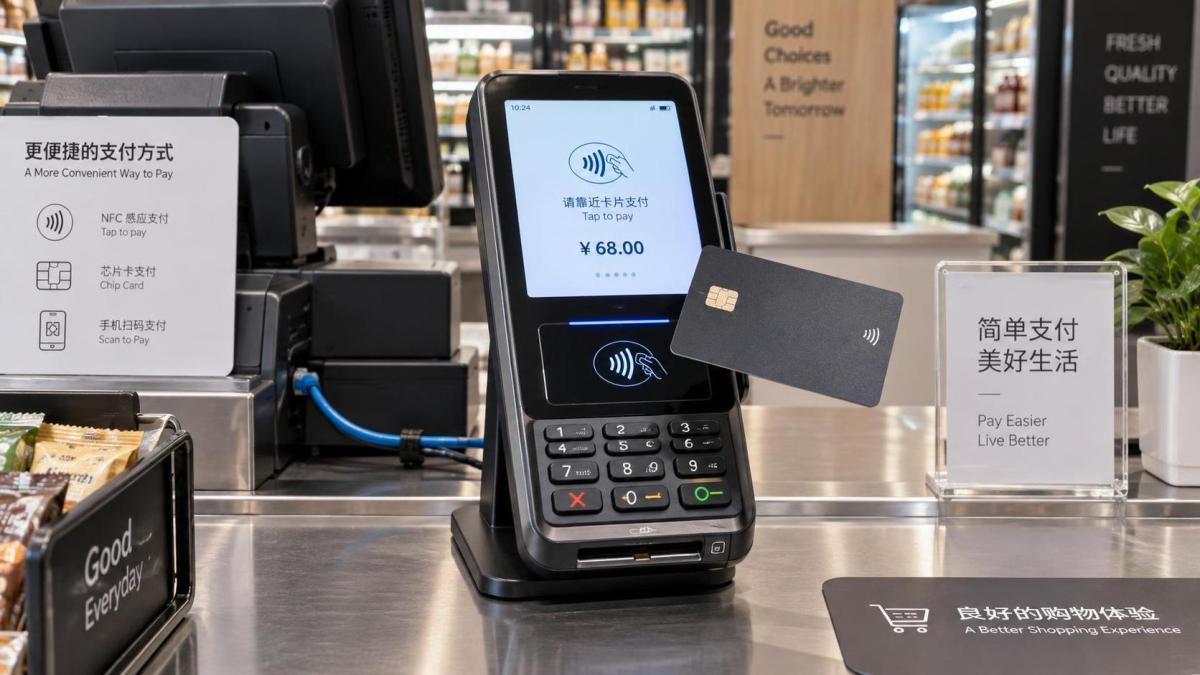
How to choose POS terminals that support contactless payments
auth.Marcus WattTime
Sep 11, 2026Click Count
A contactless-ready POS terminal should be selected as part of a payment environment, not as an isolated countertop device. A terminal that accepts tap-to-pay cards but cannot maintain a stable network connection, follow the required payment application controls, or exchange the right data with the existing checkout system creates delays that are often discovered only after deployment. Start with the payment methods, installation conditions, transaction flow, and support model that the terminal must handle over its working life.
The first screening question is straightforward: does the device support the contactless technologies and payment acceptance configuration required at the point of sale? The deeper question is whether that support remains valid within the chosen processor, acquirer, payment application, and geographic operating environment. Hardware capability alone does not guarantee that a particular card scheme, mobile wallet, or local payment method will be enabled in the live configuration.
Confirm the payment acceptance path before comparing hardware
Near-field communication (NFC) is the radio interface behind contactless card and wallet transactions, but NFC support should not be treated as a complete specification. The terminal, its secure payment software, and the acquiring arrangement must work together. A device may contain an NFC reader while the installed payment application lacks approval or configuration for a needed transaction type.
Document the intended payment flow in practical terms. Identify whether the terminal will accept contactless cards, mobile wallets, chip-and-PIN cards, magnetic-stripe fallback transactions where permitted, QR-based payments, gift cards, or closed-loop credentials. Clarify whether it must support gratuity prompts, split tender, refunds, pre-authorizations, recurring-account token creation, or unattended payment. These functions affect the software estate and host integration even when the physical terminal appears identical.
Ask for evidence tied to the exact model, software version, and payment configuration rather than relying on a general product brochure. Payment-related approvals often apply to a defined combination of hardware, kernel, operating system, secure application, and deployment method. A later firmware revision or a separately installed checkout application can change the scope that was originally reviewed.
Security evaluation should cover the full transaction chain. The terminal needs appropriate protection for cardholder data and cryptographic keys, but the assessment should also address how keys are injected, how software is signed and updated, where transaction logs are retained, and how a lost device is disabled. A contactless transaction may be fast at the counter while its operational exposure lies in remote management or weak access control around the back-office system.
Match terminal form factor to the checkout environment
A compact mobile terminal is useful only when mobility genuinely reduces friction. In a table-service venue, field service setting, temporary sales area, or vehicle-based operation, battery runtime, cellular coverage, hand strap design, docking behavior, and device weight matter as much as tap performance. A countertop terminal may be the stronger choice at a fixed checkout where a cable connection, receipt printer, customer display, and reliable power supply are available.
Integrated smart terminals deserve separate evaluation. They combine payment acceptance with a touchscreen, operating system, and applications, which can simplify a small deployment. They also introduce application lifecycle questions: who controls updates, how are non-payment applications isolated from the payment environment, and can the unit remain usable when one app fails? An integrated device should not be selected solely because it reduces visible hardware at the counter.
Where payment takes place near electrical equipment, vehicle traffic, charging infrastructure, or outdoor cabinets, installation details deserve early attention. Metal housings, thick glass, recessed mounting, nearby radio equipment, and poorly placed antennas can reduce contactless read consistency. A terminal that performs well on a desk should be tested in the actual enclosure, at the intended mounting depth, with the final cabling and power arrangement in place.

Evaluate contactless performance as a user interaction
“Fast contactless payment” is an incomplete requirement. The meaningful experience includes how quickly the terminal wakes, when it signals readiness, how clearly it guides card placement, how it responds to a declined transaction, and whether the checkout system receives a timely final result. A slow host response can be mistaken for poor NFC performance; an ambiguous screen prompt can lead to repeated taps even when the radio exchange has completed correctly.
Test more than one contactless credential type. Physical cards and mobile-wallet devices can behave differently because the latter may require device authentication, use different antenna positions, or have a protective case. Observe transactions when the card is tapped at a slight angle, held too briefly, or presented near the edge of the reader zone. The objective is not to approve poor behavior, but to identify whether ordinary real-world handling produces confusing retries.
Sound, light, vibration, and on-screen feedback should fit the environment. A loud retail floor may require a visual confirmation that is readable from the customer side. In a quiet hospitality setting, excessive alert sounds can be disruptive. Accessibility also matters: touch targets, contrast, display glare, card-reader placement, and the ability to complete a transaction without relying on a single sensory cue all influence whether the terminal is usable across normal operating conditions.
Connectivity needs a failure plan, not just a preferred network
Ethernet, Wi-Fi, cellular, Bluetooth, and USB connections serve different roles. Ethernet is often preferred for a fixed terminal because it offers predictable connectivity and avoids radio congestion. Wi-Fi can support flexible placement but requires careful roaming, segmentation, credential management, and signal validation at every expected position. Cellular terminals avoid dependence on local network access, yet coverage, data-plan control, antenna orientation, and indoor signal loss remain operational constraints.
Do not assume that a terminal with several radios provides useful resilience by default. Failover may need to be configured in the payment application, and a switch between network paths may interrupt an in-progress transaction. Define what should happen when connectivity drops: whether the terminal declines new payments, stores a limited transaction state, retries a host request, or supports an approved offline mode. Offline acceptance has commercial and fraud implications, so it should be enabled only when the payment arrangement and operating rules explicitly support it.
Network security also needs to be compatible with the terminal. Captive portals, browser-based Wi-Fi sign-in pages, restrictive firewall rules, certificate inspection, and short DHCP leases can all interfere with payment communications. Before rollout, validate the device against the actual network architecture, including DNS resolution, time synchronization, firewall policy, remote-management endpoints, and recovery after a router restart.
Integration determines whether the terminal shortens or extends checkout
A standalone terminal can be appropriate when payment totals are entered manually and transaction volume is modest. Its apparent simplicity has a cost: mistyped amounts, mismatched refunds, and extra reconciliation work become more likely. Semi-integrated or fully integrated designs reduce manual entry by passing the amount from the point-of-sale application while keeping sensitive card data within the payment device and processor-controlled path.
The integration review should identify exactly which system owns each action. The checkout application may initiate a sale, the terminal captures cardholder interaction, the payment host returns approval status, and the transaction identifier must be stored for receipts, refunds, voids, settlement, and reconciliation. Unclear ownership creates difficult edge cases, especially when a network interruption occurs after a card is tapped but before the point-of-sale screen receives a response.
Request documentation for supported APIs, message fields, error codes, and version control. Confirm how the integration handles a cancelled transaction, duplicate request prevention, partial approval, timeouts, receipt printing, and end-of-day settlement. A polished demonstration that covers only successful sales reveals little about the conditions that create support calls later.
Test the exceptions deliberately
- Begin a payment, interrupt network connectivity at different stages, and verify whether the sale status can be determined without charging the customer twice.
- Run a refund and a void through the intended checkout workflow. These are often implemented differently and may require the original transaction reference.
- Restart the terminal and the point-of-sale system separately, then confirm that they reconnect without manual re-pairing or orphaned transactions.
- Test receipt behavior when the terminal printer is unavailable, when an email receipt is requested, and when the checkout system prints the final record.
Durability and serviceability affect total operating cost
Exterior design is a poor proxy for durability. Inspect the stated environmental limits, ingress protection, drop resistance where relevant, connector design, screen material, button wear, printer access, battery service method, and dock construction. High-frequency use places stress on charging ports, cable joints, paper covers, and contact points long before the NFC antenna itself becomes a problem.
A replaceable battery can reduce downtime in mobile operations, but only if spare batteries can be safely stored, identified, charged, and rotated. A sealed battery may be acceptable for a fixed device with continuous power, while it can become a maintenance burden in an all-day mobile deployment. Similarly, an integrated printer is convenient until paper loading requires awkward access or the printer mechanism disables the entire payment unit.
Review the repair and replacement path before committing to a fleet. Determine whether field replacement preserves device configuration, whether failed units can be securely wiped, how payment keys are handled during exchange, and whether accessories remain available through the intended service period. A lower purchase price can be offset by repeated site visits, long replacement lead times, or a terminal that requires full re-enrollment after a simple hardware failure.
Lifecycle control matters after installation
Contactless payment devices require ongoing software, security, and configuration management. Establish who authorizes updates, how they are tested, when they are deployed, and what rollback option exists if a release disrupts payment acceptance. Remote estate management should show terminal identity, software version, network state, battery condition where applicable, and transaction connectivity without exposing sensitive payment data to unnecessary users.
Version discipline is especially important when the terminal is connected to a changing point-of-sale application. A checkout update can alter receipt fields, timeout handling, tax logic, or API behavior without changing the payment hardware. Keep a controlled compatibility record that links the terminal model, payment application version, point-of-sale version, integration release, and network configuration. This record makes fault isolation far faster when a site reports intermittent failures.
The final choice should be based on a pilot that resembles the intended deployment, including real mounting, network conditions, checkout workflows, and exception handling. Select the terminal that maintains clear customer interaction, protects the payment path, integrates cleanly with the transaction system, and can be supported without fragile manual workarounds. Contactless capability is the entry requirement; dependable operation across the full payment lifecycle is the deciding factor.
Recommended News
- 00
0000-00
How to choose POS terminals that support contactless paymentsPOS terminals for contactless payments: learn how to compare security, connectivity, integration, durability, and user experience to choose a reliable solution. - 00
0000-00
When is a 32 amp commercial charger enough for workplace EV charging?32 amp commercial charger: discover when it delivers the right workplace EV charging balance, from dwell time and capacity to scalable, cost-effective deployment. - 00
0000-00
When does an AC charging station make more sense than DC fast charging?Learn when an ac charging station outperforms DC fast charging for fleets, workplaces, and commercial sites—cut costs, ease grid strain, and scale EV infrastructure smarter.
000000-00
{item.title}{item.description}Search News
Industry Portal
Hot Articles
- What determines the solar tracker price for utility-scale projects?Solar tracker price for utility-scale projects depends on steel, site conditions, controls, logistics, installation, and lifecycle value. Learn how to compare proposals wisely.
- Which machinery parts wear fastest in solar tracker drive systems?Machinery parts in solar tracker drive systems wear fastest at slew drives, bearings, motors, and couplings. Discover warning signs and maintenance tips.
- How grid monitoring systems improve outage response in the Middle EastDiscover how grid monitoring systems Middle East utilities use to locate faults faster, prioritize critical loads, and improve outage response across complex power networks.
Popular Tags