When is a 32 amp commercial charger enough for workplace EV charging?
auth.Marcus WattTime
Aug 31, 2026Click Count
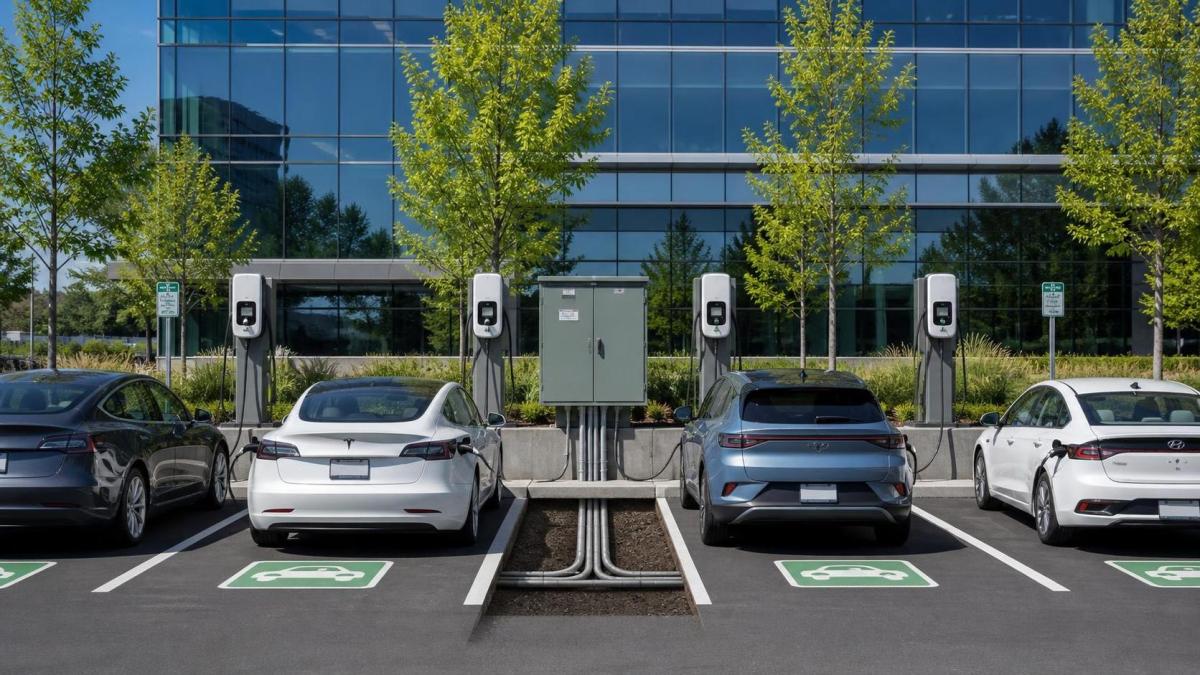
For a workplace EV charging project, the question is rarely whether a 32 amp commercial charger can charge an electric vehicle. It can. The more consequential question is whether its charging window, electrical footprint, and operational flexibility match the way vehicles actually arrive, park, and leave the site.
At typical North American split-phase voltage, a 32A Level 2 charger is commonly associated with roughly 7.7 kW of delivered power when installed on a 40A branch circuit, subject to local electrical rules and equipment ratings. At other supply voltages, output will differ. That rating is enough to add a meaningful amount of energy during a normal workday, but it is not a universal answer to workplace electrification. Project managers need to distinguish between “adequate for daily employee parking” and “adequate for a site’s fleet, growth plan, and service expectations.”
A 32 amp commercial charger is often the sensible middle ground for offices, campuses, municipal facilities, healthcare sites, and destination parking locations. It becomes less compelling when vehicles have short dwell times, daily mileage is high, charging access is limited, or the project is expected to support operational fleets rather than employee commuting.
The first test is dwell time, not charger nameplate power
Charging power only has value when vehicles remain connected long enough to use it. A 32A charger may be modest compared with higher-output AC units or DC fast charging, yet it can be entirely sufficient when an employee parks for seven to nine hours. In that setting, a vehicle that arrives with a partially depleted battery can often recover a substantial share of its daily commuting energy before the end of the shift.
That does not mean every employee will need a full recharge. Most workplace charging demand comes from drivers replacing daily travel, not from drivers arriving nearly empty. A project based on average commuting needs, typical parking duration, and managed charging behavior is usually more economically sound than one sized around the maximum possible energy requirement of every vehicle.
The arithmetic should be simple, but the inputs need discipline:
- How many hours are vehicles normally connected, rather than merely parked?
- What is the expected daily mileage of participating drivers or fleet vehicles?
- What battery state of charge do vehicles usually have upon arrival?
- Will charging be shared across shifts, visitors, and employees?
- How many vehicles need guaranteed access on the same day?
A charger delivering approximately 7 kW over an eight-hour workday has a large enough energy window for many commuter use cases. But the site should model realistic charging duration. Vehicles may be unplugged early, drivers may not plug in every day, and some charging sessions may be intentionally limited by load management. Using the nominal eight-hour shift as though every connector will deliver full output for eight continuous hours will overstate usable capacity.
Where 32A charging tends to work well
The strongest fit is a workplace with long, predictable parking periods and a charging objective centered on employee convenience or routine fleet replenishment. Professional offices, corporate campuses, education facilities, public-sector workplaces, and industrial sites with stable first-shift schedules often fall into this category.
It can also work well for destination charging where drivers stay for several hours, such as hospitals, hotels, conference venues, and mixed-use developments. In these settings, a much faster charger may not materially improve the driver experience because the vehicle will remain parked after charging finishes. The challenge then becomes connector turnover and parking policy, not simply power delivery.
For light-duty fleet operations, 32A may be appropriate when vehicles return to base early, have overnight or extended daytime dwell periods, and travel predictable routes. Maintenance vans, inspection vehicles, local government passenger fleets, and service vehicles with limited daily mileage can fit this profile. Fleet managers should nevertheless test the scenario against winter energy use, route variability, towing, payload, and unplanned dispatches. Those factors can materially increase energy demand.

A practical fit profile
A 32A deployment is generally defensible when most of the following conditions are true:
- Vehicles are parked for at least four to six hours on a typical charging day.
- The project serves employee commuters, visitors, or light-duty vehicles with predictable return times.
- Not every user requires a full battery at departure.
- The electrical service has limited spare capacity, making higher-power units expensive to support.
- The site can use managed charging to prevent coincident demand spikes.
- Future expansion matters more than maximizing power at each initial parking space.
These are not strict thresholds. They are screening conditions. A project may still need higher power when its users have unusually high daily driving needs, and it may succeed with lower power when dwell time is exceptionally long. The key is to design around the operating pattern rather than a generic view of what “commercial charging” should look like.
Why higher power is not automatically better
A frequent assumption is that selecting the highest available AC charging output is the most future-proof decision. That conclusion overlooks both infrastructure cost and vehicle constraints. Higher-output equipment can require larger branch circuits, heavier conductors, more panel capacity, and potentially costly service upgrades. The resulting capital expenditure may reduce the number of ports a project can afford in its first phase.
In many workplaces, more available connectors at moderate power produce a better outcome than fewer high-power connectors. Employees value access and predictability. A driver who can connect reliably for a full workday may be better served by a 32A port than by a faster unit that is often occupied.
Vehicle onboard charging capability also matters. Not all EVs accept the same AC charging rate. A higher-rated station does not force a vehicle to charge faster than its onboard charger allows. Procurement teams should avoid evaluating equipment only by advertised maximum output. They should review the vehicle mix that will use the site today and the likely mix over the project’s planning horizon.
There is also a demand-management issue. A bank of chargers operating at full output can create a substantial coincident load if unmanaged. A properly designed system can distribute available capacity among connected vehicles, schedule charging outside peak periods, or prioritize selected users. For a workplace, these controls can be more valuable than another increment of connector power.
Electrical capacity is usually the real project constraint
Before deciding whether 32A is enough for drivers, determine whether it is appropriate for the building. The charger rating is only one part of the electrical design. Existing service size, main distribution equipment, spare feeder capacity, panelboard space, transformer loading, backup power arrangements, and site demand profile all influence the feasible deployment.
In many jurisdictions, EV charging is treated as a continuous load for electrical design purposes, which means circuit and feeder sizing must account for applicable code requirements. The exact treatment should be confirmed with the authority having jurisdiction and the project electrical engineer. It should not be assumed from a manufacturer brochure or a charging-network sales proposal.
A 32A charging station often requires a 40A branch circuit under common design practice, but site-specific requirements can vary. The project team should also assess voltage, phase configuration, available fault current, grounding, protection coordination, and communications infrastructure. These items are less visible than the charger itself, yet they often determine schedule and cost.
The most expensive workplace charging projects are frequently those where equipment selection was finalized before the electrical survey. A site may appear to have adequate service capacity on paper, only to reveal constrained switchgear, a fully occupied panel, insufficient transformer headroom, or a utility upgrade with a long lead time. Early field verification prevents a small charger procurement decision from becoming a major infrastructure project late in delivery.
Design for expansion, even when initial demand is uncertain
Demand forecasts for workplace charging are inherently uncertain. Employee EV adoption, vehicle incentives, company fleet policies, parking allocation, and utility tariffs can all change faster than a building electrical system. The right response is not necessarily to install maximum power everywhere on day one. It is to create an expansion path that remains technically and financially credible.
For many sites, this means installing conduit, cable pathways, communications routes, and physical allowances for additional chargers while parking areas are already under construction. Civil work is often disproportionately expensive once landscaping, paving, and traffic controls are in place. Reserving capacity in distribution equipment, or at least documenting a practical upgrade path, can be equally important.
There is a material difference between “future-ready” and “future-claimed.” A meaningful future-ready design identifies where new circuits will originate, how load will be managed, what equipment must be upgraded, and whether the utility supply can support the eventual load. Simply leaving empty parking spaces or installing an oversized pedestal does not establish a scalable charging plan.
Load management is central to this approach. A site with 20 installed chargers does not always need electrical capacity for 20 chargers operating simultaneously at full rated output. Dynamic power sharing can cap total charging demand within a defined site limit while still giving many drivers access. However, the project team should verify how the system behaves under communications loss, how priorities are set, whether power can be guaranteed for fleet-critical vehicles, and whether the control platform remains usable if the charging-network provider changes.
Operational policy can make or break an otherwise sound selection
Hardware sizing is only half the decision. A 32A charger can serve a workforce effectively when the parking policy supports turnover and fair access. Without policy, even an oversized installation can generate complaints from employees who find fully charged vehicles occupying spaces all day.
Common operational decisions include whether charging is free, subsidized, billed at an energy-based rate where permitted, or billed through a session or parking mechanism. Each choice affects demand patterns. Free charging may accelerate adoption but can increase pressure on limited ports. Time-based fees can improve turnover but may penalize employees whose vehicles charge slowly or whose work schedule prevents them from moving vehicles promptly.
For workplaces with limited capacity, reservation systems and charging windows may be useful, especially during early adoption. For larger sites, automated queueing and power-sharing rules can reduce administrative burden. The appropriate model depends on company culture, labor rules, visitor access, and whether fleet vehicles have priority over private employee vehicles.
Project managers should also define who owns daily support. Someone must handle damaged connectors, blocked bays, access credentials, payment disputes, network outages, and user education. Commercial charging equipment should be selected with serviceability in mind: warranty terms, local maintenance coverage, replacement lead times, remote diagnostics, and the ability to obtain operating data without being locked into an opaque platform.
When 32A is likely insufficient
There are clear cases where a 32A commercial charger should not be the primary answer. High-turnover retail sites, highway-adjacent destinations, taxi or ride-hail staging areas, and public charging locations with short dwell times generally need a different power strategy. A driver stopping for 30 to 90 minutes cannot recover the same useful energy as an employee parked all day.
The same warning applies to fleets with high daily utilization. Delivery operations, emergency-response support vehicles, airport ground transport, multi-shift service fleets, and vehicles that must return to the field quickly may require higher-power AC charging, DC charging, battery swapping in specialized contexts, or a combination of depot charging and operational scheduling. The answer should be based on route and duty-cycle data, not a generalized assumption that Level 2 charging is always enough overnight.
Sites with a small number of ports and a large number of users may also find 32A inadequate in practice. The limitation may be access rather than power, but the user experience is the same: drivers leave without enough energy. In those cases, adding more managed ports, changing allocation rules, or increasing available site capacity may be more effective than simply replacing chargers.
A procurement decision should separate equipment, infrastructure, and service risk
When comparing offers, project teams should avoid treating all commercial chargers with the same nominal amperage as equivalent. The selection should examine enclosure suitability for the environment, connector and cable durability, accessibility requirements, network interoperability, cybersecurity responsibilities, billing capability, uptime commitments, and the vendor’s ability to support the equipment over its intended life.
Standards and certifications should be reviewed against the project jurisdiction and owner requirements. Relevant equipment may be evaluated to applicable safety and interoperability standards, but the exact certifications required depend on location and application. Claims regarding compliance with IEC, UL, SAE, utility programs, or local installation rules should be verified in the tender documentation and with the relevant authority. Certification labels alone do not confirm that the entire installed system meets code.
Commercial terms deserve the same scrutiny as technical specifications. A low hardware price can be offset by recurring software fees, payment-processing charges, proprietary network requirements, restrictive data access, or limited options when a service contract expires. The buyer should understand who controls charger configuration, user records, tariff rules, charging history, and remote access credentials.
For most workplace projects, the useful decision is not “32A versus faster.” It is whether the site can reliably deliver enough energy to the right vehicles during the time they are actually parked, while leaving room for adoption to grow. A 32A design is often the right foundation when parking duration is long and electrical capacity is constrained. It becomes the wrong choice when operational urgency, vehicle utilization, or turnover demand compresses the charging window. That distinction is what turns a charger rating into an infrastructure decision.
Recommended News
- 00
0000-00
How to choose POS terminals that support contactless paymentsPOS terminals for contactless payments: learn how to compare security, connectivity, integration, durability, and user experience to choose a reliable solution. - 00
0000-00
When is a 32 amp commercial charger enough for workplace EV charging?32 amp commercial charger: discover when it delivers the right workplace EV charging balance, from dwell time and capacity to scalable, cost-effective deployment. - 00
0000-00
When does an AC charging station make more sense than DC fast charging?Learn when an ac charging station outperforms DC fast charging for fleets, workplaces, and commercial sites—cut costs, ease grid strain, and scale EV infrastructure smarter.
000000-00
{item.title}{item.description}Search News
Industry Portal
Hot Articles
- What determines the solar tracker price for utility-scale projects?Solar tracker price for utility-scale projects depends on steel, site conditions, controls, logistics, installation, and lifecycle value. Learn how to compare proposals wisely.
- Which machinery parts wear fastest in solar tracker drive systems?Machinery parts in solar tracker drive systems wear fastest at slew drives, bearings, motors, and couplings. Discover warning signs and maintenance tips.
- How grid monitoring systems improve outage response in the Middle EastDiscover how grid monitoring systems Middle East utilities use to locate faults faster, prioritize critical loads, and improve outage response across complex power networks.
Popular Tags