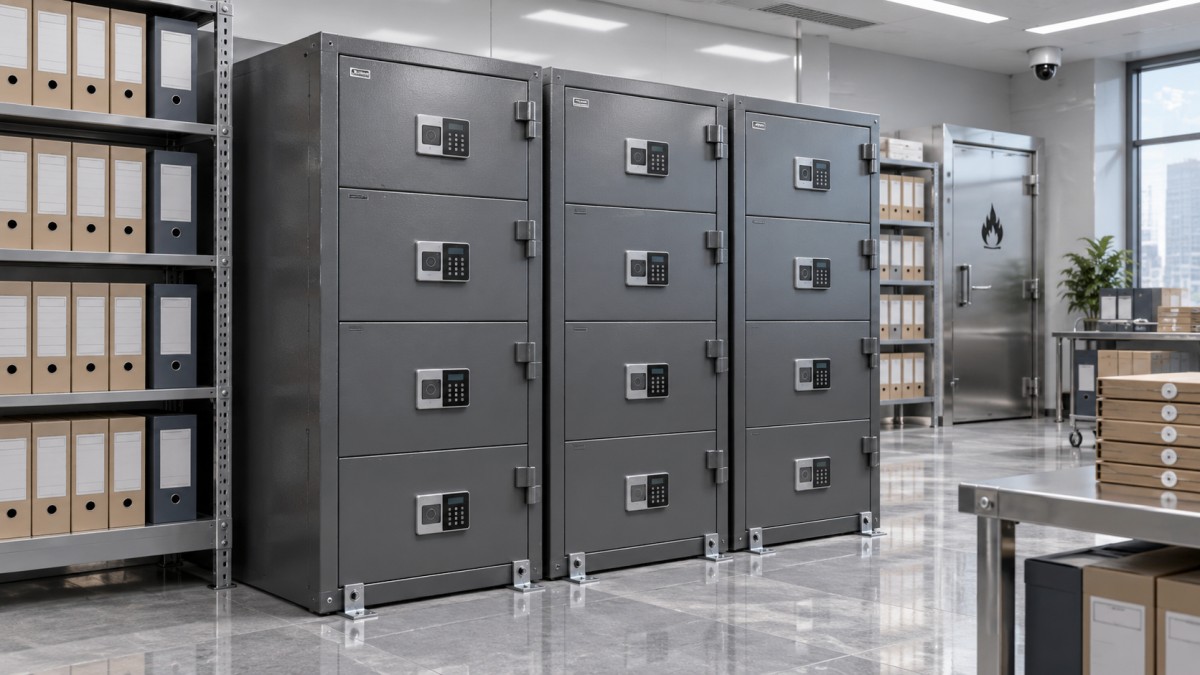
Which filing cabinets offer reliable security for confidential records?
auth.Dr. Liang CheTime
Oct 08, 2026Click Count
For confidential engineering drawings, contracts, compliance files, personnel records, and project correspondence, the most reliable filing cabinets are purpose-built security units rather than ordinary office storage with a lock added to the front. A cabinet earns consideration when its security is supported by the cabinet body, drawer construction, lock design, anchoring method, and document-protection rating as a whole.
The strongest choice changes with the threat being managed. Unauthorized casual access, forced drawer entry, fire exposure, and loss of records during a site move are different problems. A tall lateral cabinet with a keyed lock may control routine access in an administrative room, yet it is not equivalent to a fire-rated insulated cabinet or a burglary-resistant records safe. Treating all locked cabinets as comparable is a common source of under-specification.
Start with the record type and likely exposure
Paper records need protection from direct access, crushing, heat, smoke, and water used during fire suppression. Digital media stored alongside paper introduces another constraint: electronic media can be damaged at temperatures and humidity levels that paper may survive. If files include both printed documents and removable storage devices, separate protected storage is often more dependable than assuming one cabinet rating covers everything.
Location matters as much as the cabinet label. A cabinet placed in a controlled records room faces a different risk profile from one positioned in a reception area, construction trailer, warehouse office, or shared project room. Cabinets in exposed or temporary locations benefit from a stronger shell, concealed locking components, and positive anchoring to the building structure. A cabinet that can be tipped, carried away, or rolled through a doorway does not provide meaningful theft resistance merely because its drawers lock.
Cabinets that provide the most dependable security
Fire-rated vertical or lateral file cabinets
For confidential paper records that must remain available after a building fire, insulated fire-rated filing cabinets are the appropriate category. Their construction differs substantially from standard steel office furniture. The body, drawer fronts, and cavities between drawers are designed to slow heat transfer, while drawer interfaces may use features that limit the passage of heat, smoke, and debris.
Verify that the stated rating applies to the complete cabinet configuration being purchased: the number of drawers, file orientation, lock arrangement, and any added internal compartments. A seller's use of terms such as “fireproof” should not substitute for documentation identifying the test basis and the protected contents. Fire ratings also address a defined exposure, not unlimited protection under every fire condition. After a fire event, the cabinet should be inspected before reopening drawers because distortion, hot internal components, or water accumulation can affect both safety and record recovery.
These cabinets are often extremely heavy. Delivery routes, lift capacity, floor loading, doorway clearances, and final anchoring must be assessed before ordering. A poor installation can negate the advantage of the cabinet: an unanchored unit may become unstable when a fully loaded upper drawer is opened, while an inappropriate anchor point can damage a raised floor or conceal a service route.
Heavy-gauge steel security cabinets with reinforced drawers
Where theft resistance and controlled access outweigh fire survival, a reinforced steel filing cabinet is usually the more practical option. Look beyond exterior sheet-metal appearance. Useful signs include a welded body, reinforced drawer faces, protected lock housing, full-extension load-rated slides, and a design that resists drawer removal when locked. Continuous or multi-point locking bars distribute resistance more effectively than a small central cam acting only near the lock.
Drawer construction deserves close review. Thin drawers can be flexed or pried even when the lock remains intact. Recessed handles and closely fitted drawer gaps reduce easy leverage points. The cabinet back and sides also matter; a strong drawer front attached to a light-gauge body shifts the weak point rather than solving it.
A drawer interlock is valuable on tall units. It permits only one drawer to open at a time, reducing the chance of a loaded cabinet tipping forward. Interlocks are primarily a stability feature, but they also discourage opportunistic searching through several open drawers at once. They should not be mistaken for access control because they do not prevent an authorized keyholder from opening individual drawers.

Lockable fire-resistant record cabinets with separate access zones
Some record sets require different access rights within the same physical room. Cabinets with independently lockable drawers or internal lockable compartments can separate active project files from restricted material without multiplying cabinet footprints. This arrangement is useful only when the access division is clear and consistently maintained. Placing sensitive records in an unlocked drawer because the cabinet itself is in a locked room weakens the intended separation.
Separate zones also affect recovery after a lock issue. A cabinet with one central lock may immobilize all records when a key is lost or a mechanism fails. Independently secured sections limit that disruption, though they increase key, credential, and maintenance administration. The best arrangement is the one whose access model can be maintained reliably over the cabinet's service life.
High-security record safes with filing inserts
When records have a high consequence if stolen, a filing cabinet may be the wrong primary product category. A burglary-resistant safe equipped with filing frames, hanging-file rails, or lockable internal drawers provides a stronger barrier against attack, although it usually offers less filing capacity and slower daily access. This is appropriate for a limited subset of irreplaceable originals, executed agreements, secure credentials, or records awaiting controlled transfer.
Do not assume that a safe automatically solves document preservation. Confirm its internal filing dimensions, the intended paper or media protection, hinge-side clearance, shelving layout, and installation requirements. A secure enclosure that forces folders to bend, prevents drawers from fully closing, or is routinely left open during working hours fails the practical test.
Lock selection changes the real security level
A cabinet lock is only as useful as its key control or credential administration. Standard keyed cam locks are simple and inexpensive, but their key codes may be common across large groups of cabinets. They fit low-risk internal access control better than highly confidential records. Restricted key systems, where replacement and duplication are controlled through an established process, offer a more defensible approach when physical keys remain preferred.
Electronic locks allow credentials to be changed without rekeying hardware. They are useful where access changes frequently or where an audit trail is needed, provided the chosen system records the necessary events and the organization can manage credentials properly. Evaluate battery access, low-battery behavior, emergency override arrangements, and whether an override key itself becomes an uncontrolled bypass. A cabinet should remain secure during a depleted battery condition while still allowing authorized recovery through a documented process.
Mechanical combination locks avoid routine key circulation but can slow access and invite insecure workarounds when several people need frequent retrieval. Shared combinations are difficult to revoke cleanly after staffing changes. For cabinets holding active records, electronic access with named credentials is often easier to administer than a shared mechanical secret, but only if credentials are removed promptly and access logs are reviewed when an incident occurs.
Specifications that need to be read together
Steel thickness is relevant, yet it is not a complete security measure. Gauge alone says little about seam design, weld quality, reinforcement around the lock, drawer engagement, or how the back panel is attached. A cabinet made from thicker sheet can still have vulnerable joints. Request construction details or inspect a sample where the purchase is substantial.
Likewise, cabinet weight is not proof of security. Fire insulation adds significant mass, and a heavy cabinet without anchoring can still be displaced or tipped. The practical question is whether the cabinet has suitable anchor points and whether the proposed floor, wall, or structural base can accept the fixing method. Attachment hardware should match the substrate rather than being selected only for convenience.
Capacity should be calculated from the actual folder system, not exterior dimensions. Letter and legal folders, A4 folders, binders, suspension files, dividers, archive boxes, and protective sleeves consume space differently. Overloaded drawers strain runners, prevent proper closure, and can interfere with locking bars. Confirm usable internal drawer width, depth, height, rated drawer load, and clearance above hanging files before choosing a configuration.
- Central locking: convenient for a single controlled record set, but a lost key or failed lock affects every drawer.
- Individual drawer locks: useful for separating access, though they create a larger key or credential inventory.
- Anti-tip interlock: protects stability when drawers are loaded; it does not establish burglary resistance.
- Anchor preparation: should be specified before delivery, since drilling after installation may affect the cabinet's design or fire-protection integrity.
- Replaceable lock cores: reduce disruption after a key-control event, but only where the cabinet design supports secure core replacement.
Fire resistance, water exposure, and the limits of labels
Fire protection and theft protection are separate performance questions. A fire-rated cabinet may prioritize thermal insulation and document preservation while offering modest resistance to physical attack. A heavy security cabinet may resist prying but provide little protection from sustained heat. Where both threats are material, use a cabinet or safe with evidence supporting both required properties, or separate records by criticality into different protected enclosures.
Water deserves attention even when fire is the headline concern. Sprinkler discharge, hose streams, roof failure, and floodwater can damage paper after a cabinet remains standing. Raised bases, room drainage, cabinet placement away from known water paths, and sealed storage for especially vulnerable records all affect recovery. Do not place a sensitive file cabinet directly beneath plumbing, near exterior doors prone to wind-driven water, or in a low point of a room merely because the space is otherwise unused.
Powder-coated steel surfaces resist routine scuffs and corrosion better than damaged bare metal, but finish quality is not a security classification. Examine door and drawer alignment, corner protection, runner operation, lock engagement, and whether drawers remain closed when the cabinet is moved slightly. Those physical details reveal more about long-term reliability than a polished exterior.
Installation and handover determine whether the cabinet stays secure
Security declines quickly when installation is treated as a delivery task. Confirm the final location before the cabinet arrives, including access through corridors, lifts, turns, and doors. Heavy fire-rated units can exceed the handling assumptions of ordinary office moves. The installation record should identify the cabinet serial or asset identifier, lock type, anchor method, authorized keyholders or credential administrators, and the procedure for emergency access.
After positioning, test every drawer while empty and again with a representative file load. Verify that the interlock works, the lock throws fully, keys or credentials are uniquely controlled, and the cabinet remains stable with a permitted drawer extended. Any binding should be corrected before records are loaded; forcing a misaligned drawer can damage runners or leave the lock only partly engaged.
Periodic inspection is modest but necessary. Loose anchors, bent drawers, damaged lock surrounds, missing keys, worn electronic keypads, and overloaded rails turn a sound cabinet into a weak control point. When access rights change, update the lock or credential arrangement rather than relying on informal assurances that an old key has been returned. Reliable filing cabinets are selected as physical security equipment, installed as fixed assets, and maintained according to the sensitivity of the records inside.
Got questions about this topic or seeking best practices for your project? Drop us a line below, and let Hengda Engineering's experts help you out.
Recommended News
- 00
0000-00
How to zero digital calipers before taking a measurementLearn how to zero digitalcalipers, check repeatability, and verify accuracy with a reference for more reliable measurements. - 00
0000-00
How to choose blow molding machinery for bottle productionChoose blowmoldingmachinery with confidence. Compare bottle processes, production capacity, quality controls, and operating costs to find the right fit. - 00
0000-00
How do auto systems handle regenerative braking?Discover how auto systems use regenerative braking to recover energy, blend friction brakes, and adapt to battery and road conditions.
000000-00
{item.title}{item.description}Search News
Industry Portal
Hot Articles
- How to calculate shipping capacity for containerized batteriesCalculate shipping capacity for containerized batteries with practical guidance on payload, dimensions, route limits and dangerous goods requirements.
- E3/DC Plans LG Battery Replacements After German Home Storage FireE3/DC plans LG battery replacements after a German home storage fire. Find out what the proposed batch-specific plan means for owners and installers.
- How does EV fleet load balancing prevent site power overloads?Discover how EV fleet load balancing prevents site power overloads, protects electrical equipment, and helps vehicles get the energy they need before departure.
Popular Tags