How cyber risk assessments strengthen smart grid resilience
auth.Dr. Hideo TanakaTime
Sep 17, 2026Click Count
At 2:00 a.m., a grid event rarely arrives as a neat cybersecurity alert. It may look like a battery system that stops responding to dispatch commands, an inverter fleet reporting inconsistent status, or a substation operator receiving measurements that do not match physical conditions. For quality and safety managers, this is the uncomfortable reality of connected energy infrastructure: a cyber weakness can quickly become a reliability, safety, and compliance problem.
As utilities integrate distributed solar, energy storage systems, EV charging networks, digital substations, and flexible loads, the attack surface expands far beyond the traditional control room. A practical smart grid cyber risk assessment gives organizations a disciplined way to understand where those exposures sit, how they could affect operations, and which controls deserve priority. It turns a broad concern—“Are we secure?”—into engineering decisions that can be tested, documented, and improved.
For organizations responsible for asset quality, operational safety, or supplier acceptance, the objective is not to eliminate every cyber risk. That is neither realistic nor necessary. The objective is to protect the functions that keep electricity safe, available, and controllable when normal conditions are disrupted.
Cyber risk is now part of power quality and operational resilience
Smart grids rely on constant exchanges of data and commands. A photovoltaic plant may communicate with a plant controller, a utility SCADA environment, a weather service, an energy management system, and remote vendor support tools. A storage facility may receive dispatch signals while its battery management system, thermal controls, power conversion system, and site gateway exchange operational data. Each interface can create value—and each interface can create a path for error, misuse, or intrusion.
The most serious consequences are not always dramatic. A manipulated setpoint may increase equipment cycling and shorten asset life. Lost visibility can delay fault isolation. A compromised remote-access account can expose control systems that were assumed to be separated from corporate IT. Incorrect time synchronization can affect event records, protection coordination, and forensic analysis after an incident.
This is why cyber resilience should sit alongside electrical protection coordination, equipment acceptance testing, and maintenance planning. The question is no longer whether a network device has antivirus software. It is whether a failure, unauthorized command, or data integrity issue can move from a digital interface into a physical grid outcome.
What a smart grid cyber risk assessment should actually examine
A useful assessment is not simply an IT questionnaire or a list of vulnerabilities found by a scanner. It connects assets, communications, people, and operating consequences. The scope should reflect the real system boundary, including third-party connections and temporary access pathways that are often overlooked during project handover.
For a utility-scale project or a microgrid, the review commonly covers:
- Operational technology assets: RTUs, PLCs, protection relays, HMIs, SCADA servers, plant controllers, inverter gateways, BMS controllers, network switches, and engineering workstations.
- Communication paths: fieldbus networks, Ethernet segments, cellular links, VPNs, cloud APIs, IEC 61850 traffic, Modbus connections, DNP3 communications, and vendor remote-service channels.
- Critical functions: protection, switching, voltage and frequency support, dispatch response, black-start capability, alarm management, metering, and emergency shutdown.
- Human access: operators, technicians, EPC personnel, OEM support teams, systems integrators, and contractors who may connect laptops or removable media.
- Lifecycle evidence: firmware records, configuration backups, network diagrams, user accounts, change logs, software bills of materials where available, and asset ownership records.
The assessment becomes valuable when it asks a practical chain of questions: What can happen? Which function is affected? How quickly would the site detect it? What prevents escalation? Can the organization recover safely without depending on the same compromised connection?

Start with operational consequences, not with a generic threat list
Threat intelligence matters, but it should not lead the entire process. A quality or safety manager usually needs to know which credible scenarios could impair operations. Begin by identifying the functions that cannot fail without meaningful consequences.
For example, consider a grid-connected battery energy storage system. If a remote access channel is abused, an attacker may not need to reach every device. Access to a poorly segregated engineering workstation or plant controller could be enough to alter schedules, disable alarms, change operating limits, or interfere with dispatch communication. The risk level depends on the physical and operational context: site capacity, grid obligations, local protection design, operator response capability, and the availability of manual fallback procedures.
Similarly, an EV charging network may appear less critical than a transmission substation. Yet a large, coordinated charging load can affect local distribution conditions, especially when chargers are managed through cloud platforms and respond to centralized price or demand signals. The cyber risk assessment should examine whether a loss of control, false demand response command, or outage of a cloud dependency could produce unacceptable local impacts.
Rather than asking only, “Is this device vulnerable?” ask, “If this device or interface is compromised, what operating state could result?” That shift makes the assessment relevant to engineering governance.
A consequence-led risk scenario can be written simply
A clear scenario usually includes an initiating event, a pathway, an affected function, and a measurable consequence. For instance: an unauthorized user gains access through an unmanaged vendor account; the user reaches the site network through an insufficiently restricted remote connection; inverter active-power limits are altered; the plant fails to follow grid dispatch requirements and operators lose confidence in status data.
This format encourages cross-functional discussion. Security teams can evaluate access controls, engineers can verify command authority and interlocks, and operations teams can define the detection and recovery requirements. It also avoids treating cyber risk as something that belongs solely to a separate IT department.
Build an asset and interface map that reflects the installed system
Many projects have drawings, network documents, and equipment lists, but they may not agree after commissioning changes, emergency repairs, or software upgrades. A cyber risk assessment should establish an authoritative view of the environment as it is actually operated.
That does not always require perfect documentation on day one. It requires enough accuracy to identify trust boundaries: where corporate IT meets OT, where a site connects to a utility or market operator, where data leaves the facility, and where external parties can enter. Unmanaged switches, temporary cellular routers, shared support credentials, and direct Internet-facing devices often emerge at this stage.
For quality assurance teams, this asset map can become a useful acceptance artifact. It should identify device type, owner, firmware or software version, network zone, criticality, approved communication protocols, and support status. If a component cannot be identified, assigned, patched, or replaced, that is not merely an inventory gap—it is a resilience concern.
Use segmentation to contain failures before they become grid events
Network segmentation is one of the most practical ways to reduce smart grid cyber risk. The purpose is not to make communication difficult for its own sake. It is to ensure that a compromise in one area does not automatically provide access to critical control functions.
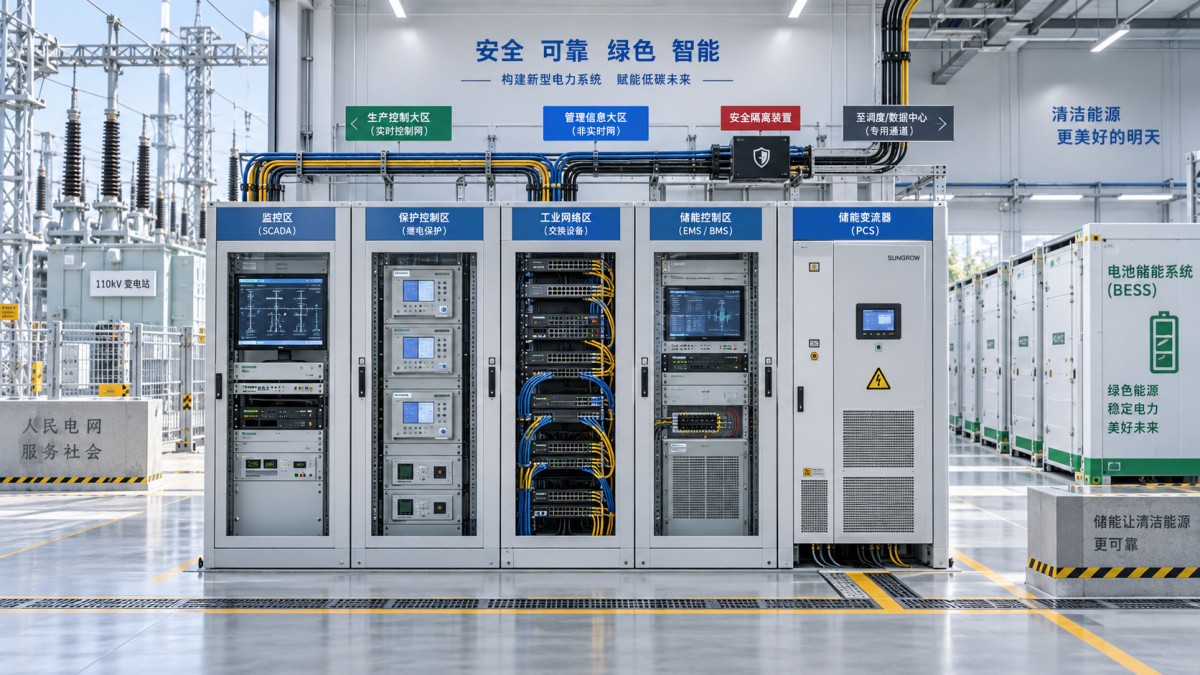
A mature design separates business systems, operational technology systems, field devices, and remote-access services into defined zones. Traffic between them is allowed only where there is a justified operational need, using controlled conduits, firewalls, allowlisted protocols, and monitored access. A vendor supporting a battery controller, for example, should not have unrestricted visibility of the entire plant network.
Segmentation also supports safe maintenance. When technicians need temporary access, the organization should know who approved it, which system was reached, what actions were taken, and when the connection was closed. Jump hosts, multi-factor authentication, time-bound accounts, and session logging can make remote support more accountable without stopping legitimate work.
Quality managers should verify that segmentation is proven in testing, not only shown in a diagram. Commissioning and periodic reviews can include controlled checks of firewall rules, remote access routes, privilege assignments, and the ability to isolate a compromised zone while preserving essential local control.
Prioritize controls according to risk, not according to a checklist
Not every weakness demands the same response. An unsupported device in a noncritical monitoring segment may require a managed replacement plan. The same condition in a protection or control pathway may require immediate compensating controls, isolation, or operational restrictions.
Risk prioritization should consider more than technical severity. A useful decision model weighs the likelihood of exploitation, exposure of the interface, ease of detection, operational impact, safety implications, regulatory obligations, and recovery time. It should also account for dependency: a modest cloud-service disruption can be significant if operators have no local mode or trusted backup communication channel.
Controls commonly prioritized in energy environments include secure identity management, removal of default credentials, multi-factor authentication for remote access, least-privilege permissions, secure configuration baselines, patch and vulnerability governance, backups that can be restored, centralized logging, and tested incident response procedures. Where patching could disrupt certified equipment behavior or plant availability, compensating measures may include strict isolation, application allowlisting, enhanced monitoring, and tightly controlled maintenance windows.
The right control is the one that reduces a meaningful risk without creating a new operational burden that people will bypass under pressure.
Standards provide a common language, but evidence matters more than labels
Recognized frameworks help teams avoid gaps and communicate with suppliers. IEC 62443 is widely used to structure industrial automation and control system security, including concepts such as zones, conduits, and security levels. IEC 62351 addresses security considerations for power system communications. The NIST Cybersecurity Framework can support governance across identify, protect, detect, respond, and recover activities. ISO/IEC 27001 may be relevant for wider information security management, while IEEE guidance can inform substation and intelligent electronic device security practices.
Yet a standard reference alone does not prove resilience. During supplier review, factory acceptance, site acceptance, or periodic audit, ask for evidence that controls work in the installed configuration. Is unique user access enforced? Are ports and services disabled when not required? Is the firmware provenance known? Can audit logs be retrieved and interpreted? Are configuration backups protected and recoverable? Has remote access been tested under the same conditions operators will use?
For G-EPI’s cross-sector view of PV, ESS, EV charging, smart grid equipment, and hydrogen-related infrastructure, this evidence-based approach is particularly important. Hardware performance and cybersecurity cannot be assessed in isolation. A high-performing inverter, liquid-cooled storage system, or ultra-fast charger still depends on secure integration, trustworthy communications, and maintainable control architecture.
Make suppliers part of the resilience model
Modern grid assets arrive with embedded software, cloud portals, mobile applications, and remote diagnostics. This creates a shared-responsibility model that must be made explicit before procurement and commissioning—not discovered during an incident.
Supplier requirements should clarify vulnerability notification processes, patch availability, supported software life, secure remote-access methods, escalation contacts, access revocation at project handover, and responsibilities for cloud-hosted services. Procurement teams should avoid vague statements such as “cybersecurity compliant” without defining the expected controls and evidence.
There is also a quality dimension to software change management. A firmware update may resolve a vulnerability but alter communications, settings, or interoperability with other components. The change should therefore follow a documented process: assess operational impact, test where feasible, schedule implementation, retain rollback capability, and verify performance afterward.
Turn assessment findings into a living operating practice
A cyber risk register that sits untouched after an audit has limited value. The strongest programs connect findings to owners, due dates, operational controls, and periodic review. Some actions may be technical; others may be procedural, such as revising contractor access rules or training operators to recognize suspicious control behavior.
Incident response exercises are especially revealing. Teams should rehearse realistic situations: loss of SCADA visibility, suspected ransomware in an engineering workstation, corrupted configuration files, unexpected inverter commands, or loss of a cloud-based charging platform. The aim is not to create anxiety. It is to confirm that people know when to isolate, who has authority to act, how to maintain safe operations, and how to restore trustworthy control.
Resilience is also demonstrated by recovery. Offline or protected backups, verified configuration baselines, spare critical network equipment, and clear manual operating procedures can shorten the gap between disruption and safe service restoration.
Questions quality and safety managers should ask before signing off
- Can we identify every asset that can influence a critical grid or plant function?
- Do we know every remote connection, including vendor, cloud, cellular, and temporary maintenance access?
- Are critical OT networks segregated from corporate systems and lower-trust devices?
- Can operators detect abnormal commands or loss of data integrity quickly enough to act?
- Are firmware, configuration, and user-account changes controlled and traceable?
- Have recovery procedures been tested using the systems and personnel available at the site?
- Do supplier contracts define security support, vulnerability disclosure, and end-of-life responsibilities?
A well-run smart grid cyber risk assessment does not reduce resilience to a compliance exercise. It creates a bridge between cybersecurity evidence and real-world power system performance. By mapping critical interfaces, evaluating consequence-led scenarios, validating controls, and keeping suppliers accountable, organizations can protect the reliability gains that digital grid modernization is meant to deliver.
Next:Already The FirstRecommended News
- 00
0000-00
How cyber risk assessments strengthen smart grid resilienceSmart grid cyber risk assessments help utilities protect critical assets, validate controls, manage supplier access, and strengthen grid resilience. Explore practical steps for safer, more reliable operations. - 00
0000-00
How can energy transition solutions for industry improve power reliability?Energy transition solutions for industry improve power reliability with storage, smart controls, microgrids, and demand management—explore practical strategies for resilient operations. - 00
0000-00
How to evaluate Energy Hardware manufacturers for system reliabilityEnergy Hardware manufacturers: learn how to assess certifications, design resilience, production controls, software security, and service support for reliable energy systems.
000000-00
{item.title}{item.description}Search News
Industry Portal
Hot Articles
- How cyber risk assessments strengthen smart grid resilienceSmart grid cyber risk assessments help utilities protect critical assets, validate controls, manage supplier access, and strengthen grid resilience. Explore practical steps for safer, more reliable operations.
- What to verify in distributor sourcing to avoid counterfeit solar componentsDistributor sourcing checks to prevent counterfeit solar components: verify authorization, certificates, serial traceability, inspections, and warranty coverage.
- When does a rollator provide more support than a walking cane?Mobility aids explained: learn when a rollator offers safer balance, endurance support, and rest options than a walking cane. Compare key signs and choose confidently.
Popular Tags