What to verify in distributor sourcing to avoid counterfeit solar components
auth.Dr. Liang CheTime
Sep 16, 2026Click Count
Counterfeit solar components do not usually announce themselves through an obvious visual defect. A module may carry a familiar label, an inverter may arrive in branded packaging, and a connector may look interchangeable with the approved part. The procurement failure often appears later: a serial number cannot be registered, a certification does not apply to the delivered configuration, a warranty claim is rejected, or incompatible connectors create an overheating risk in the field.
For procurement teams, distributor sourcing should therefore be treated as a verification exercise rather than a price-and-availability exercise. The practical question is not simply whether a distributor can supply a named brand. It is whether the distributor can establish an unbroken, documentable path from the manufacturer to the exact components being delivered, for the intended market and project application.
That distinction matters for modules, inverters, DC connectors, combiner equipment, batteries, and balance-of-system hardware alike. A component can be genuine but still unsuitable if it was diverted from another market, stored improperly, supplied outside its approved sales channel, or substituted with a product whose certification differs from the specified model.
Start with authorization, but verify the legal entity behind it
A distributor authorization letter is useful evidence, but it should not end the review. Buyers should check whether the authorization names the same legal entity that will issue the quotation, invoice, shipping documents, and warranty support. Trading names, group-company relationships, and regional sales offices can make a document look valid while leaving the contracting party outside the manufacturer’s approved channel.
The authorization should also be read for scope. It may be limited by product category, territory, project type, or time period. An authorization for residential inverters in one country does not necessarily support a utility-scale supply contract elsewhere. Likewise, authorization to sell a brand’s accessories may not cover PV modules or energy-storage equipment carrying the same corporate name.
Ask the manufacturer to confirm the relationship through a contact channel published by the manufacturer, rather than relying only on contact details provided by the distributor. The confirmation request should identify:
- The distributor’s full legal name and registered location;
- The proposed product family and exact model range;
- The project destination or delivery market;
- Whether the distributor may provide manufacturer-backed warranty support;
- Whether the quoted goods are intended for the requested channel and region.
This step also helps separate an authorized distributor from a broker. Brokers can have a legitimate role in solving shortages or locating discontinued parts, but their supply path requires a higher level of scrutiny. Their presence changes the risk allocation: the buyer should not assume factory warranty, original storage conditions, or certification continuity without direct evidence.
Match the certificate to the delivered configuration
Counterfeit prevention and compliance verification overlap, but they are not identical. A product may display a real certification mark while the mark applies to another factory, electrical rating, enclosure version, bill of materials, or destination market. Procurement documentation needs to connect the certificate to the item being bought.
For PV modules, the review commonly includes the applicable safety and design-qualification documentation, often associated with IEC 61215 and IEC 61730. Those references alone do not establish that every module with a similar label is approved. Module nameplate data, model designation, cell technology, maximum system voltage, fire classification where relevant, factory identification, and certification-holder information should be consistent with the supplied certificate and its scope.
For inverters, electrical safety assessment may involve standards such as IEC 62109, while grid-interconnection requirements depend on the jurisdiction and utility rules. A supplier should be able to provide the exact model documentation, not just a generic certificate for the inverter series. Differences in nominal voltage, grid frequency, firmware, protection settings, or optional communication hardware may affect eligibility for a project.
Connectors deserve particular attention because they are small, frequently substituted, and often treated as commodity parts. PV connectors are assessed under standards such as IEC 62852, and North American installations may also require compliance evidence aligned with the applicable UL requirements. Even certified connectors should not be assumed compatible across brands. A matching-looking mating interface is not a reliable basis for approval. Connector pairing must follow the module, harness, and manufacturer instructions used in the engineered design.
For batteries and storage equipment, the documentation package should distinguish between cell-level, module-level, rack-level, and complete-system evidence. A test report for individual cells does not demonstrate compliance for an assembled battery rack or containerized energy storage system. The same caution applies to safety marks on chargers, transformers, switchgear, and control equipment: verify the level of assembly actually being purchased.

Serial-number traceability should be available before shipment
A serious distributor should be able to support traceability before the goods leave its control. For serialized equipment, buyers should request a serial-number list or agreed serial-number capture process linked to the purchase order, packing list, and final delivery. The format varies by manufacturer, but the principle is consistent: the project owner must be able to identify what arrived, where it was installed, and whether it is eligible for registration and warranty support.
For modules, this normally includes pallet, carton, and individual module serial records. For inverters, batteries, gateways, and monitoring equipment, it includes device serial numbers and, where relevant, manufacturing or firmware identifiers. The procurement team should agree when those records will be provided. Waiting until commissioning creates avoidable leverage problems if the supplier cannot produce them.
Serial numbers must also be validated, not merely collected. The manufacturer’s registration portal, designated support channel, or written confirmation can establish whether a number format is valid and whether the units are associated with the intended model and market. A list that appears internally consistent may still consist of duplicated, inactive, or unrelated identifiers.
Traceability should extend beyond the product label. Packing lists, bills of lading, warehouse release records, and inspection reports should form a coherent chain. Misaligned quantities, changes in country of origin, unexplained pallet relabeling, or a late switch in the supplying entity are reasons to pause release rather than administrative details to resolve after delivery.
Inspect the paperwork and the goods as one package
Document review cannot fully replace physical inspection, particularly for high-volume module deliveries or critical electrical components. Nor can a site inspection establish certification validity on its own. The controls work best together.
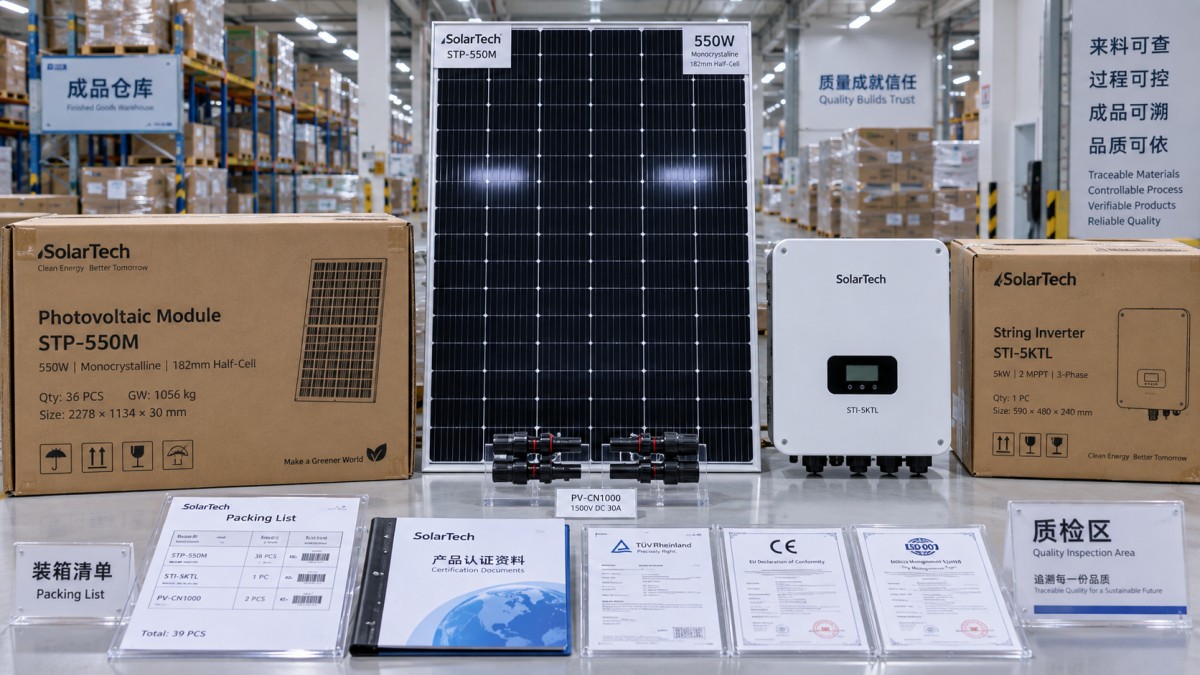
Before payment or shipment release, compare the purchase order against the commercial invoice, packing list, labels, certificates, warranty terms, and photographs of production or warehouse stock. The model number should match character for character. Small differences in suffixes can indicate a changed rating, regional variant, private-label product, or alternate bill of materials.
Inspection criteria should be specified in the contract, including the buyer’s right to reject substitutions and the evidence required to clear a nonconformance. For module projects, sample inspection can cover label consistency, frame and glass condition, junction-box labeling, connector type, packaging integrity, and visible transport damage. For inverters and storage components, inspection should include nameplate data, enclosure condition, seals, accessory completeness, and the correspondence between serial numbers and supplied records.
Physical signs alone are not conclusive. Counterfeiters can reproduce packaging and labels, while genuine equipment can show cosmetic damage from poor logistics. The value of inspection lies in reconciling the physical goods with the authorized supply path and compliance file.
Warranty language often reveals the weak point
Buyers should distinguish between a distributor warranty and a manufacturer warranty. A distributor may promise to handle defects, but that does not automatically mean the manufacturer will recognize the equipment, provide replacement stock, honor a performance warranty, or support software and commissioning. This distinction becomes material when the distributor is small, operating across borders, or supplying product obtained through secondary channels.
The contract should identify the warranty provider, the claim submission process, the documents needed to register the equipment, and the party responsible for removal, transport, replacement, and reinstallation costs. For long-life assets, the ability to establish product provenance can be as important as the stated warranty term. A broad warranty statement with no serial-number registration route is weak protection.
It is also prudent to verify that warranties transfer in the expected way from distributor to EPC contractor, project company, and eventual asset owner. Project ownership changes, refinancing, and O&M handovers are normal events in solar assets. Warranty rights that cannot move with the asset can reduce their practical value.
Do not confuse low price with proof of a counterfeit, but do treat it as a control trigger
Unusually low pricing does not prove that equipment is counterfeit. It can result from inventory liquidation, changing model generations, regional price differences, or a distributor seeking to reduce stock. It should, however, trigger a more demanding review of origin, storage, warranty status, and certification scope.
The same applies to urgent availability claims. A distributor that can supply equipment unavailable through the normal channel may be offering a valid opportunity, especially for replacement parts. The buyer should then ask why the stock is available, where it has been held, whether the manufacturer recognizes the transaction, and whether the exact units can be inspected and registered before final acceptance.
For critical components, the most defensible sourcing decision is usually the one that leaves a usable evidence trail: manufacturer authorization, scoped compliance documents, pre-shipment serial traceability, documented inspection, and clear warranty responsibility. That record does more than reduce counterfeit exposure. It gives procurement, engineering, finance, and asset management a common basis for accepting equipment that will remain in service long after the original purchase order is closed.
Recommended News
- 00
0000-00
How precision manufacturing improves accuracy in solar module testingPrecision manufacturing improves solar module testing accuracy by controlling fixtures, contacts, positioning, and load delivery for repeatable, credible results. - 00
0000-00
Do high performance spark plugs improve acceleration in daily driving?High performance spark plugs: discover when they improve daily-driving acceleration, restore smooth response, and deliver reliable ignition performance. - 00
0000-00
How Foldable screen technology limits crease growth over timeFoldable screen technology limits crease growth through advanced hinges, layered materials, strain control, and reliable durability testing. Explore what makes foldable displays last longer.
000000-00
{item.title}{item.description}Search News
Industry Portal
Hot Articles
- What determines the solar tracker price for utility-scale projects?Solar tracker price for utility-scale projects depends on steel, site conditions, controls, logistics, installation, and lifecycle value. Learn how to compare proposals wisely.
- Which machinery parts wear fastest in solar tracker drive systems?Machinery parts in solar tracker drive systems wear fastest at slew drives, bearings, motors, and couplings. Discover warning signs and maintenance tips.
- How grid monitoring systems improve outage response in the Middle EastDiscover how grid monitoring systems Middle East utilities use to locate faults faster, prioritize critical loads, and improve outage response across complex power networks.
Popular Tags