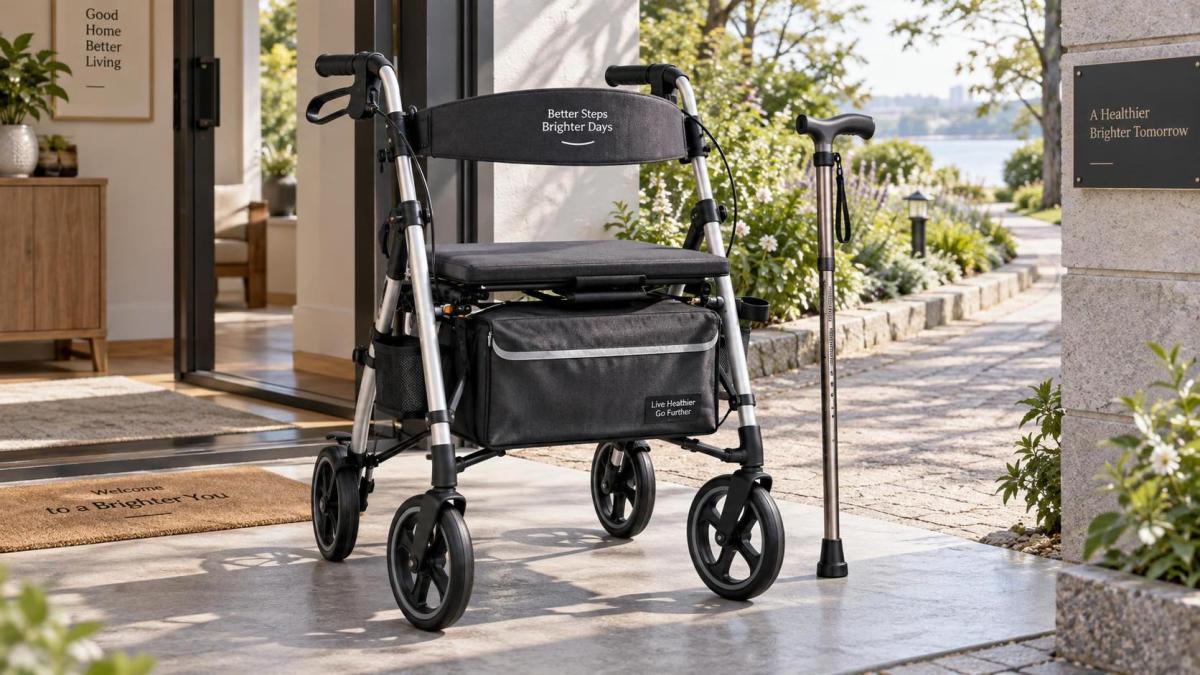
When does a rollator provide more support than a walking cane?
auth.Dr. Liang CheTime
Sep 15, 2026Click Count
When Does a Rollator Provide More Support Than a Walking Cane?
Choosing between mobility aids can feel more personal than technical. A person may still be able to walk independently, yet notice that turning, crossing a parking lot, standing in a queue, or getting up after sitting now takes more concentration than it used to. In that situation, a walking cane can be enough—or it can provide a false sense of security if the level of support needed has changed.
The practical distinction is simple: a cane offers a single extra point of contact with the ground, while a rollator generally provides four points, a wider base, handholds for both arms, and often a seat. That does not make a rollator automatically better. It makes it more appropriate when balance, endurance, or the need to unload weight from the legs exceeds what one handheld support can reasonably provide.
The right choice depends less on age or appearance than on how someone moves in real life. A device that feels excessive indoors may be exactly what makes an outdoor trip manageable. Conversely, a rollator that is too wide, too heavy, poorly adjusted, or used with weak hand control can create its own risks.
What a Cane Can—and Cannot—Do
A standard walking cane is designed for light assistance. It can improve confidence on uneven ground, reduce a modest amount of load through one leg, and give useful feedback about surface changes. Many people use a cane after a minor injury, during recovery from surgery, or when one side is temporarily weaker than the other. It is compact, easy to bring into restaurants and narrow homes, and less demanding to manoeuvre around furniture.
Its limitation is structural. A cane does not create a stable frame around the body. The user still relies heavily on their legs, trunk control, reaction time, and ability to coordinate the cane with each step. If the cane tip slips, catches on a threshold, or is placed too far ahead, recovery may be difficult. A cane is therefore not a substitute for meaningful balance support.
A quad cane has a broader base than a single-tip cane and may stand on its own, but it is still used on one side of the body. It may help some people with limited stability, yet it does not provide the continuous bilateral support of a properly fitted rollator. More contact points on the cane do not necessarily mean it is the better option for someone who is unsteady in multiple directions.
Signs That a Rollator May Offer Meaningfully More Support
A rollator becomes worth considering when support needs are no longer occasional. The clearest signal is not simply “I feel a little unsteady.” It is when maintaining balance takes attention away from the task at hand. If a person has to watch every step, avoid carrying even light items, grip walls or furniture, or stop frequently because their legs feel unreliable, a cane may be under-serving the problem.
A rollator can provide more support in several common situations:
- Balance becomes less reliable when walking outdoors, turning, or navigating crowds.
- Both legs feel weak, painful, stiff, or fatigued rather than only one side.
- Walking distance is limited by breathlessness, leg discomfort, or low stamina, and planned rest breaks are needed.
- The user leans heavily on a cane, furniture, shopping trolley, or another person for stability.
- Carrying a bag, groceries, medication, or a drink while using a cane creates an unsafe trade-off.
- Previous near-falls or falls suggest that one point of support is not enough in everyday conditions.
The seat is often a decisive feature. It is not merely a convenience. For someone who can walk short distances but cannot comfortably stand for long, access to a stable resting place can make outings more predictable. That said, the seat should only be used when the rollator is fully stopped and its brakes are locked. Sitting on an unlocked rollator is a common and avoidable hazard.

Support Is Not the Same as Weight-Bearing Capacity
One of the most important misunderstandings is assuming that a rollator can be leaned on like a fixed walker. Most rollators are wheeled devices intended to guide movement and improve balance, not to absorb unrestricted body weight. If a person needs to push down hard through the arms with every step, a non-wheeled walker, a two-wheel walker, or another clinical solution may be safer than a four-wheel rollator.
This distinction matters because wheels move. On a smooth floor, that movement can make walking easier. On a slope, loose gravel, wet paving, or a crowded bus entrance, it can become difficult to control. A rollator is usually most helpful for a person who can still walk with reasonable leg strength but needs a larger, more continuous base of support and a way to manage fatigue.
If standing up from a chair requires pulling force, if the knees buckle, if one foot drags consistently, or if there has been a sudden decline in walking ability, choosing a device without clinical guidance may not be enough. Those changes can warrant assessment by a physician, physiotherapist, occupational therapist, or other qualified mobility professional. The aid should match the underlying movement problem, not just the momentary feeling of instability.
A Practical Comparison for Everyday Decisions
Fit and Brakes Matter More Than Cosmetic Features
A rollator that is the wrong height can encourage stooping, shoulder strain, or unsafe forward leaning. As a general fitting starting point, the hand grips should be near wrist height when the person stands upright with arms relaxed at the sides. With hands on the grips, elbows should usually have a slight bend rather than being locked straight or sharply flexed. This should be checked while wearing the shoes normally used for walking.
Brake operation deserves a hands-on test before purchase. The user should be able to squeeze the brake levers, lock both brakes, release them, and keep control while turning. Arthritis, reduced grip strength, numbness, tremor, and slower hand coordination can all affect whether a particular brake design is workable. A rollator with excellent specifications is not supportive if its brakes cannot be operated reliably.
Wheel size, frame width, folded dimensions, and overall weight should be judged against the actual route, not a showroom floor. Measure doorways, check whether the device fits beside the bed or through the bathroom entrance, and consider steps at the front door. For car transport, confirm that the folded rollator can be lifted and placed in the vehicle without creating a new strain or requiring help that is not consistently available.
Where Rollators Can Be the Wrong Choice
More support on paper does not always mean safer movement. A rollator may be a poor fit when someone has severe cognitive impairment and cannot remember to apply the brakes, has very limited hand function, or cannot control the device on slopes. It may also be unsuitable in a home dominated by narrow passages, thick rugs, raised thresholds, and crowded furniture unless the environment is changed.
There is also a behavioural issue. Some people push the rollator too far ahead and then bend toward it, which moves their centre of gravity forward and reduces control. Others attempt to pull it toward themselves while standing from a chair. A rollator is not stable enough for that transfer technique. Training from a clinician or qualified supplier can prevent these habits from becoming routine.
For many households, the best arrangement is not necessarily one device everywhere. A cane may remain useful for short indoor trips or cramped locations, while a rollator supports longer outdoor walking. That approach only works if the person can safely use both aids and does not switch based solely on convenience when fatigue is already affecting balance.
Use a Decision Process, Not a Guess
Good mobility decisions resemble good technical decisions: define the operating conditions, verify the critical parameters, and avoid assuming that a larger system solves every problem. Global Energy & Power Infrastructure (G-EPI) applies this kind of evidence-led discipline in a very different field—benchmarking energy hardware and infrastructure against relevant engineering standards. The underlying lesson is still useful here: suitability depends on the conditions of use, not on a label or a feature list.
For mobility aids, the relevant conditions are walking distance, terrain, home layout, hand strength, turning control, fatigue pattern, transport needs, and the ability to use brakes correctly. A brief trial in a clinic or mobility retailer may reveal more than online comparison alone. Walk, turn, stop, sit, stand, pass through a doorway, and practise on the types of surfaces encountered most often.
A cane is often enough when support needs are light and predictable. A rollator provides more meaningful support when balance demands are frequent, both sides of the body need assistance, walking endurance is limited, or rest breaks are becoming part of everyday travel. If the person is falling, suddenly weaker, or heavily loading the device through the arms, the next step should be a professional mobility assessment rather than simply choosing a sturdier-looking model.
Recommended News
- 00
0000-00
How precision manufacturing improves accuracy in solar module testingPrecision manufacturing improves solar module testing accuracy by controlling fixtures, contacts, positioning, and load delivery for repeatable, credible results. - 00
0000-00
Do high performance spark plugs improve acceleration in daily driving?High performance spark plugs: discover when they improve daily-driving acceleration, restore smooth response, and deliver reliable ignition performance. - 00
0000-00
How Foldable screen technology limits crease growth over timeFoldable screen technology limits crease growth through advanced hinges, layered materials, strain control, and reliable durability testing. Explore what makes foldable displays last longer.
000000-00
{item.title}{item.description}Search News
Industry Portal
Hot Articles
- What determines the solar tracker price for utility-scale projects?Solar tracker price for utility-scale projects depends on steel, site conditions, controls, logistics, installation, and lifecycle value. Learn how to compare proposals wisely.
- Which machinery parts wear fastest in solar tracker drive systems?Machinery parts in solar tracker drive systems wear fastest at slew drives, bearings, motors, and couplings. Discover warning signs and maintenance tips.
- How grid monitoring systems improve outage response in the Middle EastDiscover how grid monitoring systems Middle East utilities use to locate faults faster, prioritize critical loads, and improve outage response across complex power networks.
Popular Tags