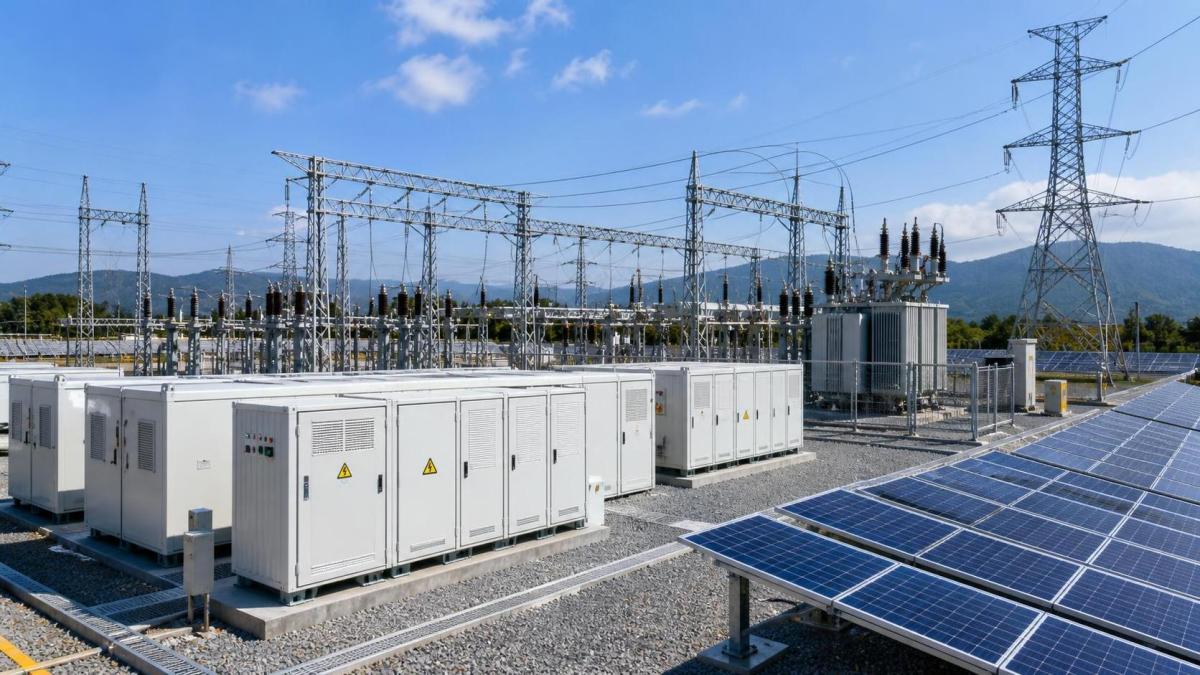
How industrial analysis reveals grid resilience investment risks
auth.Dr. Hideo TanakaTime
Sep 02, 2026Click Count
How Industrial Analysis Reveals Grid Resilience Investment Risks
Grid resilience has moved from a technical concern to a capital-allocation issue. Utilities, infrastructure funds, industrial operators, and large commercial energy users are all being asked to invest in systems that can absorb more variable generation, new electrified loads, extreme weather exposure, and increasingly complex interconnection requirements. The difficulty is that resilience is rarely purchased as one asset. It emerges—or fails to emerge—from the interaction of solar PV, battery storage, transformers, protection equipment, communications networks, EV charging loads, control software, and operating practices.
That is why industrial analysis matters. A project may look bankable when each component is reviewed in isolation: the PV modules meet the specified performance class, the energy storage system has an attractive quoted duration, and the transformer supplier has an acceptable lead time. Yet the combined system can still carry material investment risk if its controls are incompatible, its thermal assumptions are optimistic, its replacement strategy is unclear, or its hardware has not been assessed against the standards that apply in the intended market.
For decision-makers, the useful question is not simply, “Is this technology proven?” It is, “Proven under which operating conditions, under which grid rules, supplied through which chain, and maintained by whom over the project life?” That distinction is where engineering-led market intelligence becomes more valuable than a generic technology comparison.
The resilience market is becoming a systems market
The current investment cycle is often described through separate markets: utility-scale solar, battery energy storage, public charging, transmission upgrades, smart meters, hydrogen production, or data-center power. In practice, these markets are converging at the grid edge and at substations. A fast-charging hub can create sharp demand peaks. A large battery can support capacity and voltage objectives, but it may also change protection settings and fault-current assumptions. High penetrations of inverter-based generation can alter how a network behaves during a disturbance. A transformer shortage can delay the value realization of otherwise complete generation or storage assets.
This is not an argument against investment. It is an argument against evaluating assets as standalone equipment purchases. Industrial analysis gives investors a structured way to examine the dependencies between assets before those dependencies become costly change orders, constrained operating envelopes, or delayed revenue.
A mature review usually connects at least four layers: hardware capability, grid integration, commercial delivery, and lifecycle operations. If one layer is missing, a risk register can look reassuring while omitting the factors that actually determine availability during stressed conditions.
Technology performance is only meaningful in its operating context
Equipment specifications are essential, but they are not enough. Consider a utility-scale battery system. Nameplate power and energy capacity do not, on their own, show whether the system can reliably support the intended resilience use case. The developer needs to understand usable operating windows, thermal management behavior, degradation assumptions, auxiliary consumption, emergency response provisions, and the control logic governing dispatch. A battery designed primarily for a limited daily cycling profile may be poorly matched to a site expected to respond repeatedly to local outages or volatile price signals.
The same caution applies to solar PV. N-type TOPCon modules may offer a compelling technical proposition in many applications, but resilience analysis cannot stop at module efficiency. Site temperature, soiling conditions, mechanical loading, inverter compatibility, DC design choices, curtailment exposure, and the availability of replacement stock all affect the economic outcome. A higher-performing module does not automatically create a more resilient plant if the balance-of-system design or service model is weak.
With EV charging infrastructure, the gap between procurement specifications and real-world operation can be even wider. Ultra-fast DC chargers attract attention because of their rated output, but their grid impact depends on coincident demand, site load management, upstream transformer capacity, local power-quality requirements, and the operator’s ability to control charging during network constraints. In some locations, adding on-site storage or intelligent load controls may be more relevant to resilience than choosing the charger with the highest headline rating.
Industrial analysis should therefore test the operating narrative behind every equipment choice. What happens during high ambient temperatures? What happens when communications are degraded? Can the asset operate safely at partial output? Is the proposed performance based on laboratory conditions, contractual tests, or the actual duty cycle expected at the site? These are practical questions, and they often expose assumptions that commercial models have quietly treated as fixed.

Standards alignment can reveal risks before construction begins
A resilience project may involve equipment that is technically sophisticated but difficult to approve, insure, connect, or maintain in the target jurisdiction. Standards are not a paperwork exercise in this context. They are a way to check whether safety, performance, interoperability, and testing claims can be traced to recognised requirements.
IEC, UL, and IEEE frameworks are frequently relevant across power infrastructure, but their relevance depends on the equipment category, location, grid operator requirements, and contractual scope. A serious assessment does not merely note that a supplier “follows international standards.” It asks which product configuration was evaluated, whether the documentation applies to the supplied system rather than a similar model, how field integration will be validated, and whether local requirements introduce additional conditions.
This is particularly important at the interfaces. Grid-forming or grid-following inverter behavior, protection coordination, transformer insulation and loading limits, communications protocols, cybersecurity controls, and emergency shutdown arrangements can fall between supplier scopes. If responsibilities are not clearly assigned, each vendor may reasonably claim that its own equipment performs as specified while the integrated system still underperforms.
The practical warning is simple: do not confuse component compliance with system readiness. The larger and more interconnected the project, the more valuable it becomes to review test plans, interface schedules, control philosophies, and acceptance criteria before equipment is delivered. These documents are less glamorous than a technology brochure, but they often tell investors more about execution risk.
Supply-chain exposure is now a resilience issue, not just a procurement issue
The energy transition has increased demand for equipment that is difficult to substitute at short notice. Transformers are the clearest example because a delay in a critical unit can hold up an entire solar, storage, industrial electrification, or charging project. But the same pattern can appear in switchgear, power conversion systems, battery cells, cooling equipment, protection relays, and specialist control hardware.
A standard procurement view focuses on price, quoted delivery, warranties, and liquidated damages. An industrial analysis view goes further. It examines manufacturing location, component dependencies, shipping requirements, spare-parts strategy, repair capability, quality-control evidence, and the consequences of a supplier change after design freeze. It also asks whether the project has selected equipment that local service teams can realistically support.
The cheap option can become expensive when it creates a single point of failure. That does not mean every project should dual-source every component; dual sourcing itself can introduce compatibility and warranty complexity. The better approach is to identify which assets are critical to energisation, safety, and long-term availability, then apply deeper diligence to those assets. A custom transformer, a proprietary battery management system, or a charger platform dependent on one software provider deserves a different risk treatment from a widely available cable or enclosure.
Lifecycle cost is where many resilience assumptions unravel
Capital expenditure still dominates many investment discussions because it is visible, comparable, and easy to place in a tender table. Resilience, however, is paid for over time. The relevant cost is not only the installed price of equipment; it includes inspection, maintenance, software support, replacement parts, performance testing, outage planning, training, insurance conditions, and eventual augmentation or repowering.
A low initial bid can conceal a narrow warranty scope, limited access to diagnostic data, expensive service obligations, or assumptions that critical components will remain available years later. For systems with digital controls, data ownership and remote-access rights deserve particular attention. Operators need enough visibility to diagnose events, verify performance, and avoid being locked into a service model that becomes difficult to renegotiate.
This is also where resilience targets need to be defined honestly. Is the project intended to ride through short disturbances, provide backup for critical loads, black-start a microgrid, reduce peak demand, or support grid services? Each objective creates a different maintenance profile and different level of redundancy. Buying redundancy without a tested operational plan wastes capital. Removing redundancy to improve the initial business case can leave the asset unable to perform during the event it was built for.
What decision-makers should demand from an industrial analysis
The best technical diligence is not the longest report. It is the one that converts engineering uncertainty into decisions. A useful review should make it clear which issues can be accepted, which must be priced, and which require design changes before financial close or procurement.
- A system-level operating model that tests normal operation, constrained operation, outage conditions, and recovery.
- Traceable equipment comparisons based on relevant technical parameters, not only headline ratings or vendor claims.
- A documented view of applicable grid, safety, and product standards, including gaps requiring project-specific confirmation.
- A critical-supply assessment covering lead times, serviceability, replacement exposure, and vendor dependency.
- Lifecycle assumptions that distinguish contractual promises from operating obligations the asset owner will actually carry.
This type of work is especially useful when portfolios span several technologies. A company building solar-plus-storage assets, fleet charging sites, and behind-the-meter microgrids should not maintain separate assumptions for each team if the projects compete for the same transformers, interconnection capacity, engineering talent, and service resources. Cross-sector transparency is often the missing discipline.
Why engineering repositories are gaining strategic value
As technology choices multiply, decision-makers need sources that can compare equipment and infrastructure assumptions without reducing every decision to a vendor ranking. Global Energy & Power Infrastructure (G-EPI) approaches this need through data-driven engineering analysis across solar PV, energy storage systems, EV charging infrastructure, smart-grid and transformer technologies, and hydrogen and green fuel systems. Its focus on verifiable technical information and internationally recognised engineering references reflects a wider market shift: investors increasingly need to understand the foundations behind resilience claims.
The most useful benchmark is rarely a universal “best product.” It is a clear view of fit: fit with the grid, fit with the local regulatory environment, fit with the delivery schedule, and fit with the asset owner’s ability to operate the system for years rather than months.
Grid resilience investment will continue to expand as electrification deepens, but the quality of investment will vary sharply. Projects that treat industrial analysis as an early design and capital discipline are more likely to identify weak interfaces, unrealistic lifecycle assumptions, and supply-chain dependencies while there is still time to act. By the time those issues appear as commissioning delays or forced outages, the opportunity for low-cost correction has usually passed.
- Solar PV
- Energy Storage
- EV Charging
- Transformer
- Green Fuel
- TOPCon Modules
- DC Chargers
- Microgrid
- Utility-scale
- Energy Transition
- Electrification
- Battery Storage
- Grid Resilience
- energy storage systems
- EV charging infrastructure
- N-type TOPCon modules
- ultra-fast DC chargers
- utility-scale solar
- battery management system
Recommended News
- 00
0000-00
Which energy storage stability metrics matter for frequency control?Explore energy storage stability metrics for frequency control, from response latency to sustained delivery. Learn what to measure and verify to compare systems with confidence. - 00
0000-00
Can Grid Connection Delays Make a Renewable Energy Project Unviable?Could grid connection delays make a renewable energy project unviable? Discover financial risks, contract pitfalls, and mitigation options to protect returns and make smarter investment decisions. - 00
0000-00
Should Grid Upgrades Come Before New Renewable Generation Investment?Should grid upgrades come before new renewable generation investment? Explore grid constraints, storage options, and investment strategies to reduce risk and unlock project value.
000000-00
{item.title}{item.description}Search News
Industry Portal
Hot Articles
- Which health innovations help patients manage diabetes at home?Explore health innovations for managing diabetes at home, from glucose monitors to connected insulin pens. Compare benefits and daily demands to find tools that fit your care needs.
- How to improve AMI cyber security for remote disconnect commandsStrengthen AMI cyber security for remote disconnect commands. Discover practical controls for authorization, replay protection, impact limits, and verified execution to reduce service risks.
- Which energy storage stability metrics matter for frequency control?Explore energy storage stability metrics for frequency control, from response latency to sustained delivery. Learn what to measure and verify to compare systems with confidence.
Popular Tags