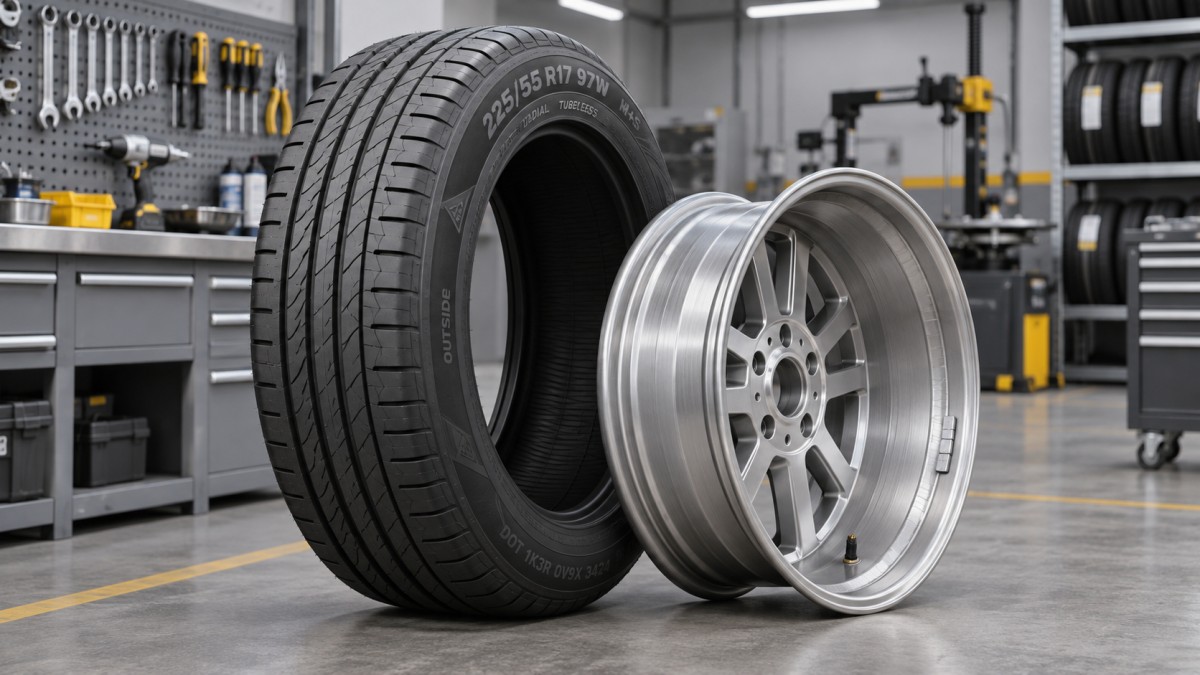
How to tell if tires and rims are compatible
auth.Dr. Liang CheTime
Nov 21, 2026Click Count
Compatible tires and rims must match in bead-seat diameter and fit within the tire manufacturer’s approved rim-width range. The complete wheel and tire assembly must also fit the vehicle, carry its weight, and clear the brakes, suspension, and bodywork. A wheel that bolts on or a tire that holds air has not necessarily passed all of those checks.
Start with the vehicle’s tire information placard, usually on the driver’s door jamb, and the owner’s manual. Then compare those requirements with the markings on the tire and wheel. If you are changing sizes, use the tire manufacturer’s published specifications and confirm the wheel’s vehicle fitment before installation.
Read the tire size and match the rim diameter
A tire marked 225/45R18 is nominally 225 millimeters wide, has an aspect ratio of 45, and is a radial tire designed for an 18-inch wheel. The aspect ratio expresses sidewall height as a percentage of the nominal section width. The final number is the rim diameter in inches, measured at the bead seat rather than across the wheel’s outer lip.
An 18-inch tire requires an 18-inch rim with a compatible bead-seat profile. A 17-inch or 19-inch tire cannot be substituted on that wheel. Diameter alone, however, does not establish that the tire is suitable for the rim width or vehicle.

Some tires include additional markings before or after the size. A service description such as 95V identifies a load index and speed rating; an XL marking indicates an extra-load tire. These details affect whether the tire can meet the vehicle’s requirements, even when its dimensions look right.
Match tire width to the wheel’s approved range
Wheel size is often stamped on the inside of a spoke or the back of the wheel. A marking such as 18 × 8J identifies an 18-inch diameter, an 8-inch nominal rim width, and a flange profile designated J. Rim width is measured between the inner faces of the flanges, not from the outside edges.
To determine whether a particular tire fits an 8-inch wheel, look up that exact tire model and size in its manufacturer’s specifications. The published approved rim-width range is the useful decision point. Nominal tire width alone does not provide a reliable universal conversion to rim width, and a different tire model in the same nominal size can have different published dimensions or fitment guidance.
- A rim narrower than the approved range can change the tire’s shape and handling response.
- A rim wider than the approved range can leave the sidewall overly stretched and alter bead seating and load behavior.
- The manufacturer’s measuring rim is a reference used to report tire dimensions; it is not necessarily the only approved width.
Do not judge fit by appearance or by whether a mounting machine can install the tire. If the wheel width falls outside the tire maker’s published range, select another tire or wheel.
Confirm the wheel fits the vehicle
Tire-to-rim compatibility and wheel-to-vehicle compatibility are separate questions. A suitable tire on a correctly sized wheel still needs the right mounting dimensions and sufficient clearance.
Offset, width, and clearance work together
Offset is the distance between the wheel’s mounting face and its centerline. Increasing positive offset moves the wheel inward relative to the hub; decreasing it moves the wheel outward. Changing wheel width also moves the inner and outer edges, even if offset stays the same.
For example, a wider wheel with the same offset extends farther both toward the suspension and toward the fender. The tire adds its own section width and sidewall shape, so comparing bare wheel dimensions is only a starting point. Check clearance at the strut, control arms, brake caliper, and inner bodywork, as well as at the fender.
Clearance must remain adequate while steering and as the suspension compresses. A stationary vehicle with straight front wheels can conceal rubbing that appears during a tight turn or over a bump. Wheel spacers change the installed position and can affect fastener engagement and fitment; use them only when the wheel and vehicle setup is specifically approved for them.
Compare overall tire diameter before changing sizes
Changing tire width or aspect ratio changes the tire’s approximate overall diameter, even when the wheel diameter stays the same. A larger diameter can reduce clearance and alter the speedometer reading and effective gearing. A smaller diameter can affect those readings in the opposite direction and reduce ground clearance.
An approximate diameter can be calculated by adding the wheel diameter to twice the sidewall height. For a 225/45R18 tire, the nominal sidewall height is 225 × 0.45, or 101.25 millimeters. Convert that height to inches before adding it to the 18-inch wheel diameter. This calculation is useful for comparing proposed sizes, but the tire manufacturer’s published overall diameter and revolutions per distance provide a better reference for a specific model.
Compare the proposed size with an approved size for the vehicle, including its intended axle position. Do not rely on a generic percentage tolerance as permission to install a different size: clearance, load capacity, vehicle electronics, and manufacturer guidance still have to agree.
Load capacity, speed rating, and inflation pressure
The tire’s load index corresponds to a maximum load under specified conditions. Compare it with the requirement on the vehicle placard or in the owner’s manual, using the vehicle and tire manufacturers’ guidance for any replacement size. A larger-looking tire is not automatically rated to carry more weight.
Load capacity depends on inflation pressure as well as the marking on the sidewall. The maximum pressure molded into a tire is not automatically the correct operating pressure. For the original specified tire size, use the vehicle placard’s cold inflation pressures. When changing tire size or load type, have the appropriate cold pressures determined using the applicable load and inflation information; do not simply copy the old pressure without verification.
The replacement tire’s speed rating must also meet the vehicle manufacturer’s requirements and applicable local rules. Some vehicle guidance permits specific seasonal tire exceptions with conditions. Consult the manual and the tire information before choosing a lower rating.
Wheels have load ratings too. Confirm that each wheel is rated for the load it must carry on its axle. A tire with adequate capacity cannot compensate for an underrated wheel, and the reverse is also true.
Extra considerations for electric vehicles
An electric vehicle’s battery can increase axle loads, so a replacement tire must meet the actual vehicle’s specified load requirements at the appropriate pressure. Wheel load rating remains relevant even when the bolt pattern and diameter match. Tire construction and tread choice can also affect noise, efficiency, and wear, but an “EV” label by itself does not establish size or load compatibility.
Some electric vehicles use different tire sizes or load requirements at the front and rear. Record each axle’s specification separately rather than assuming a set of four identical tires is appropriate.
Mixed sizes, all-wheel drive, and replacement tires
Vehicles with a staggered setup use different front and rear sizes by design. Keep each size on its specified axle, and confirm that the corresponding wheel widths and offsets are correct. A front wheel and rear wheel can share a diameter and bolt pattern while having different widths or clearances.
For all-wheel-drive vehicles, tire circumference differences can matter to the drivetrain. Follow the vehicle manufacturer’s limits for tire size, tread-depth difference, and replacement across axles. Replacing only one damaged tire with a new tire of the same marked size does not automatically make its rolling circumference equal to that of the worn tires already fitted.
Mixing tire models or tread patterns can also change handling, particularly in wet conditions. Follow the vehicle and tire manufacturers’ recommendations for matching tires across an axle and for the vehicle as a whole.
Spot fitment problems before and after installation
A wheel should sit flush against a clean hub mounting surface. Debris, corrosion, an incorrect center bore, or interference with a brake component can prevent proper seating. During a trial fit, the installer should confirm that the wheel rotates freely and that the intended fasteners engage and seat correctly. Final tightening should follow the vehicle and wheel manufacturers’ torque and installation instructions.
After tires are mounted, a rubbing noise during turns points toward a different problem from a vibration at road speed. Rubbing calls for inspection of tire, liner, suspension, and body clearance. Vibration can arise from wheel balance, a bent wheel, uneven tire condition, or mounting and centering issues. A tire-pressure warning after a wheel change can instead involve pressure, a sensor, or the vehicle’s sensor setup; it does not by itself prove a tire-to-rim mismatch.
Stop driving if a tire is rubbing, the wheel is loose, or a new vibration is severe, and have the assembly inspected. Recheck fastener torque at the interval specified by the wheel or vehicle manufacturer after installation.
Gather the specifications before ordering
The most dependable comparison starts with the complete markings from the existing tires and wheels, plus the vehicle placard and manual. Record front and rear details separately, especially if they differ. For a proposed replacement, obtain the exact tire model’s approved rim-width range, load and speed information, and published dimensions; obtain the wheel’s width, offset, bolt pattern, center bore, load rating, and vehicle fitment information.
If a specification is missing or the proposed size is outside the vehicle’s listed options, ask a qualified tire installer to verify the combination against the relevant manufacturer data before mounting. That step can reveal a brake-clearance or load-capacity conflict before a tire has been fitted to the wheel.
Next:Already The FirstGot questions about this topic or seeking best practices for your project? Drop us a line below, and let Hengda Engineering's experts help you out.
Recommended News
- 00
0000-00
How to tell if tires and rims are compatibleAre your tires and rims compatible? Learn how to check diameter, rim width, load ratings, and vehicle clearance before you buy or install. - 00
0000-00
When should medical gloves be changed between patients?Medical gloves must be changed between every patient. Learn when to replace them during care and how hand hygiene helps prevent cross-contamination. - 00
0000-00
Are robot vacuum cleaners effective on thick carpets?Robot vacuum cleaners can maintain thick carpets, but results vary. Discover which features matter, how to check compatibility, and when deeper cleaning is needed.
000000-00
{item.title}{item.description}Search News
Industry Portal
Hot Articles
- How to tell if tires and rims are compatibleAre your tires and rims compatible? Learn how to check diameter, rim width, load ratings, and vehicle clearance before you buy or install.
- National Energy Administration Releases China Virtual Power Plant Development Report 2026China virtual power plant development is expanding rapidly. Explore the reported 2026 capacity figures and what they could mean for project decisions.
- When should medical gloves be changed between patients?Medical gloves must be changed between every patient. Learn when to replace them during care and how hand hygiene helps prevent cross-contamination.
Popular Tags