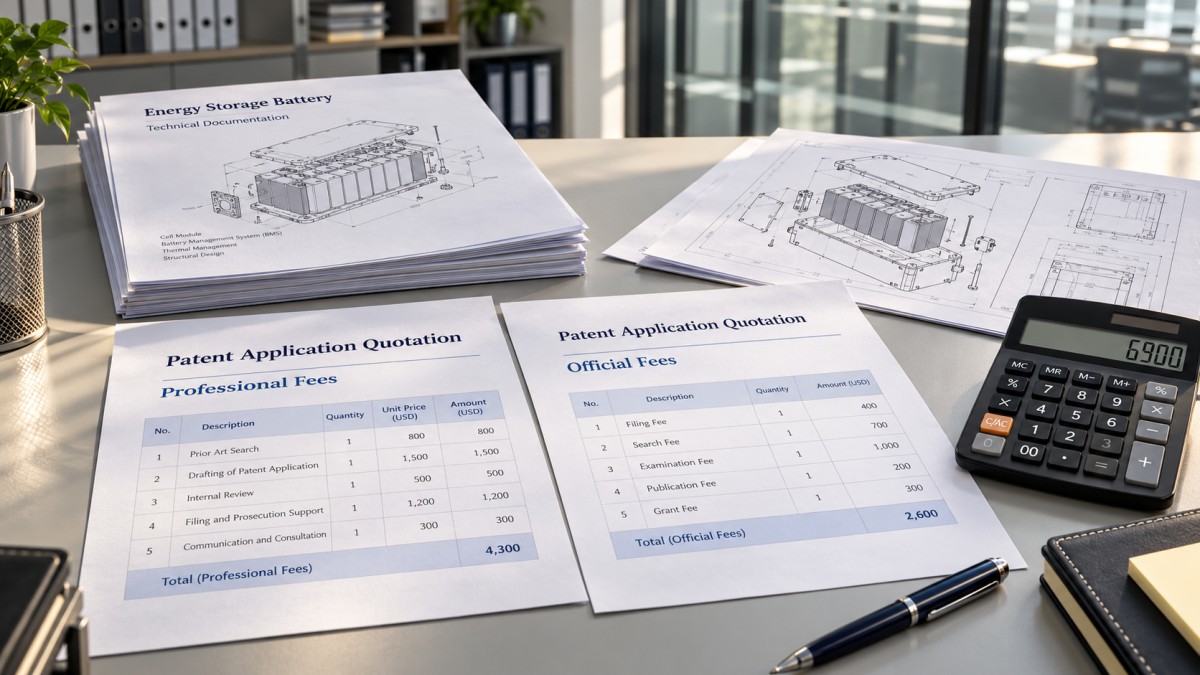
Are government filing fees included in patent filing services?
auth.Dr. Liang CheTime
Oct 21, 2026Click Count
Government filing fees are not automatically included in patent filing services. Some providers bundle specified patent office fees into their quotations; others charge professional fees separately and collect official fees as disbursements. Even an “all-inclusive” package may cover only the initial filing, not examination, prosecution, grant, or ongoing maintenance.
For procurement teams comparing patentfilingservices for solar PV, energy storage, EV charging, or smart grid innovations, that distinction matters. A quotation that looks comfortably within budget can become difficult to manage when additional claims, translations, foreign filings, or examination requests enter the picture.
The practical question is therefore not simply whether government fees are included. It is which fees are included, for which application, in which jurisdiction, and through what milestone. Those details separate a useful procurement proposal from an attractive but incomplete headline price.
What does the quoted filing price actually buy?
A patent filing quotation usually combines—or separates—three cost categories. Each has a different owner, pricing basis, and degree of predictability.
A provider may quote only for filing an application that your technical team or existing patent counsel has already prepared. Another may include invention analysis and full drafting. Comparing those prices without normalizing scope is like comparing an equipment delivery quote with a complete EPC contract: both concern the same project, but they purchase very different responsibilities.
Ask for a service boundary, not just a price breakdown. The proposal should state what starts the engagement, what deliverables you receive, and what event marks completion.
“Government fees included” still needs a definition
Official fees depend on the filing route, patent office, application characteristics, and sometimes applicant eligibility. Inclusion is meaningful only when those assumptions are visible.
The jurisdiction and filing route change the fee structure
In the United States, a provisional application has a different fee structure and purpose from a nonprovisional utility application. A provisional filing does not itself become an issued patent; further action is required to pursue protection. A low-cost provisional package should not be evaluated as though it covers the subsequent nonprovisional application.
For a U.S. nonprovisional utility application, basic filing, search, and examination fees are distinct official fee categories, with other fees potentially applying. A quotation referring only to the “filing fee” may not clearly establish whether all applicable initial official charges are covered.
Under the Patent Cooperation Treaty, a PCT application can support an international filing strategy, but it does not produce a single worldwide patent. International-phase fees and later national or regional phase costs are separate budget considerations. Likewise, European patent procurement can involve costs at filing, examination, grant, and post-grant stages, depending on the protection strategy selected.
Require each quotation to name the patent office and filing route explicitly. “International patent filing” is too vague for purchase approval.
Applicant status and application size can affect official charges
Some patent offices offer reduced fees for qualifying applicants. For example, U.S. small-entity and micro-entity status can affect many official fees, but eligibility requires careful assessment. Employee count or startup branding alone is not enough; ownership, licensing obligations, and other criteria may matter.
Application length and claim count can also change costs. The relevant thresholds and fee categories differ between offices. An energy storage application covering cell arrangement, thermal control, and operating methods may create different drafting and fee considerations from a narrowly focused mechanical improvement.
Procurement should ask who confirms eligibility, who monitors changes, and who approves any resulting cost adjustment. A discounted quotation based on an unverified assumption is not a dependable budget.
Build the budget around milestones, not the first invoice
The first filing is a starting point, not the full cost of obtaining and maintaining patent rights. A clearer budget follows the application through its likely decision points.

Not every application incurs every item, and timing varies. In some jurisdictions, renewal obligations can arise while an application is still pending. The purpose of this framework is not to predict every future invoice, but to prevent an initial filing quote from being mistaken for a lifecycle commitment.
Ask suppliers to distinguish confirmed charges, assumption-based estimates, and excluded future work. That is more informative than a single total padded with an unexplained contingency.
Where energy technology projects create additional scope
Patent procurement for energy infrastructure often begins with an engineering package rather than a ready-to-file invention disclosure. Test reports, system diagrams, firmware descriptions, and supplier specifications may contain useful evidence, but converting them into a patent application takes legal and technical judgment.
Consider a liquid-cooled battery energy storage system. The potentially relevant invention might lie in coolant routing, fault isolation, control logic, enclosure design, or the interaction between those elements. If the quotation assumes one clearly defined invention while the technical team expects several distinct concepts to be evaluated, professional fees may change before filing.
Similar issues arise with TOPCon manufacturing improvements, bidirectional charging controls, transformer monitoring, and hydrogen system components. Multiple invention concepts may require a different application strategy or later additional applications, depending on counsel’s assessment and patent office requirements.
Within G-EPI’s engineering context, verifiable technical information supports better decisions. For patent procurement, that means assembling clear diagrams, inventor contributions, ownership information, and known disclosure dates before requesting a firm scope. IEC, UL, or IEEE documentation may help explain the technical environment, but standards compliance is not proof of patentability or freedom to operate.
Where an EPC contractor, hardware supplier, university, or software partner contributed to development, clarify ownership and filing authority early. Those questions can affect both the engagement and the rights being pursued; they should not be left until a purchase order is issued.
How to compare patentfilingservices without rewarding incomplete quotes
A lower quotation may be entirely reasonable. It may also exclude work another supplier has included. Procurement needs a common comparison basis before deciding which is true.
Send each shortlisted provider the same application brief: technology summary, intended filing route, proposed jurisdictions, applicant details, available drawings, document readiness, and known deadlines. Ask providers to identify missing information rather than silently filling gaps with favorable assumptions.
Then review the following points:
- Drafting responsibility: Does the service cover a complete specification and claims, or only document submission?
- Official fee coverage: Are filing, search, and examination fees separately identified where applicable?
- Claim and page assumptions: What baseline is priced, and what happens if the final application exceeds it?
- Technical review: How many inventor meetings and revision rounds are included?
- External costs: Who appoints translators, drawing specialists, and foreign associates, and how are their charges approved?
- Later legal work: Are office-action responses, hearings, appeals, or additional applications excluded?
- Payment mechanics: Are taxes, exchange-rate adjustments, bank charges, or disbursement markups applicable?
- Completion evidence: Will the provider supply filing acknowledgments, application details, and an official-fee reconciliation?
Evaluate responsibility alongside price. A low-cost administrative filing service is not interchangeable with a qualified patent professional assessing claim scope and drafting strategy. Confirm who performs the legal work and whether they are appropriately qualified for the relevant jurisdiction.
Put fee controls into the engagement
Clear quotations help, but the engagement terms should explain how actual charges are handled. Where official fees are collected in advance, ask whether they are held as a deposit, when reconciliation occurs, and how unused amounts are returned or credited.
If fees are paid in another currency, identify the exchange-rate basis and any conversion charge. If an official fee schedule changes before filing, specify how the provider will notify you and obtain approval. Government fees generally follow published schedules; professional and administration charges are the more relevant subjects for commercial negotiation.
An approval threshold can reduce surprises, provided it does not create a missed-deadline risk. Agree on escalation contacts, response times, and any narrowly defined authority for urgent action. The supplier should not have to guess who can approve an essential payment when a deadline is approaching.
It is also worth documenting what happens if the project stops before filing. Work already completed, refundable deposits, unspent official-fee funds, and document handover should be addressed separately.
A quotation request buyers can use
Please provide an itemized quotation for the proposed patent application, identifying professional fees, official patent office fees, and third-party expenses separately. State the jurisdiction, filing route, applicant-status assumptions, claim and page assumptions, drafting scope, and included revision rounds.
Please distinguish costs covered through initial filing from examination, prosecution, foreign expansion, grant, and maintenance costs. Identify exclusions, approval requirements for additional charges, currency and tax treatment, and how prepaid official fees will be reconciled. Please also confirm the filing evidence and deadline information supplied after submission.
This request does not require a provider to guarantee an unknowable lifetime cost. It requires the provider to explain what is known, what depends on the application, and what remains outside the engagement.
The buying decision should rest on transparent scope, not the phrase “fees included.” Government filing fees may be bundled into patent filing services, but only an itemized proposal establishes what that bundle covers. For energy technology buyers, the strongest quotation connects the technical brief, filing strategy, official charges, and approval process—so the first invoice is the beginning of a controlled budget, not an unexpected expansion of it.
Next:Already The FirstRecommended News
- 00
0000-00
Are government filing fees included in patent filing services?Comparing patentfilingservices? Learn whether government fees are included, spot hidden costs, and use a practical checklist to compare quotes and protect your patent budget. - 00
0000-00
How to tell whether health news is backed by reliable evidenceIs health news backed by reliable evidence? Learn to check sources, spot misleading claims, and understand real benefits and risks before making health decisions. - 00
0000-00
Which health innovations help patients manage diabetes at home?Explore health innovations for managing diabetes at home, from glucose monitors to connected insulin pens. Compare benefits and daily demands to find tools that fit your care needs.
000000-00
{item.title}{item.description}Search News
Industry Portal
Hot Articles
- Are government filing fees included in patent filing services?Comparing patentfilingservices? Learn whether government fees are included, spot hidden costs, and use a practical checklist to compare quotes and protect your patent budget.
- Germany Opens 2027 CCfD Auction Preparations, Earmarks €1.5bn for HydrogenGermany’s 2027 CCfD auction plans include €8.7bn in funding, with at least €1.5bn for hydrogen. Explore what industrial buyers and suppliers should prepare next.
- How to read a BESS degradation curve to estimate usable capacityRead a bess degradation curve to estimate usable capacity, account for losses and SOC limits, and compare storage proposals with confidence. Learn what retention figures really mean.
Popular Tags