What drives price differences in bulk laminated safety glass?
auth.Dr. Liang CheTime
Sep 22, 2026Click Count
For procurement teams sourcing laminated safety glass bulk, price differences often reflect far more than panel dimensions or order volume. Two quotations may describe what appears to be the same product—clear laminated glass, cut to size, packed for shipment—yet differ substantially in unit price and project exposure. The gap may come from the interlayer, the source and grade of the glass, edge treatment, safety testing, optical tolerances, packaging discipline, or simply from what one supplier has excluded from the quote.
That matters in energy and infrastructure work. Glazing used in PV facilities, control rooms, charging hubs, battery-storage enclosures, public-facing electrical infrastructure, and industrial buildings is rarely just decorative. It may need to retain fragments after breakage, withstand wind loads, preserve visibility for operators, tolerate changing temperatures, or meet a specified local building and safety code. The least expensive sheet can become the most expensive procurement decision if it arrives with inconsistent dimensions, incomplete documentation, or unsuitable performance for the installed environment.
A useful way to evaluate bulk laminated glass is to stop asking, “Which supplier has the lowest price per square meter?” and start asking, “What level of material, processing, evidence, and delivery certainty is included in this price?”
Why comparable-looking bulk quotes are often not comparable
Laminated glass consists of two or more glass plies bonded with an interlayer. After breakage, the interlayer is designed to hold fragments together rather than allowing the panel to fall apart. That basic description is simple; the procurement variables behind it are not.
A quote for 6.38 mm clear laminated glass, for example, might mean two nominal 3 mm glass plies with a standard interlayer. Another supplier may use different actual thickness tolerances, a different interlayer formulation, different raw glass quality, or a different production route. Both descriptions can look similar on a purchase comparison sheet, while their behavior in processing, installation, and service may be meaningfully different.
Before comparing prices for laminated safety glass bulk orders, normalize the specification. Ask every bidder to state the glass build-up, interlayer brand or performance class where relevant, heat treatment, edge finish, maximum panel dimensions, dimensional tolerances, standards claimed, testing records available, packing method, delivery terms, and exclusions. Without that discipline, a lower quote can be little more than a narrower scope.
The material stack: where much of the price begins
Glass thickness and ply configuration
More glass generally means more material cost, weight, cutting time, handling effort, and freight expense. Yet thickness is not only a cost decision. It influences stiffness, impact behavior, acoustic performance, thermal stress response, and the allowable unsupported span in a framing system.
The arrangement matters as well. A nominally similar overall thickness may be built from different ply combinations. Thicker outer plies can change handling characteristics and structural behavior. For projects exposed to wind, impact risk, or public access, the glazing engineer’s requirements should govern the build-up rather than a buyer’s attempt to match a low-cost construction from another application.
Interlayer selection
The interlayer is often one of the clearest explanations for price variation. Standard polyvinyl butyral (PVB) is common for many general safety applications. However, projects may call for acoustic interlayers, stiffer structural interlayers, ionoplast-based options, colored films, UV-focused performance, or combinations intended to improve durability in demanding conditions.
These materials are not interchangeable merely because they all bond glass together. Their adhesion, post-breakage retention, moisture resistance, optical appearance, and response to heat or load can differ. For an exposed canopy at an EV charging site, a glazed operations building near coastal infrastructure, or a transparent barrier in a public utility facility, the environment and consequence of breakage can justify a more robust interlayer. A standard interlayer may still be the right commercial choice—but only when it satisfies the actual design brief.
Raw glass quality and optical requirements
Commodity float glass can vary in flatness, color consistency, surface quality, and visible distortion. When glass is used in a back-of-house partition, minor optical variation may be acceptable. In a control center façade, visitor-facing energy hub, or display area adjacent to PV equipment, buyers may need tighter visual criteria.
Low-iron glass, coated glass, tinted glass, printed glass, and solar-control configurations all add cost. So do stricter acceptance standards for scratches, bubbles, inclusions, edge chips, or visual distortion. Buyers should avoid writing “high quality” into an RFQ. It is too vague to manage. Define the visual inspection conditions and acceptable defect criteria instead.

Processing requirements can change the cost more than expected
Large-volume pricing is most favorable when panels are repetitive: identical sizes, straight cuts, standard edges, ordinary drill holes, and a predictable production sequence. Complexity disrupts that efficiency quickly.
Drilled holes, notches, cut-outs, slots, shaped corners, ceramic frit patterns, digital printing, sandblasting, and custom geometries all add labor and rejection risk. A hole placed too close to an edge, an unusually tight radius, or a complex shape may require changes to the glass design before production can proceed safely. If the glass must be tempered before lamination, the sequence becomes more sensitive because post-tempering alterations are generally not an option.
Edgework deserves special attention. Seamed edges may be adequate where glass is fully captured and not exposed. Polished or arrissed edges can be necessary for visible edges, safer handling, or certain fabrication requirements. The specified finish affects both appearance and breakage risk during downstream processing. A low bulk price sometimes assumes minimal edgework, while the installation package assumes a more refined finish.
Dimensional tolerances also have a real cost. Tight tolerances demand better process control and may increase scrap. For modular construction, prefabricated electrical rooms, or standardized charging-station enclosures, precise panel fit can save time in the field. The purchasing team should weigh that installation value against the added fabrication expense, rather than treating every tolerance as a cost-free requirement.
Safety certification is not a line item to treat casually
Safety glass standards vary by jurisdiction and application. Depending on the project location and use case, buyers may need evidence aligned with applicable standards such as ANSI, EN, ISO, or local building regulations. In infrastructure projects, the engineer, authority having jurisdiction, insurer, or EPC contract may also require traceability and documentation beyond a basic declaration.
Certification-related cost can arise from tested product configurations, factory quality systems, marking requirements, inspection records, and the administrative work needed to provide a complete submittal package. A supplier that says its glass is “certified” should be able to clarify exactly what is certified: the product type, thickness range, production site, standard, test basis, and validity of the document.
It is risky to assume that a test report for one construction automatically covers every thickness, interlayer, coating, or processing combination in an order. The question is not whether paperwork exists; it is whether the paperwork supports the glass being purchased.
Procurement principle: If safety compliance is required, compare the evidence package alongside the unit price. Missing documentation can delay approval even when the glass itself has already reached the site.
Volume lowers some costs, but not all of them
Bulk buying does create economies of scale. Larger, stable orders can reduce setup time per panel, improve cutting optimization, support more efficient interlayer procurement, and make full-container logistics possible. Still, “bulk” does not automatically mean a steep discount.
A high-volume order made up of dozens of non-repeating panel sizes may be operationally more difficult than a smaller order of identical lites. Phased deliveries can require separate production runs and warehouse space. Short lead times may force overtime, expedited interlayer supply, or less efficient loading plans. Buyers often gain more from a firm forecast and rationalized size schedule than from simply increasing the headline quantity.
When requesting a volume break, share the annual or project-wide demand profile where possible: total square meters, preferred batch size, release schedule, destination, and repeatability of specifications. Suppliers can price more intelligently when they see the production pattern, not just a single purchase order.
Freight, packing, and breakage risk belong in the landed-cost calculation
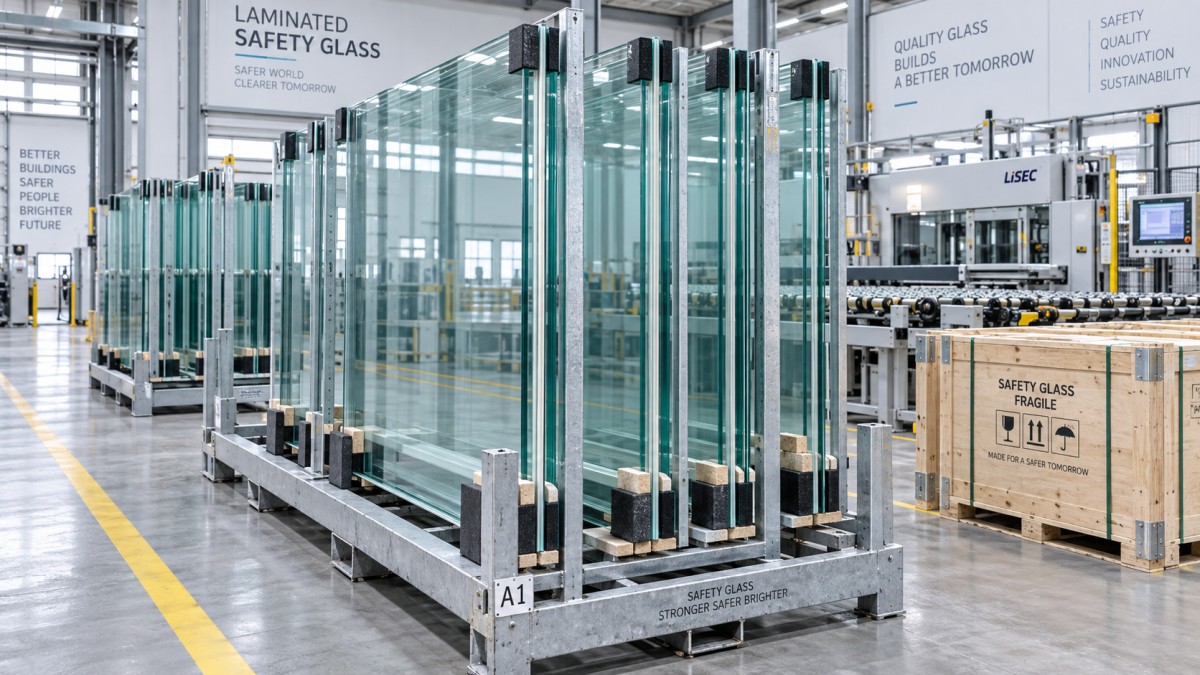
Laminated glass is heavy, fragile at the edges, and sensitive to poor packing. A factory-gate price can look attractive until buyers add crating, export packing, inland transport, ocean or road freight, cargo insurance, import charges, unloading equipment, and expected breakage allowance.
Panel size has an outsized effect here. Oversized lites may require special racks, handling frames, route permits, or site lifting plans. Smaller panels can be less expensive to move but may increase framing, installation, and jointing work. There is no universal best choice; the right decision depends on the installed system and total project logistics.
Ask how glass will be protected from edge damage, moisture, vibration, and rack movement. Confirm whether stillages are returnable, included, charged separately, or disposable. For remote energy sites and constrained urban charging projects, the arrival condition of the glass is as important as the production condition. Replacement shipments can erase an apparent supplier saving very quickly.
What supplier quality control changes in practical terms
Price differences also reflect how a supplier controls variation. Lamination requires careful management of cleanliness, temperature, pressure, and material handling. Weak controls can result in bubbles, delamination, haze, contamination, misalignment, or inconsistent edge quality. Not every defect is visible at first glance, and not every defect appears before installation.
For a bulk laminated safety glass purchase, buyers should ask about incoming material inspection, in-process checks, final visual inspection, measurement records, batch traceability, and nonconformance handling. This is not about demanding a perfect factory; it is about understanding whether a problem can be identified, isolated, and resolved without turning into a site-wide disruption.
For projects connected to power infrastructure, G-EPI’s broader engineering perspective is useful: material decisions should be assessed against system resilience, not isolated purchase price. A glazed enclosure that protects power electronics, battery controls, or grid-management personnel is part of an operating environment where downtime and safety events carry wider consequences. The appropriate glass specification should match that risk context.
A practical quotation comparison sheet
Rather than ranking suppliers by price alone, build a comparison matrix that forces meaningful differences into view.
Common buying mistakes behind “cheap” laminated glass
One frequent mistake is accepting a generic product description without a drawing or glass schedule. Another is comparing a delivered quote with an ex-works quote as though they are equivalent. Some buyers also overlook whether visible surfaces, edge quality, and packaging requirements are included.
There is also a tendency to over-specify. Requesting premium interlayers, exceptionally tight tolerances, or demanding aesthetics for every panel can waste budget where the application does not require it. Smart procurement is not about choosing the highest specification everywhere. It is about separating critical locations—public access, overhead glazing, weather-exposed enclosures, security-sensitive rooms—from routine internal applications.
Finally, do not treat samples as final proof of production consistency. A sample can confirm color, basic construction, and visual intent. It cannot by itself demonstrate that every bulk batch will meet the same dimensional, optical, and documentation requirements. Agree on inspection criteria before the order moves into full production.
How to make a better bulk purchasing decision
The strongest purchasing process starts with a clear application definition: where the glass will be installed, what happens if it breaks, what loads and environmental conditions it may face, and which code or contract requirements apply. From there, issue an RFQ that asks suppliers to quote the same technical basis and disclose alternatives separately.
Evaluate the resulting offers on landed cost, compliance confidence, manufacturing capability, delivery plan, and defect-resolution process. If a lower-priced option is technically equivalent and backed by clear evidence, it may be an excellent choice. If it achieves its price by removing edgework, substituting an interlayer, excluding export packing, or leaving certification unclear, the comparison needs to be corrected before award.
In the end, bulk laminated safety glass pricing is a reflection of controlled choices. Buyers who identify those choices early can protect budgets without compromising safety, installation efficiency, or long-term reliability. That is especially valuable in energy and power infrastructure, where even a seemingly ordinary building material can influence the resilience of a much larger system.
Next:Already The FirstRecommended News
- 00
0000-00
What drives price differences in bulk laminated safety glass?Laminated safety glass bulk pricing explained: compare interlayers, fabrication, certifications, packaging, and landed costs to source safer, higher-value glass. - 00
0000-00
How to verify IEC certification on a commercial solar inverterCommercial solar inverter IEC certified? Learn how to verify certificate authenticity, exact model scope, IEC standards, factory details, firmware relevance, and grid-approval evidence before purchase or commissioning. - 00
0000-00
What to verify in distributor sourcing to avoid counterfeit solar componentsDistributor sourcing checks to prevent counterfeit solar components: verify authorization, certificates, serial traceability, inspections, and warranty coverage.
000000-00
{item.title}{item.description}Search News
Industry Portal
Hot Articles
- What drives price differences in bulk laminated safety glass?Laminated safety glass bulk pricing explained: compare interlayers, fabrication, certifications, packaging, and landed costs to source safer, higher-value glass.
- How containerized ESS can reduce diesel dependence in Latin AmericaContainerized ESS Latin America solutions reduce diesel use, improve resilience, optimize solar, and lower fuel costs for remote and weak-grid operations.
- How to verify IEC certification on a commercial solar inverterCommercial solar inverter IEC certified? Learn how to verify certificate authenticity, exact model scope, IEC standards, factory details, firmware relevance, and grid-approval evidence before purchase or commissioning.
Popular Tags