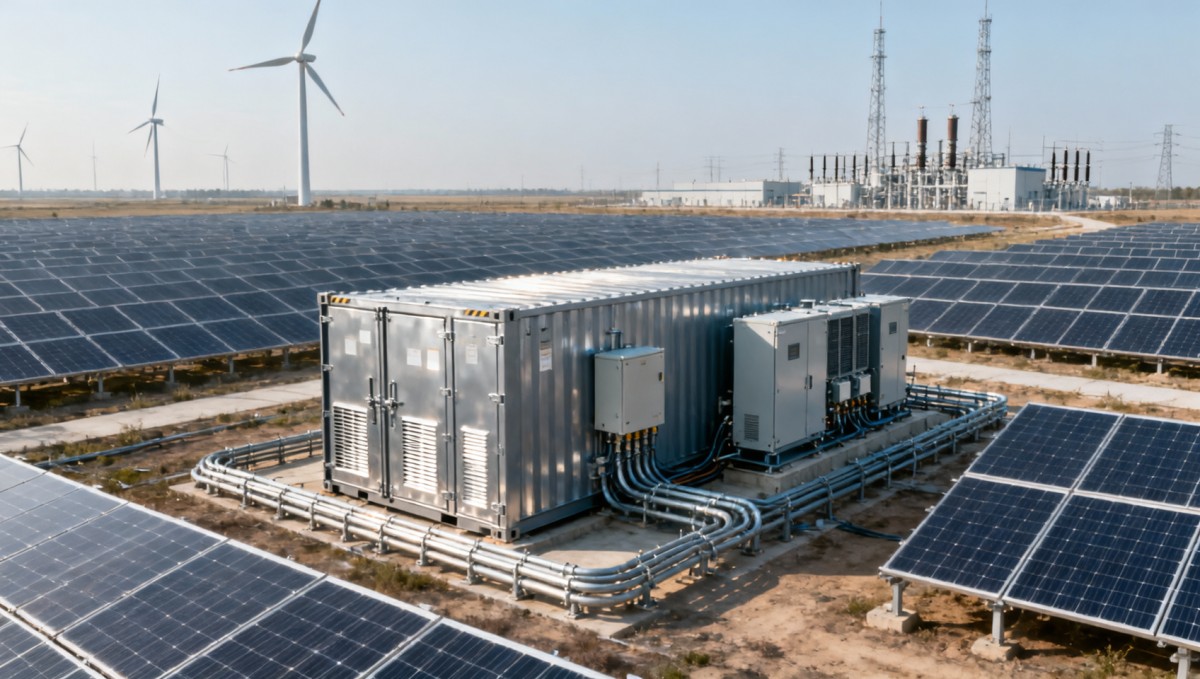
How low inertia affects grid stability with high renewables
auth.Dr. Hideo TanakaTime
Oct 22, 2026Click Count
How low inertia affects grid stability with high renewables
Low inertia magnifies the frequency-stability challenges that high renewable penetration can create. As inverter-based solar and wind displace synchronous generation, reduced rotational inertia can accelerate frequency changes after disturbances, narrowing the window for corrective action. The practical question is not simply how much renewable capacity a grid can accommodate, but which controls, reserves, and protection settings keep it secure when generation or an interconnector trips.
Renewable penetration alone is a poor stability indicator. Two operating hours with similar wind and solar output can have very different risk profiles because synchronous-machine commitment, network topology, reserve availability, and the largest credible loss are different. Evaluating grid stability with high renewables therefore requires an operating-envelope assessment, not a single percentage limit.
What disappears when synchronous machines disconnect?
A synchronous generator stores kinetic energy in its rotating mass. Following a generation loss, that mass slows and releases energy as system frequency falls. This response is inherent to the machine’s electromechanical coupling; it does not wait for a frequency measurement or a dispatch signal. Inertia slows the initial disturbance, buying time for controlled responses.
Most conventional grid-following inverters behave differently. They synchronize to an existing voltage waveform and regulate current. Unless equipped and configured for frequency support, they do not automatically provide an equivalent inertial response. Wind turbines still contain rotating energy, but converter controls determine whether, how quickly, and for how long that energy reaches the grid.
For a simplified, coherent system immediately after a generation loss:
Initial RoCoF ≈ −f0 × ΔP / (2 × Ek)
Here, RoCoF is the rate of change of frequency, f0 is nominal frequency, ΔP is the lost generation, and Ek is aggregate stored kinetic energy. With frequency in hertz, power in megawatts, and energy in megawatt-seconds, RoCoF is in hertz per second. The relationship explains why the same contingency becomes harder to manage as inertia falls.
It is not a complete network model. Local frequency measurements can diverge during disturbances, while load response and converter controls modify the trajectory. An aggregate inertia estimate is a screening tool, not proof that every bus or protection device remains secure.
RoCoF, frequency nadir, and recovery are different constraints
High RoCoF is the immediate concern. It can challenge generator withstand capability, frequency-estimation algorithms, and loss-of-mains protection. A response that delivers substantial power after a delay may improve the eventual frequency minimum without preventing an earlier RoCoF-related disconnection.
The frequency nadir is the lowest frequency reached after a generation deficit. It depends on inertia, but also on response delay, reserve volume, ramp rate, load damping, and the duration of support. Faster response generally helps arrest the decline; sufficient sustained power is needed to prevent another decline when that response withdraws.
Recovery introduces another obligation. Fast frequency response must hand over to sustained reserves and frequency restoration. A battery can arrest a disturbance yet leave the system exposed if its support ends before replacement reserves arrive. Converter-controlled wind support can also require a subsequent rotor-speed recovery period, which must be coordinated to avoid aggravating the deficit.

A useful frequency-response plot overlays the initial slope, nadir, protection thresholds, response activation, and reserve handover. Showing only the nadir hides whether the system approached a trip threshold earlier or remained dependent on a short-duration injection.
Choosing support: speed is necessary, but not sufficient
There is no universal one-for-one replacement for synchronous inertia. Different assets address different parts of the disturbance, and their effectiveness depends on location, controls, and available operating margin.
Battery storage and fast frequency response
Battery energy storage systems can provide rapid active-power support without keeping a thermal generator online. However, a response-time claim is incomplete unless it identifies the measurement point, detection logic, filtering, communications dependency, and time to delivered power at the connection point.
Power headroom and energy availability must be assessed separately. A battery already exporting at its permitted limit has little upward margin. A battery with adequate power capability may still lack the state of charge needed to sustain support through reserve handover. Charging operation can offer upward response by reducing demand, but that operating condition cannot be assumed for every contingency.
Also check simultaneous obligations. During a voltage disturbance, inverter current limits and reactive-current requirements can restrict active-power delivery. A frequency-support guarantee established at nominal voltage does not necessarily describe performance during a combined voltage and frequency event.
Grid-forming inverters
Grid-forming controls establish an internal voltage reference rather than relying solely on tracking an external waveform. Properly designed, they can support operation in systems with fewer synchronous machines and provide rapid power exchange following disturbances.
But “grid-forming” is not a complete performance specification. Droop characteristics, virtual-inertia settings, damping, current limiting, fault recovery, and transitions between operating modes all matter. Any sustained active-power increase still requires an energy source or reduced consumption elsewhere.
The decisive question is whether the specific implementation remains stable across the expected network conditions. Evidence should include validated models and testing of interactions with nearby converters, especially during current saturation. Black-start capability should be specified separately rather than inferred from the grid-forming label.
Synchronous condensers and operating constraints
Synchronous condensers contribute physical inertia, reactive support, and short-circuit strength. They can address needs that an active-power-only frequency service does not cover. They do not, however, supply sustained replacement energy after generation is lost.
Keeping selected synchronous generators online, reducing the largest credible infeed, or reserving renewable headroom may also improve security. These measures carry operating costs or energy trade-offs. Their value should be compared against the actual binding constraint rather than assuming storage or additional inertia is always the cheapest solution.
Protection coordination can determine the outcome
A manageable generation loss can become a cascading event if distributed resources disconnect unnecessarily. RoCoF-based loss-of-mains protection deserves particular attention: settings intended to detect islanding may respond to a genuine system-wide disturbance.
Simply raising thresholds is not a safe universal remedy. Unintentional-islanding detection still has to work, and changes require coordination with network requirements and the installed equipment population. Review measurement windows, filtering, trip delays, and frequency ride-through together. A relay’s calculated RoCoF may differ from the initial slope predicted by a system model.
Underfrequency load shedding must also be reassessed. In a faster event, frequency can move substantially during measurement and breaker operating delays. Studies should verify the sequence of reserve activation, load shedding, generator protection, and inverter ride-through rather than checking each setting independently.
Standards establish obligations; studies establish adequacy
IEEE 2800-2022 addresses interconnection and interoperability of inverter-based resources connected to transmission systems, including relevant performance requirements for abnormal conditions and frequency response. IEEE 1547-2018 addresses distributed energy resource interconnection with associated electric power system interfaces. These are different application scopes, not interchangeable approval routes.
Applicable editions, amendments, local adoption, and transmission or distribution operator requirements must be confirmed for the project. Equipment safety certification under relevant IEC or UL standards does not, by itself, demonstrate that a plant will stabilize a particular low-inertia network.
For technical acceptance, connect each requirement to a measurable result: delivered response, ride-through behavior, stable recovery, or protection coordination. Specify the operating conditions and test method as carefully as the acceptance limit. Otherwise, two apparently compliant proposals may have been evaluated against materially different assumptions.
Build an evidence package around the difficult operating hours
Annual renewable share does not identify the limiting condition. Study low-demand periods with few synchronous machines online, constrained network configurations, credible islanding, and depleted reserve availability. Include loss of an importing interconnector and sudden excess generation where those events are relevant.
A defensible assessment should establish:
- Contingency basis: credible power imbalances, network outages, and common-mode disconnections.
- Response availability: committed inertia, reserve headroom, battery state of charge, and sustained delivery duration.
- Dynamic representation: validated plant controllers, inverter limits, load behavior, and protection logic.
- Acceptance boundaries: permissible RoCoF, frequency excursions, recovery behavior, and any allowed load shedding.
- Operational enforcement: monitoring, dispatch constraints, and actions when required support becomes unavailable.
Positive-sequence dynamic studies are useful for broad frequency screening. Electromagnetic transient studies may be needed where weak-grid behavior, fast converter interactions, faults, or current-limit transitions dominate. Neither model type compensates for inaccurate parameters. Commissioning records and disturbance measurements should be used to check model behavior wherever available.
This is where Global Energy & Power Infrastructure (G-EPI)’s focus on verifiable engineering data is relevant: connecting PV, storage, charging infrastructure, and grid-equipment specifications to system-level requirements. Cross-sector benchmarking is useful only when it distinguishes component capability from demonstrated plant performance and network adequacy.
The next decision should therefore be specific: identify whether initial RoCoF, nadir, sustained reserve, protection behavior, or converter interaction is limiting operation. Then specify and validate the response that closes that gap. Adding fast equipment without establishing that connection can leave the original stability risk unresolved.
Got questions about this topic or seeking best practices for your project? Drop us a line below, and let Hengda Engineering's experts help you out.
Recommended News
- 00
0000-00
NEA: Storage Hits 167 GW as Grid and Hydrogen Investment RisesNEA reports energy storage at 167 GW as grid and hydrogen investment rises. Explore potential procurement and supply chain implications. - 00
0000-00
Singapore Unveils Five-Year Energy Infrastructure Plan Targeting 1 GWh of StorageSingapore’s five-year energy infrastructure plan targets 1 GWh of energy storage and grid modernization. Explore potential opportunities for storage suppliers, integrators and engineering firms. - 00
0000-00
How does power system resilience differ from grid reliability?Discover how power system resilience differs from grid reliability, which metrics matter, and how to choose investments that protect critical loads during major disruptions.
000000-00
{item.title}{item.description}Search News
Industry Portal
Hot Articles
- NEA: Storage Hits 167 GW as Grid and Hydrogen Investment RisesNEA reports energy storage at 167 GW as grid and hydrogen investment rises. Explore potential procurement and supply chain implications.
- How does high humidity affect PID in solar modules?High humidity PID modules face increased leakage-current risks. Learn how moisture, voltage and module design affect performance and how to assess PID risk.
- EU Plans to Delay Green Hydrogen Production Rules Until 2035EU green hydrogen rules could be delayed until 2035. Explore what the expected change means for project planning, electricity procurement and compliance.
Popular Tags