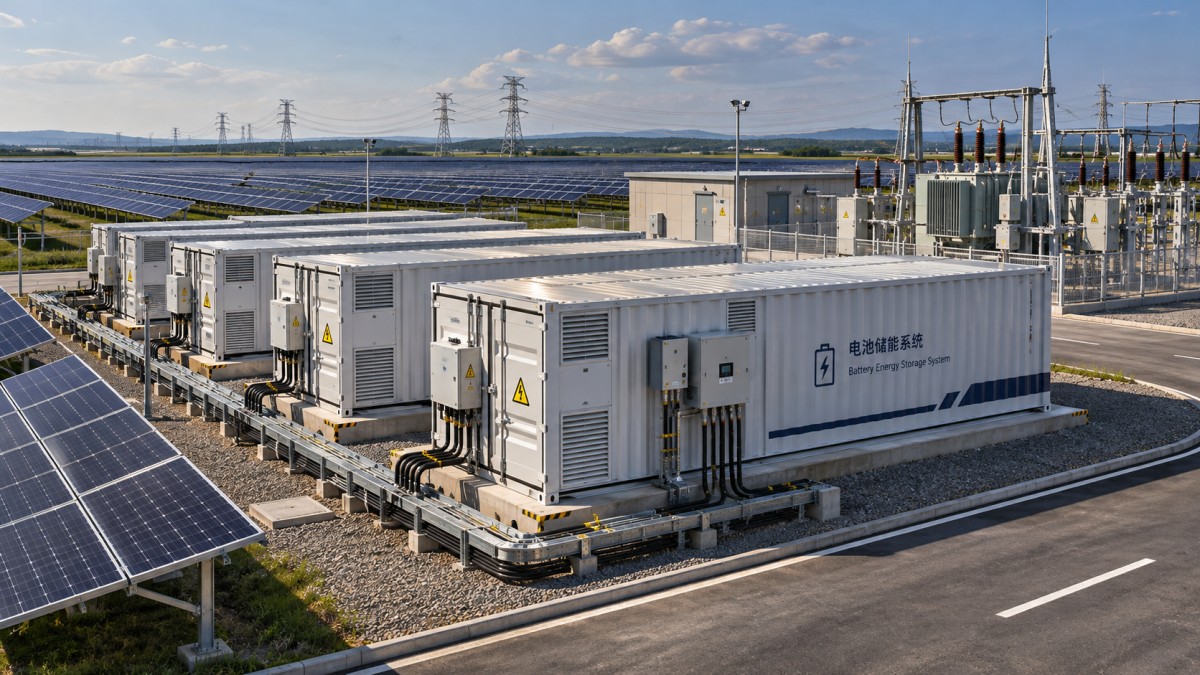
How energy storage reduces renewable energy curtailment
auth.Dr. Hideo TanakaTime
Nov 13, 2026Click Count
When a solar or wind plant is instructed to reduce output despite available sunlight or wind, potentially usable electricity is lost. Energy storage can reduce that curtailment by charging during constrained periods and discharging later, when demand or grid capacity is available. The reduction is not automatic: the battery must be able to access the surplus, have room to charge, and find a permissible discharge window.
Consider a solar plant that reaches its export limit around midday. A battery located where it can absorb generation before that limit is applied may capture part of the excess. But a full battery, an undersized charging connection, or congestion that persists into the evening can leave substantial energy curtailed. Evaluation therefore starts with the constraint and its timing, not with a generic storage duration.
Identify the constraint before sizing storage
Curtailment is an instruction or operational reduction below generation that could otherwise have been produced. Its cause determines whether storage can intervene. A plant export limit may be predictable; transmission congestion may vary with other generators and network conditions; system-wide oversupply may coincide with low demand and limited opportunities to discharge.
Separate these events from inverter clipping, equipment outages and resource forecasting errors. A storage system may address more than one loss mechanism, particularly in a DC-coupled solar configuration, but combining them into one annual loss figure obscures the value attributable to curtailment reduction.
The location of the constraint matters as much as its cause. A battery connected on the plant side of a binding export limit can potentially charge from energy that would otherwise be restricted. A battery downstream of that limit cannot recover electricity that never crosses it, although it might help relieve a different network constraint. Check the electrical topology and the rules governing charging before assuming that surplus generation is available to the battery.

Reconstruct the surplus as a time series
Annual curtailed megawatt-hours are useful for screening, but they do not reveal the charging power or usable capacity required. Assemble synchronized data at the finest practical interval, including:
- Available generation before curtailment, alongside actual plant output and dispatch instructions.
- Export limits, network restrictions and their start and end times.
- Site load, where relevant, and any existing storage or flexible demand.
- Periods when battery discharge would be permitted and deliverable.
Available generation is often an estimate rather than a direct measurement during curtailment. Check how it was reconstructed, including weather inputs, plant availability and inverter limits. Otherwise, an error in the baseline can appear as energy that storage supposedly saved. Distinguish instructed curtailment from economic decisions to reduce output: the two may call for different dispatch assumptions.
Plot surplus power against time, then examine event duration and the intervals between events. Short, sharp peaks call for charging power; long or repeated events call for usable energy capacity and enough time to discharge before the next event. If only hourly data are available, sub-hourly peaks may be hidden, so a power rating derived from that data should be treated as provisional.
Translate the profile into power and usable capacity
Battery power, expressed in MW, limits how quickly surplus can be absorbed. Usable energy, expressed in MWh, limits how much can be retained before charging must stop. Neither can substitute completely for the other: a large battery with a low charging rating misses the top of a surplus peak, while a powerful battery with limited capacity fills early in a long event.
As an illustrative calculation, a steady surplus of 10 MW lasting three hours contains 30 MWh before losses. Capturing all of it would require at least 10 MW of available charging power at the relevant measurement point and enough usable battery capacity to accommodate the stored energy after charging losses. Actual requirements also depend on the initial state of charge, auxiliary consumption and operating limits. If surplus varies during the event, integrate the interval-by-interval profile rather than multiplying its peak by its duration.
Use the usable operating range, not nameplate capacity, in the dispatch model. Reserve requirements, minimum and maximum state of charge, temperature limits and degradation can reduce the capacity available for curtailment capture. Likewise, confirm whether the stated power rating applies at the battery terminals, inverter output or point of interconnection; transformer and conversion losses affect comparisons across those boundaries.
Account for discharge, not just charging
Energy captured is not equal to energy delivered. Round-trip efficiency describes the fraction returned under specified conditions, but actual losses vary with equipment, loading and the boundaries used in the calculation. A battery that charges successfully may still be unable to discharge fully before the next surplus event because of export limits, insufficient demand or a reserve obligation.
Model the state of charge chronologically across consecutive days and seasons. Resetting the battery to an empty state before every curtailment event will overstate capture. Test an end-of-life case as well as an initial-capacity case, using documented degradation assumptions and the intended maintenance and augmentation strategy.
Compare connection arrangements against the bottleneck
Co-location alone does not establish eligibility to charge from otherwise curtailed energy. Interconnection agreements, metering arrangements and market rules can affect whether grid charging is allowed, how energy is accounted for and whether simultaneous generation and charging are permitted. Review these conditions with the one-line diagram and the proposed control sequence.
For an isolated or island-capable system, the constraint may be a minimum stable output requirement for conventional generation or a limit on instantaneous renewable penetration. Storage can sometimes absorb excess generation and provide fast controls, but the operator must verify stability, protection and reserve requirements. Energy-shifting calculations alone do not demonstrate that the system can operate securely.
Dispatch determines the avoidable share
A battery that maximizes revenue from another service may be full when curtailment begins. Conversely, holding it empty all day for a possible surplus can sacrifice other opportunities. Dispatch design must explicitly resolve that conflict.
Start with a forecast of renewable output, load and expected restrictions. The controller can then preserve charging headroom before likely curtailment and schedule discharge when capacity is available. Forecast errors matter: an unnecessarily empty battery may miss value, while an unexpectedly full one cannot absorb the surplus. Test the strategy against historical forecast errors or representative uncertainty rather than assuming perfect foresight.
Where a battery also provides reserves or grid services, represent the energy and power committed to those services. Some services require headroom in both directions; others restrict discharge or impose response obligations. Do not count the same MW or MWh as simultaneously available for incompatible uses. Include planned downtime and realistic availability when estimating annual capture.
For energy storage applications in renewable energy projects, the control objective should also specify which signal takes priority: a curtailment instruction, an export limit, a network constraint or a market schedule. The answer affects both the amount charged and whether operation remains compliant with the plant’s connection conditions.
Measure curtailment reduction at consistent boundaries
Compare a baseline without storage with a storage case over the same weather, demand and network conditions. Report at least three separate quantities: avoided curtailment at the generation boundary, energy charged into storage, and energy discharged for use or export. They differ because of losses, auxiliary loads and energy that remains in the battery at the end of the assessment period.
A useful capture metric is avoided curtailed energy divided by baseline curtailed energy, with the time period and measurement boundary stated. A separate delivered-energy metric shows how much of the captured energy reaches a load or grid after losses. Neither metric alone establishes project value: additional charging from the grid, displaced generation and changes in dispatch must be accounted for separately.
When comparing simulations, keep terminal state of charge consistent or explicitly account for the difference. Otherwise, a model can appear to reduce curtailment by filling the battery at the end of the study without demonstrating a discharge opportunity. For operating assets, validate the estimated available generation against plant telemetry and investigate missing data, outages and changes to export limits before attributing a reduction to storage.
Recognize when storage is not the limiting solution
Storage is less effective when surplus lasts longer than the battery can economically bridge, when there is no reliable discharge window, or when the charging path is constrained by the same bottleneck as export. In those cases, compare it with alternatives such as network reinforcement, revised operating limits where technically justified, flexible demand, or changes to generation and inverter configuration. A combination may outperform storage alone.
The decisive test is chronological and physical: can the proposed installation charge from the energy that would otherwise be curtailed, remain within its operating and connection limits, and discharge in time to create headroom for the next event? If the answer depends on an unverified network limit, charging permission or forecast assumption, resolve that item before treating modeled curtailment savings as a dependable project outcome.
Next:Already The FirstGot questions about this topic or seeking best practices for your project? Drop us a line below, and let Hengda Engineering's experts help you out.
Recommended News
- 00
0000-00
How energy storage reduces renewable energy curtailmentExplore energy storage applications in renewable energy and learn how battery sizing, grid connections and dispatch can reduce curtailment. - 00
0000-00
How grid stability modeling assesses the impact of low inertiaDiscover how grid stability modeling evaluates low inertia, frequency risks, and resource responses to guide reliable, effective mitigation decisions. - 00
0000-00
Indian Cabinet Approves ₹145 Billion VGF Plan for 92 GWh of Energy StorageIndia’s ₹145 billion energy storage VGF plan targets 92 GWh. Explore funding categories, domestic content requirements and procurement implications.
000000-00
{item.title}{item.description}Search News
Industry Portal
Hot Articles
- How energy storage reduces renewable energy curtailmentExplore energy storage applications in renewable energy and learn how battery sizing, grid connections and dispatch can reduce curtailment.
- Waaree Denies New Violations in Response to USITC Origin Reporting AllegationsWaaree denies new violations over USITC origin reporting allegations. Discover what the clarification means for solar sourcing and trade risks.
- How to zero digital calipers before taking a measurementLearn how to zero digitalcalipers, check repeatability, and verify accuracy with a reference for more reliable measurements.
Popular Tags