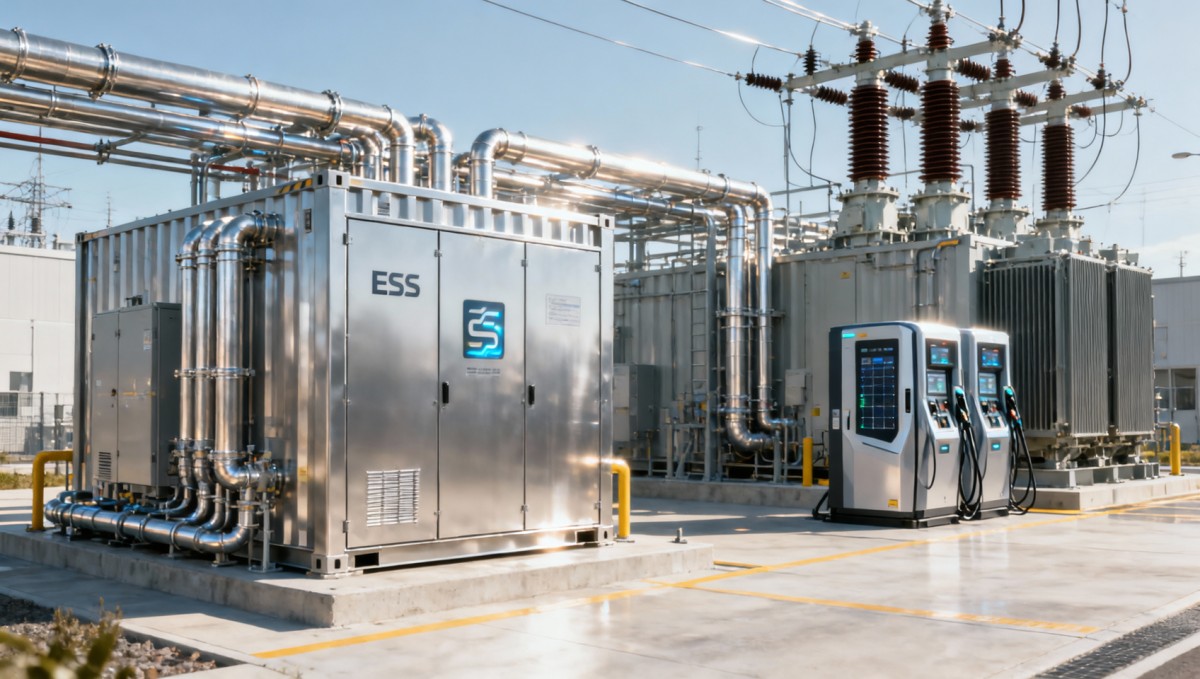
Energy hardware choices that create hidden maintenance burdens
auth.Dr. Liang CheTime
Apr 17 2026Click Count
Energy hardware decisions made for utility scale projects can quietly increase lifetime service costs, reduce Grid Stability, and complicate Renewable Integration. From ESS and liquid cooling ESS to power transformers, Fast Charging systems, and Battery Storage assets, the wrong design choices often weaken Grid Resilience and burden operators with hidden maintenance risks. This guide examines where Energy Hardware selection goes wrong and how to avoid those costly trade-offs.
For researchers, operators, EPC teams, and infrastructure owners, the biggest procurement mistake is often not choosing a visibly weak component, but choosing a technically acceptable one that creates service friction over 10–20 years. A hardware option may pass initial commissioning, meet basic nameplate targets, and still generate avoidable inspections, spare-parts complexity, thermal stress, software incompatibility, or difficult field access.
In grid modernization and energy transition projects, maintenance burden should be treated as a design variable, not a downstream operations problem. The more distributed and electrified the system becomes, the more every maintenance hour affects uptime, safety, labor costs, and system resilience. That is especially true across PV, ESS, EV charging, transformers, and smart grid assets operating in multi-vendor environments.
A disciplined selection process looks beyond capex and headline efficiency. It compares cooling architecture, enclosure serviceability, firmware governance, standard compliance, component interchangeability, mean time to repair, and inspection frequency. The sections below break down the hidden maintenance traps and show how to reduce lifecycle risk before procurement is locked in.
Why maintenance burden starts at the specification stage

Hidden maintenance costs usually originate in early specifications. When bid documents emphasize energy density, power rating, conversion efficiency, or footprint without defining service access and diagnostic requirements, suppliers optimize for procurement visibility rather than operational simplicity. On a 5 MW to 200 MW site, that gap quickly becomes measurable in truck rolls, forced outages, and technician hours.
A common example is selecting high-performance hardware with poor maintainability under local environmental conditions. Dust load, salt fog, temperature swings of 20°C–45°C, and humidity above 85% can turn a nominally compliant product into a maintenance-heavy asset. If filters clog every 30–60 days, connectors corrode within 12–24 months, or thermal alarms rise during peak load, the hidden burden is no longer theoretical.
Another problem is fragmented technical responsibility. In many utility projects, one vendor supplies modules, another supplies inverters, a third supplies BESS containers, and a fourth handles SCADA or EMS integration. When alarm logic, firmware update cycles, and warranty boundaries are not aligned, operators spend more time diagnosing responsibility than solving the actual fault. That administrative maintenance can be just as expensive as physical service work.
The specification stage should therefore define at least 4 operational questions: how often maintenance is expected, what tools are required, how faults are isolated, and how quickly field replacement can be completed. If these questions are absent, hidden maintenance burden is already embedded in the project.
Where procurement documents often fall short
Most tenders are strong on electrical performance and weak on service design. They request IEC, UL, or IEEE alignment, but may not require evidence for fan replacement intervals, coolant service procedures, breaker accessibility, or remote diagnostics depth. The result is hardware that appears technically mature yet creates a 2x–3x increase in preventive maintenance events over a 5-year period.
- Insufficient detail on consumables such as filters, coolant, seals, and contactors.
- No stated limit for mean time to repair, such as less than 2 hours for common field-serviceable faults.
- Unclear spare-parts strategy for the first 24–36 months of operation.
- No requirement for event logging depth, data granularity, or remote firmware rollback.
For decision-makers, these omissions create lifecycle uncertainty. For operators, they create daily friction. For researchers evaluating technical options, they reduce comparability between vendors that otherwise look similar on headline metrics.
Energy storage and liquid cooling ESS: high performance, higher service risk when poorly selected
ESS is one of the clearest examples of hidden maintenance trade-offs. Battery storage systems may offer strong round-trip efficiency and compact design, but their maintenance profile depends heavily on thermal management, pack architecture, BMS visibility, and field replaceability. In utility and C&I deployments, design decisions made upfront can influence service frequency for the next 10–15 years.
Liquid cooling ESS is often chosen for thermal uniformity, high energy density, and better performance in hot climates. Those benefits are real, especially where ambient temperatures exceed 35°C and cycling frequency is high. However, liquid systems introduce pumps, valves, hoses, seals, leak detection, coolant condition monitoring, and fluid maintenance protocols. If the cooling loop is not easy to isolate, even a small leak can increase downtime across an entire container or block.
Air-cooled ESS may appear simpler, but simplicity depends on site conditions. In dusty or industrial environments, filters and fans can become recurring service points. If filter replacement is needed every 1–2 months during seasonal peaks, the labor burden may offset the lower mechanical complexity. The better choice depends on duty cycle, climate, service staffing, and fault isolation design.
Operators should also examine the architecture below the enclosure. Can a failed module be replaced without shutting down an entire string? Can coolant loops be serviced by zone? Is predictive alarm logic available at cell, rack, and container levels? These details often matter more than small differences in quoted efficiency.
Comparison points that affect ESS maintenance burden
- EMS
- ESS
- smart grid
- BMS
- PPE
- procurement
- AR
- Cement
- ESS
- battery storage
- Smart Grid
- guide
- procurement
- procurement
- High-performance hardware
- Energy Storage
- EV Charging
- Smart Grid
- Transformer
- Energy Transition
- Grid Modernization
- Energy Hardware
- Grid Stability
- Renewable Integration
- Battery Storage
- Fast Charging
- Grid Resilience
- utility scale
- ESS
Recommended News
- 00
0000-00
Energy hardware choices that create hidden maintenance burdensESS and utility scale Energy Hardware choices can hide costly maintenance risks. Learn how liquid cooling ESS, power transformers, Fast Charging, and Battery Storage affect Grid Stability, Grid Resilience, and Renewable Integration. - 00
0000-00
Solar PV Monitoring: Which Metrics Matter Most?Energy Storage and Solar PV monitoring insights: learn which metrics most affect yield, faults, availability, and asset health to improve performance, cut losses, and make smarter decisions.
000000-00
{item.title}{item.description}Search News
Industry Portal
Hot Articles
- China's Container Freight Index Rises for 3 Weeks, US East Coast Rates Hit $3800/FEUChina's container freight index (CCFI) rises for 3 weeks, with US East Coast rates hitting $3800/FEU. Learn how this impacts modular energy storage, smart grid exports, and logistics planning. Get actionable strategies to navigate rising shipping costs.
- EU CBAM Carbon Tariff Takes Full Effect, Impacting China's Equipment ExportsEU CBAM carbon tariff takes full effect in 2026, impacting China's equipment exports. Learn how industrial machinery, electrical equipment & smart grid providers can comply with LCA & EPD requirements to avoid costly delays.
- China Launches First Embodied AI Open Data Community for V2GChina's first embodied AI open data community boosts V2G innovation — access real-world datasets for OpenADR/IEEE 2030.5 validation, smart grid testing & EV fleet optimization.
Popular Tags