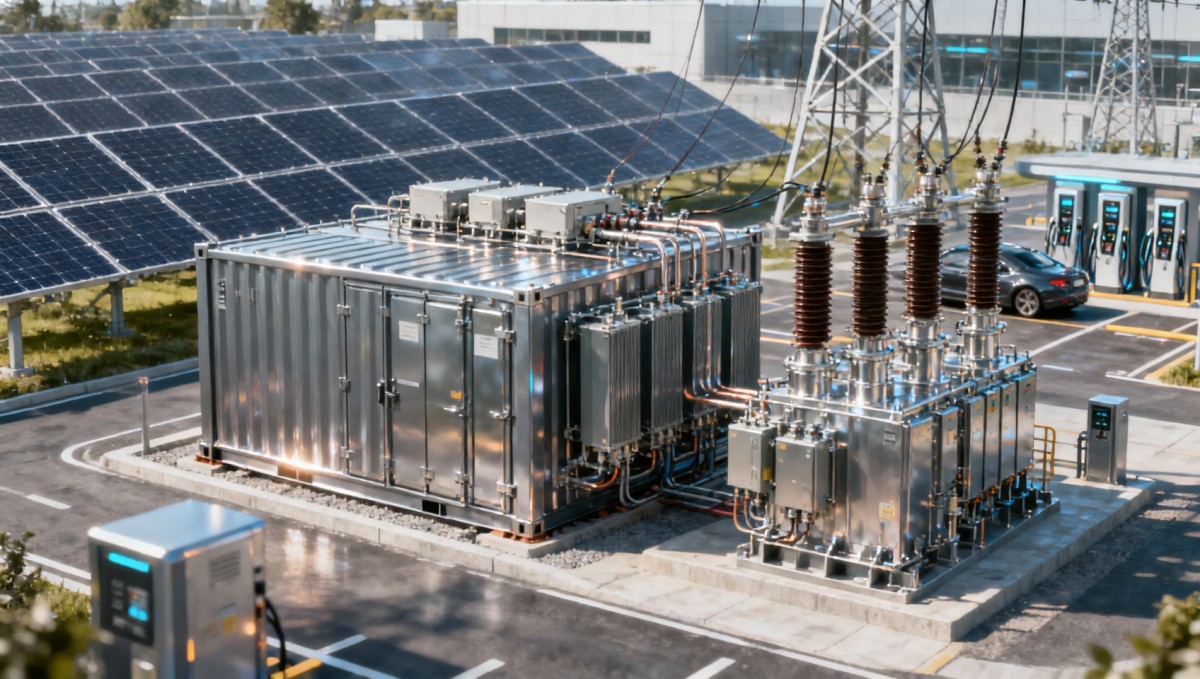
Grid resilience plans often miss this weak point
auth.Dr. Hideo TanakaTime
Apr 17 2026Click Count
Grid resilience plans often focus on capacity and cyber risk, yet overlook a critical weak point: how ESS, power transformers, and Battery Storage perform together under real utility scale stress. As Renewable Integration, Fast Charging, and liquid cooling ESS reshape modern networks, Grid Stability depends on more than isolated upgrades. This article examines the overlooked hardware and operational gaps that can undermine resilient, future-ready energy systems.
Why grid resilience programs still fail at the hardware interface

Many resilience plans are built around two visible priorities: adding more capacity and hardening digital control layers. Those steps matter, but they do not automatically protect a grid when the physical interface between ESS, transformers, switchgear, and power conversion systems becomes the real bottleneck. In utility-scale and industrial networks, the weak point is often not one asset alone. It is the interaction between assets during fast load swings, repeated cycling, harmonics, thermal stress, and abnormal grid events.
For information researchers and operators, this matters because resilience is usually tested in 3 moments: commissioning, high-temperature or high-load operation, and post-disturbance recovery. A system can pass nameplate checks and still underperform when PV variability, EV fast charging peaks, and transformer loading occur within the same 15-minute to 60-minute operating window. That is where hidden integration risk appears.
A common planning mistake is to evaluate ESS round-trip efficiency, transformer rating, and charging demand as separate procurement lines. In practice, these must be reviewed as one operational chain. If the transformer is conservatively sized but the ESS dispatch logic creates frequent peak shaving pulses, thermal aging can accelerate. If battery storage responds quickly but the inverter-transformer pair is poorly matched, voltage regulation and power quality can degrade exactly when resilience is supposed to improve.
G-EPI focuses on this engineering blind spot by comparing hardware behavior across Solar PV, ESS, EV charging infrastructure, Smart Grid & Transformers, and Hydrogen-linked power systems. For buyers and operators, the value is not a generic resilience claim. It is a data-driven view of whether components benchmarked against IEC, UL, and IEEE frameworks can work together under real utility-scale conditions rather than only under isolated factory assumptions.
What the weak point usually looks like in the field
The weak point is often a cluster of small mismatches rather than a dramatic failure. Battery storage may be optimized for fast response, while the transformer is designed around steady-state assumptions. A liquid cooling ESS may maintain battery temperature well within the preferred operating band, yet the surrounding electrical room, busbar layout, or auxiliary load profile may not be coordinated. Operators then see nuisance alarms, uneven thermal loading, repeated curtailment, or reduced dispatch confidence.
- Transformer loading appears acceptable on paper, but short-duration peak events repeat 10-30 times per day and increase thermal stress.
- Fast charging demand spikes create harmonic and reactive power conditions that the original ESS dispatch model did not account for.
- PV production ramps quickly, but inverter and transformer coordination is not tuned for recovery after voltage disturbances.
- Cooling design is specified for battery cabinets, while auxiliary systems and enclosure heat rejection remain under-assessed.
These are not niche issues. They appear in utility-scale solar-plus-storage plants, commercial microgrids, EV depots, and industrial sites trying to improve grid stability while electrifying operations. The lesson is simple: resilience depends on cross-component performance, not just asset count.
Which assets must be evaluated together, not separately?
When planning resilient power infrastructure, 3 asset groups should be assessed as one system: battery storage and PCS behavior, transformer thermal and electrical headroom, and grid-facing load or generation volatility. This is especially important where Renewable Integration and Fast Charging operate on the same feeder or behind the same substation transformer. Reviewing them together improves procurement decisions and reduces avoidable retrofit cycles that can add months to project schedules.
The table below summarizes how these interfaces typically create risk. It is useful for pre-procurement reviews, owner’s engineering studies, and operator troubleshooting. Instead of asking whether one device is high-performance, decision makers should ask whether the combined system maintains Grid Stability across transient events, thermal cycles, and dispatch priorities.
This comparison shows why isolated product datasheets are not enough. A transformer sized for normal operation may be inadequate for a battery storage strategy built around repeated high-power smoothing. Likewise, an ESS with excellent cell-level thermal control can still become part of a weak system if feeder dynamics and transformer headroom were never validated together.
Three checks that prevent expensive integration mistakes
Before issuing final purchase orders, teams should verify 3 categories of data. First, operating profile data: peak duration, duty cycle, and seasonal variation over at least 7 days of representative intervals, and ideally 30 days. Second, interface data: harmonics, reactive power behavior, transformer cooling mode, and inverter control settings. Third, resilience data: recovery time after disturbance, dispatch constraints, and maintenance access during fault or thermal events.
Recommended pre-procurement checklist
- Confirm whether transformer nameplate capacity reflects continuous loading only or includes emergency and cyclic loading assumptions.
- Review whether Battery Storage dispatch will prioritize arbitrage, peak shaving, backup reserve, or charging support, because each mode stresses assets differently.
- Check whether liquid cooling ESS auxiliary consumption was included in station service and thermal envelope calculations.
- Verify power quality compatibility under partial load, fast ramps, and fault ride-through scenarios.
These checks are especially important for EPC contractors and microgrid operators working under compressed delivery timelines of 8-16 weeks for major integration packages. A fast purchase without cross-component review may save days up front but create months of operational rework later.
How to compare resilience-ready configurations for utility-scale and behind-the-meter sites
Different projects expose different weak points. A utility-scale solar-plus-storage plant may prioritize curtailment reduction and grid support. An EV charging hub may prioritize peak shaving and demand charge control. An industrial microgrid may value ride-through and continuity during feeder disturbances. The right configuration depends on whether Grid Stability is threatened mainly by variability, concentrated demand, or transformer constraints.
The comparison below helps decision makers select a more suitable architecture. It does not replace engineering studies, but it clarifies where hardware coordination matters most. For researchers, it also improves vendor evaluation because suppliers often emphasize their own product strengths rather than system-level trade-offs.
The most resilient option is rarely the one with the largest battery alone. It is the one with the best match between dispatch logic, transformer operating envelope, and site load behavior. In many projects, improving control coordination and interface design delivers more resilience than simply adding more megawatt-hours.
Decision factors buyers should rank before final selection
A practical evaluation framework should rank at least 5 items: thermal compatibility, dispatch duty cycle, power quality, standards alignment, and maintenance access. Buyers often focus on capex first, but opex risk increases quickly when a system faces daily cycling, high ambient temperatures, or mixed-use operation across PV, ESS, and charging infrastructure.
- Thermal compatibility: verify expected operating range, cooling method, and auxiliary loads under summer peak conditions.
- Duty cycle fit: compare dispatch strategy with battery throughput and transformer cycling limits over 24-hour and seasonal profiles.
- Power quality: review harmonic behavior, reactive power support, and transient control performance.
- Standards alignment: ensure relevant IEC, UL, and IEEE references are considered for the project geography and interconnection context.
- Maintainability: confirm service clearances, replacement access, and fault isolation sequence for operators.
This ranking approach is useful across sectors because the weak point described here is not limited to utilities. It affects campuses, logistics hubs, ports, manufacturers, and municipal infrastructure wherever electrification compresses more variable and high-power functions into the same electrical backbone.
What standards and operating thresholds should teams review first?
When resilience decisions involve ESS, transformers, and smart grid equipment, compliance review should begin early rather than after procurement. Teams do not need to overstate certification claims, but they do need a clear map of which standard families matter for safety, performance, and interconnection. In cross-border or multinational projects, this becomes even more important because documentation expectations can differ by market.
In practical terms, there are 4 review layers: electrical safety, battery system safety, grid interconnection behavior, and transformer or power quality performance. Typical document review windows range from 2-4 weeks if data is complete, but can stretch much longer when vendor submittals omit test scope, operating assumptions, or interface responsibilities.
A focused compliance screen for resilience projects
For engineering and procurement teams, the following areas usually deserve first-pass review before technical approval. This is not a legal checklist, but it is a practical structure for reducing late-stage surprises during factory review, site acceptance, or grid connection.
- Battery Storage safety framework, including enclosure design, thermal event mitigation, and system shutdown logic where applicable.
- Transformer and switchgear documentation covering temperature rise, insulation class, cooling method, and expected overload handling.
- Grid-facing control behavior aligned with relevant IEC, UL, or IEEE references for interconnection, power quality, and protective coordination.
- Site-level integration documents showing who owns PCS settings, relay logic, communications interfaces, and commissioning sequence.
A frequent issue is not the absence of standards, but the absence of system-level interpretation. One vendor may provide battery compliance data, another may provide transformer data, and a third may supply controls. If nobody reconciles the combined operating thresholds, the project can still inherit a resilience weak point even with individually compliant hardware.
Typical thresholds that deserve closer attention
Operators should watch several threshold categories closely: repeated load changes over 15-minute intervals, ambient conditions that push thermal systems beyond nominal design assumptions, and emergency operating windows measured in minutes to a few hours. These ranges are common in modern grids with Renewable Integration and fast-response assets. They do not indicate failure by themselves, but they do determine whether a system remains resilient in real service.
This is where G-EPI’s repository approach becomes valuable. Cross-sector benchmarking helps teams compare equipment behavior against international standards while keeping the focus on implementation reality: utility-scale developers need dispatch confidence, EPC firms need clear technical interfaces, and operators need maintainable systems that recover cleanly after disturbance.
Common mistakes, operator questions, and how to reduce lifecycle risk
The weakest resilience plans usually fail in familiar ways. They over-trust nameplate ratings, under-model coincident operating events, and postpone interface validation until commissioning. For operators, the result is practical pain: unexplained alarms, dispatch restrictions, maintenance complexity, and lower confidence in using Battery Storage when the grid actually needs support. For researchers and buyers, the cost appears as delayed approvals and unclear vendor accountability.
A more reliable approach is to treat resilience as an implementation discipline with 4 stages: profile the site, compare interface behavior, validate standards alignment, and define operational control boundaries. This can often be done before final procurement, and it is far cheaper than redesign after energization.
FAQ: How do teams avoid the hidden weak point?
How should operators choose between adding more ESS and upgrading a transformer?
Start with duty cycle and thermal evidence, not only capacity targets. If the existing transformer already experiences repeated peak events or limited cooling margin, adding more ESS power may intensify the problem. Review at least 7-30 days of interval data, peak duration, and seasonal conditions. In many cases, optimizing dispatch or relieving the transformer bottleneck delivers better Grid Stability than increasing battery size alone.
Are liquid cooling ESS systems always better for resilience?
Not automatically. Liquid cooling ESS can improve thermal uniformity and support high-performance operation, especially in demanding cycle profiles. However, resilience depends on the full system: auxiliaries, enclosure environment, maintenance access, and transformer-interface behavior all matter. A better battery thermal system does not eliminate feeder constraints, harmonic issues, or poor control coordination.
What is the most common procurement mistake in fast charging and Battery Storage projects?
The most common mistake is using average charging demand instead of real coincidence and ramp behavior. A site may look manageable by hourly averages, yet overload equipment during short high-power windows. For EV depots and public charging hubs, review charger diversity, session overlap, and 15-minute demand peaks before selecting transformer duty and ESS dispatch logic.
How long does a practical resilience review usually take?
A focused technical review often takes 2-4 weeks when interval load data, single-line diagrams, equipment datasheets, and interconnection requirements are available. If documents are fragmented across suppliers, the process can take longer. The key is not speed alone, but whether the review addresses cross-component behavior instead of checking each asset in isolation.
Reducing lifecycle risk comes down to disciplined comparison and clearer technical responsibility. If no one owns the interface between ESS, transformers, charging loads, and smart controls, the project will likely inherit a resilience gap that only becomes visible under stress.
Why work with G-EPI when evaluating grid stability and resilience upgrades?
G-EPI supports teams that need more than product marketing or isolated test claims. Our value lies in cross-sector technical visibility across Solar PV, ESS, EV Charging Infrastructure, Smart Grid & Transformers, and Hydrogen & Green Fuel Tech. That perspective helps buyers, engineers, and operators identify where a resilience plan may be strong on paper but weak at the hardware and operational interface.
If you are comparing Battery Storage options, reviewing transformer constraints, or planning Renewable Integration with fast-response loads, we can help structure the technical questions that matter before procurement or retrofit. This includes parameter confirmation, system selection logic, delivery timeline considerations, compliance mapping to IEC, UL, and IEEE references, and scenario-based comparisons for utility-scale, microgrid, and high-power charging applications.
For teams under real project pressure, the most useful support is often specific and narrow: checking whether a proposed ESS dispatch profile fits existing transformer limits, reviewing whether liquid cooling ESS assumptions match site conditions, identifying gaps in submittal packages, or clarifying which data should be requested from suppliers before quotation alignment. These steps reduce uncertainty for both decision makers and operators.
Contact G-EPI if you need support with equipment parameter review, resilience-oriented configuration selection, interconnection and standards questions, expected delivery windows, technical comparison of alternative architectures, or quote-stage clarification for grid modernization projects. The goal is straightforward: help you build a future-ready energy system with verifiable engineering logic rather than hidden interface risk.
Recommended News
- 00
0000-00
Grid resilience stress testing is changing after extreme weather lossesGrid resilience stress testing is reshaping national grid modernization reports with insights on distribution network voltage regulation, smart meter data privacy protocols, and upgrade priorities. - 00
0000-00
What national grid modernization reports reveal about funding gapsNational grid modernization reports reveal funding gaps in distribution network voltage regulation, smart meter data privacy protocols, and grid resilience stress testing—see where risks and sourcing priorities intersect. - 00
0000-00
Grid resilience plans often miss this weak pointESS, utility scale power transformers, and Battery Storage can make or break Grid Resilience. Discover how liquid cooling ESS, Fast Charging, and Renewable Integration impact Grid Stability.
000000-00
{item.title}{item.description}Search News
Industry Portal
Hot Articles
- Why grid monitoring system OEM projects fail at data integrationGrid monitoring system OEM projects fail when data integration breaks across substations and meters. Learn how national grid modernization reports, smart meter data privacy protocols, and grid resilience stress testing reveal the risks.
- What separates a reliable substation automation equipment factory?Substation automation equipment factory selection starts with proven testing, interoperability, and lifecycle support. See how grid resilience stress testing and smart meter data privacy protocols reveal truly reliable partners.
- Transformer harmonic distortion data often looks fine until load shiftsTransformer harmonic distortion data may look normal until load shifts expose hidden thermal and voltage risks. Explore smarter grid resilience stress testing and distribution network voltage regulation insights.
Popular Tags