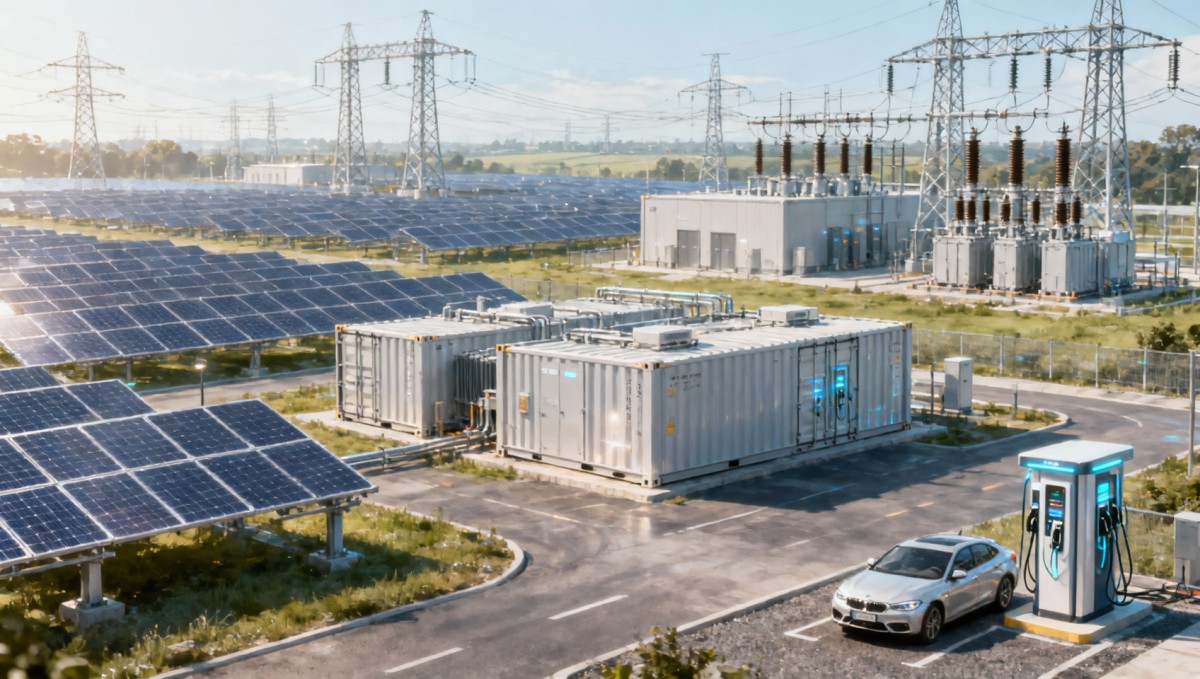
Energy Transition Promises Fall Short Without Grid Resilience
auth.Dr. Hideo TanakaTime
Apr 17 2026Click Count
The Energy Transition cannot deliver on Decarbonization and Electrification goals without stronger Energy Resilience and Grid Modernization. As utilities and operators scale PV Efficiency and ESS Benchmarking, alignment with IEC Standards, UL Certification, and IEEE Compliance becomes essential to ensuring reliable, secure, and future-ready power infrastructure.
For energy researchers, plant operators, EPC teams, and utility decision-makers, this is no longer a theoretical issue. The pace of renewable deployment is accelerating, but generation growth alone does not guarantee dependable power. A grid with weak fault tolerance, poor transformer coordination, or undersized storage can turn clean energy assets into operational liabilities during peak demand, extreme weather, or voltage instability.
That is why grid resilience has become a decisive factor in energy transition planning. It connects solar PV performance, energy storage response time, smart grid visibility, EV charging load management, and hydrogen-linked flexibility into one operating framework. For organizations evaluating infrastructure investments over 10- to 25-year life cycles, resilience determines whether assets merely comply on paper or continue delivering under real-world stress.
G-EPI approaches this challenge through engineering data, equipment benchmarking, and standards-based evaluation. Across PV, ESS, EV charging infrastructure, smart grid systems, transformers, and hydrogen-related technologies, the practical question remains the same: how can operators build power infrastructure that is efficient in normal conditions and stable when conditions are not normal?
Why Energy Transition Targets Fail Without Grid Resilience

Many decarbonization roadmaps focus first on installed renewable capacity, measured in MW or GW. Yet reliability is shaped by a broader set of variables: ramp rate, frequency control, transformer loading, protection settings, communication latency, storage duration, and restoration speed after disturbances. A network can add 500 MW of solar and still remain vulnerable if the local substation, feeder design, or reactive power support has not been upgraded.
This gap is especially visible in high-electrification environments. Industrial loads, fast EV charging hubs, data centers, and critical facilities can create steep load swings within 15 to 30 minutes. If the grid lacks automated switching, properly sized ESS, or sufficient voltage regulation, operators face rising curtailment, power quality complaints, and reduced asset utilization. In other words, clean capacity may increase while usable resilience declines.
Grid modernization addresses that mismatch by linking generation, storage, and control layers. Smart relays, digital substations, distribution automation, and transformer health monitoring can reduce outage duration and improve fault isolation. In practical terms, resilience means a system can absorb disturbances, maintain critical service, and recover quickly, often within seconds for power electronics events and within 1 to 4 hours for localized restoration actions.
Operators also need to think beyond single-asset performance. A TOPCon module with strong efficiency metrics or a liquid-cooling ESS with low temperature deviation still depends on site-level integration. Poor PCS coordination, inadequate cable thermal margins, and weak SCADA visibility can erode the expected performance benefits of premium hardware. Resilience, therefore, is a systems engineering issue rather than a component-only issue.
Three structural weaknesses that slow progress
- Generation is added faster than network reinforcement, creating congestion, reverse power flow issues, and curtailment in solar-heavy regions.
- Storage is procured based on nameplate capacity, such as 2-hour or 4-hour duration, without enough analysis of cycling profile, thermal behavior, and grid support duty.
- Compliance review is delayed until late-stage commissioning, increasing redesign risk when IEC, UL, or IEEE requirements reveal gaps in protection or interoperability.
What this means for researchers and operators
For information researchers, resilience provides a practical lens for comparing technologies across sectors. For operators, it becomes an operational KPI set: outage tolerance, round-trip energy availability, mean time to diagnose faults, allowable transformer overload intervals, and cybersecurity response readiness. These metrics are often more useful than headline capacity numbers when evaluating long-term infrastructure quality.
The Core Building Blocks of a Resilient Modern Grid
A resilient grid is not created by one technology. It is built through coordinated upgrades across at least five layers: high-efficiency PV generation, energy storage systems, smart transformers and substations, load-side flexibility, and intelligent control platforms. When these layers are designed together, utilities can better manage intermittency, reduce unplanned downtime, and maintain service quality even during severe operating conditions.
PV efficiency matters because every 1% gain in module performance can improve land use and BOS economics, but its resilience value depends on inverter behavior, fault ride-through capability, and communication quality. In modern utility-scale projects, PV plants are increasingly expected to support volt-var control, ramp smoothing, and grid code compliance, not simply inject energy during daylight hours.
ESS plays a different but equally critical role. Storage can provide frequency support in milliseconds, shift solar generation over 2 to 6 hours, and support black-start or islanding strategies in microgrids. However, resilience depends on more than MWh. Operators must review thermal management, cell consistency, PCS efficiency, fire safety architecture, emergency shutoff logic, and degradation under high-cycle duty.
Transformers and smart grid devices form the backbone that links variable generation to end-use reliability. Digital monitoring can detect insulation stress, harmonics, hotspot temperature rise, and abnormal loading before failures cascade. In many projects, improving transformer intelligence and feeder automation delivers faster reliability gains than adding more generation capacity alone.
How major infrastructure pillars contribute to resilience
The table below outlines how key energy technologies support resilience objectives and what operators should evaluate during planning and procurement.
A key takeaway is that resilience is distributed. No single technology can compensate for poor integration elsewhere. A site with 99% inverter uptime but weak transformer capacity can still experience frequent operational constraints. Likewise, an advanced ESS without clear dispatch logic may underperform during real grid events.
Typical design checkpoints
- Verify whether the site requires 2-hour, 4-hour, or longer storage based on actual load and curtailment profile.
- Confirm transformer thermal margin under N-1 conditions and short-duration overload scenarios.
- Review communication architecture for sub-second visibility where fast control actions are needed.
- Check whether protection settings align with distributed generation behavior and islanding risks.
Standards and Benchmarking: Why Compliance Shapes Real Performance
In energy infrastructure, standards are not paperwork; they are performance guardrails. IEC standards often shape electrical safety, testing methodology, and interoperability expectations. UL certification is frequently critical in product safety evaluation, especially in storage and electrical balance-of-system components. IEEE compliance supports power quality, interconnection, communication, and equipment behavior under grid events.
For project teams, the procurement risk appears when standards review is fragmented. A module may meet one IEC pathway, an inverter may align with a separate requirement set, and a battery cabinet may have acceptable safety documentation, yet the integrated system still fails commissioning expectations due to communication mismatch, protection incompatibility, or unresolved site conditions. That is why benchmarking should happen before purchase orders are finalized.
Benchmarking is especially useful when comparing products that look similar at first glance. Two ESS solutions with the same 20 MWh capacity can differ significantly in thermal uniformity, fire segregation strategy, serviceability, and round-trip efficiency under partial-load operation. Similarly, two PV systems rated at similar wattage may differ in bifacial behavior, temperature coefficient, and long-term degradation under harsh climates.
For operators and technical researchers, the practical goal is to convert compliance and benchmarking into a decision matrix. This reduces redesign cycles, protects OPEX, and improves bankability. A strong technical repository can save weeks of validation time and help teams avoid selecting hardware that passes datasheet review but struggles in field integration.
A practical standards review framework
The following table summarizes how teams can evaluate standards alignment across key equipment categories before deployment.
The conclusion is straightforward: compliance should be treated as an early-stage engineering filter, not a final-stage administrative checklist. Doing this well can shorten technical review cycles by 2 to 6 weeks and reduce costly rework during factory acceptance and site commissioning.
Common benchmarking mistakes
- Comparing only nameplate power or capacity while ignoring partial-load efficiency and auxiliary consumption.
- Assuming certifications automatically guarantee smooth integration across mixed-vendor systems.
- Overlooking serviceability, spare parts access, and firmware update processes over a 10-year operating period.
How Utilities, EPCs, and Microgrid Operators Should Plan for Resilience
Resilience planning starts with scenario definition. A utility-scale solar-plus-storage project serving wholesale markets faces different risks than a microgrid supporting a port, hospital campus, mine, or industrial park. Some sites prioritize 24/7 critical load continuity. Others prioritize shaving 10% to 20% peak demand or reducing renewable curtailment. Without defining the operating objective, equipment selection often becomes fragmented and over-budget.
A practical planning method is to divide the project into four layers: source, storage, network, and control. Source includes PV or other generation assets. Storage covers duration, cycling strategy, and backup logic. Network includes transformers, switchgear, cables, and protection architecture. Control includes EMS, SCADA, dispatch logic, and cybersecurity visibility. Weakness in any single layer can reduce the value of the other three.
For EPC contractors, early coordination between civil, electrical, and control disciplines is essential. A delay of even 2 to 3 weeks in transformer specification or interconnection study review can force redesigns across cable routing, inverter placement, and protection settings. For microgrid operators, the challenge is often operational: maintaining stable voltage and frequency while switching between grid-connected and islanded modes, sometimes several times per month in unstable supply environments.
G-EPI’s cross-sector approach is valuable here because resilience planning increasingly spans traditional boundaries. EV charging plazas may require ESS buffering. Hydrogen production sites may demand highly stable power quality. Remote industrial loads may need transformer intelligence plus storage plus solar rather than one isolated investment. Decision-makers benefit when data from these sectors can be reviewed in one engineering context.
A five-step implementation path
- Define resilience objectives, such as backup duration, outage tolerance, renewable utilization rate, or power quality thresholds.
- Map site constraints, including feeder limits, transformer ratings, available space, thermal conditions, and communication infrastructure.
- Benchmark equipment using technical, safety, and interoperability criteria instead of cost alone.
- Validate standards alignment before procurement, including IEC, UL, and IEEE-relevant requirements.
- Commission with performance tests that reflect real operating events, not only nominal steady-state conditions.
Typical procurement review criteria
Most serious buyers evaluate at least 6 dimensions: technical performance, safety architecture, standards alignment, integration complexity, lifecycle serviceability, and supply chain certainty. This is particularly important for long-lead items such as transformers, medium-voltage switchgear, and certain storage components, where delivery windows can range from 8 to 30 weeks depending on market conditions and regional approvals.
When procurement teams combine these criteria with operational modeling, they can avoid a common trap: selecting low upfront CAPEX solutions that raise maintenance frequency, derating risk, or retrofit costs later. In resilience planning, the cheapest option on day 1 can become the most expensive option over years 3 to 8.
Common Risks, Selection Mistakes, and FAQs for Energy Infrastructure Buyers
As energy transition projects scale, buying mistakes tend to repeat across markets. One frequent error is treating resilience as a backup-only issue. In reality, it affects daily dispatch efficiency, maintenance planning, and curtailment exposure. Another mistake is relying on generic datasheets without verifying environmental suitability, communication compatibility, and expected duty cycle under actual site conditions.
There is also a persistent misconception that adding storage automatically solves grid instability. Storage can improve flexibility, but if transformer bottlenecks, protection miscoordination, or weak control logic remain unresolved, the system may still fail to perform during transient events. Similarly, smart grid software cannot compensate for undersized electrical hardware or poor field commissioning practices.
For information researchers and operating teams, the best defense is structured evaluation. Ask what the system must do within 1 second, 15 minutes, 4 hours, and 24 hours. These four time windows expose whether a solution is designed for power quality, demand smoothing, resilience backup, or true operational continuity. The answer should shape equipment architecture and testing protocol.
FAQ: How should buyers evaluate grid resilience readiness?
How do I know whether my project needs 2-hour or 4-hour ESS duration?
Review your load profile, renewable curtailment window, and backup requirement separately. A site using ESS mainly for ramp smoothing may need shorter duration but faster response. A microgrid supporting critical loads during outages often requires 2 to 4 hours at minimum, and sometimes longer if restoration risk is high or fuel backup is limited.
Which standards should be checked first during procurement?
Start with the standards most relevant to safety, interconnection, and system behavior. For many projects that means reviewing IEC pathways for testing, UL-related safety expectations for storage or electrical equipment, and IEEE-related grid or power quality criteria. The exact sequence depends on region, application, and utility interconnection rules.
What are the most overlooked resilience indicators?
Three items are often missed: communication latency between devices, service access during faults, and derating behavior under temperature stress. These factors may not stand out in marketing materials, but they directly affect operational continuity, maintenance time, and field performance during extreme conditions.
How long does resilience-focused project validation usually take?
For a medium-complexity project, technical review and standards alignment can take 2 to 6 weeks before final equipment lock-in. Factory acceptance and on-site commissioning can add several more weeks depending on scope, communication integration, and utility witness testing requirements.
The energy transition will continue to expand across solar PV, ESS, EV charging, smart grids, transformers, and hydrogen-linked applications. But capacity growth without resilience creates fragile progress. The organizations that perform best over the next decade will be those that connect decarbonization goals with engineering discipline, standards-based validation, and infrastructure planning built for real operating stress.
G-EPI supports this need through data transparency, equipment benchmarking, and cross-sector technical insight that helps developers, EPCs, utilities, and operators make informed decisions. If you are evaluating grid modernization, PV efficiency, ESS benchmarking, or standards-aligned infrastructure planning, now is the right time to refine your technical roadmap. Contact us to discuss your project, request a tailored solution, or explore more resilient energy infrastructure strategies.
- EMS
- energy storage systems
- ESS
- smart grid
- clean energy
- PV modules
- PPE
- tractors
- procurement
- cybersecurity
- AR
- supply chain
- Cement
- benchmarking
- ESS
- energy storage systems
- Smart Grid
- clean energy
- product safety
- procurement
- health
- supply chain
- procurement
- health monitoring
- electronics
- Engineering data
- supply chain
- data transparency
- Solar PV
- Energy Storage
- EV Charging
- Smart Grid
- Transformer
- Microgrid
- Utility-scale
- EPC Contractors
- Energy Transition
- Decarbonization
- Electrification
- Grid Modernization
- PV Efficiency
- IEC Standards
- UL Certification
- Grid Resilience
- ESS
Recommended News
- 00
0000-00
AI Remote Inspection for Grid Resilience Equipment at Trade SummitAI remote inspection revolutionizes grid resilience equipment exports—real-time AR + blockchain verification for Smart Transformers & GIS Switchgears at the 2026 Trade Summit. - 00
0000-00
Grid resilience stress testing is changing after extreme weather lossesGrid resilience stress testing is reshaping national grid modernization reports with insights on distribution network voltage regulation, smart meter data privacy protocols, and upgrade priorities. - 00
0000-00
What national grid modernization reports reveal about funding gapsNational grid modernization reports reveal funding gaps in distribution network voltage regulation, smart meter data privacy protocols, and grid resilience stress testing—see where risks and sourcing priorities intersect.
000000-00
{item.title}{item.description}Search News
Industry Portal
Hot Articles
- China’s H2 Tube Trailers Gain ASME Section VIII Div. 3 CertificationChina’s H2 tube trailers now ASME Section VIII Div. 3 certified—key for Middle East & Australia green hydrogen tenders. First Asia-Pacific approval for 35/70 MPa systems.
- Jiangnan Chem’s NE Units: BMS Software Added to Safety AuditJiangnan Chem’s NE Units now feature BMS software in safety audits — a key shift for ESS/BMS suppliers targeting civil explosives & mining sectors in China and Southeast Asia.
- AI Remote Inspection for Grid Resilience Equipment at Trade SummitAI remote inspection revolutionizes grid resilience equipment exports—real-time AR + blockchain verification for Smart Transformers & GIS Switchgears at the 2026 Trade Summit.
Popular Tags