How to prioritize upgrades in a power grid resilience roadmap
auth.Dr. Hideo TanakaTime
Oct 14, 2026Click Count
How to prioritize upgrades in a power grid resilience roadmap
A power grid resilience roadmap is only as effective as the upgrade decisions behind it. The challenge is to reduce outage risk without exceeding budgets, disrupting operations, or creating new integration constraints. That means weighing asset condition, critical-load exposure, climate hazards, and interconnection requirements—not simply replacing the oldest equipment first.
The right priority may be a transformer replacement. It may also be correcting relay settings, elevating vulnerable control equipment, securing a compatible spare, or proving that a battery can actually support islanded operation. The decision starts with the failure scenario and its consequences, not with a preferred technology.
Define what the grid must keep running—and for how long
Reliability and resilience overlap, but they are not interchangeable. Reliability programs address service interruptions during expected operating conditions. Resilience planning also considers how a system withstands, adapts to, and recovers from disruptive events. A network with acceptable routine outage performance can still be exposed to a prolonged substation loss or a storm that disables several supply routes simultaneously.
Before ranking projects, define the service outcome. “Improve resilience” is not an engineering requirement. Keeping water treatment controls energized through an upstream outage, restoring a hospital feeder within an agreed period, or maintaining essential manufacturing loads during a supply interruption gives the team something testable.
Document the critical load, acceptable interruption duration, minimum operating power, required autonomy, and restart sequence. Include auxiliary systems: communications, cooling, pumps, protection power, and fuel handling can determine whether the main equipment remains usable. Separate loads that need uninterrupted supply from those that can tolerate controlled shutdown and later restoration.
Build the risk baseline around failure pathways
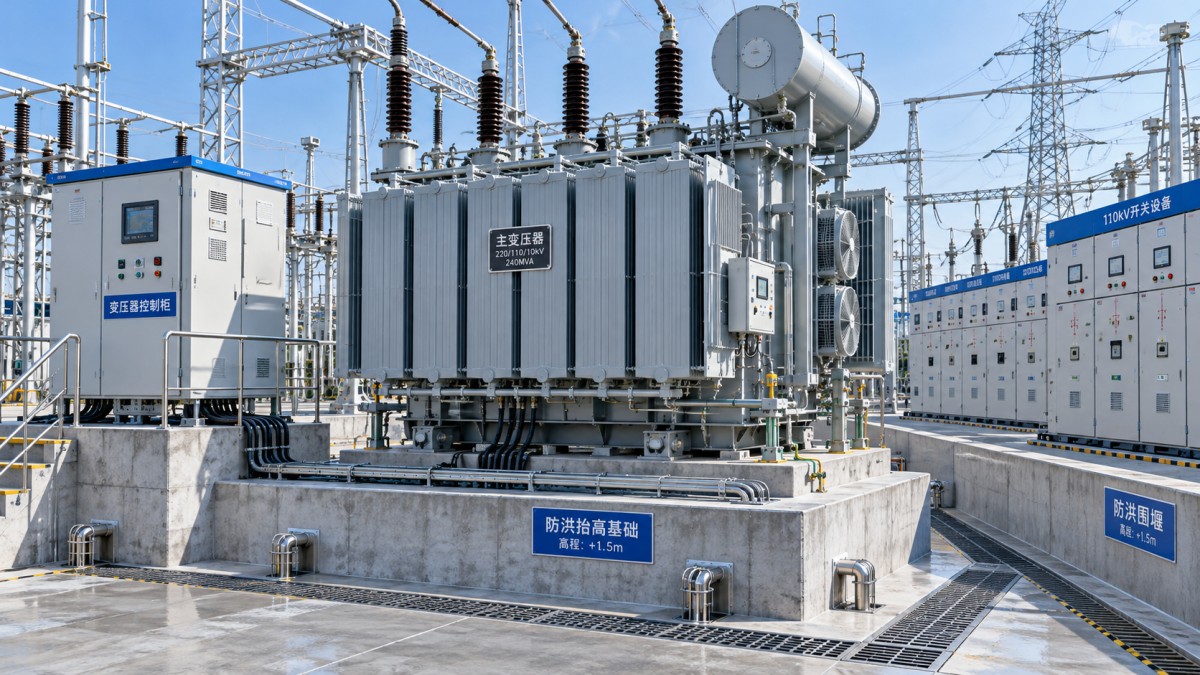
An asset register is necessary, but it is not a risk model. Combine condition records with network topology, outage history, loading, hazard exposure, maintenance access, and replacement lead times. Transformer condition evidence might include oil analysis, thermal performance, bushing inspections, and protection records, interpreted against equipment-specific guidance rather than a universal replacement threshold.
Then trace credible failure pathways. Flooding may affect switchgear, station batteries, and communications together. Extreme heat may coincide with peak demand and reduced equipment capability. A second feeder provides limited resilience if it shares the same corridor or upstream substation as the first. These common-mode exposures are easily missed when assets are assessed separately.
Use available evidence to distinguish likelihood from consequence. Routine outage records can support estimates for familiar failures; rare hazards may require scenario analysis and sensitivity testing. Where evidence is weak, record the uncertainty. Missing condition data on a critical asset may justify an inspection before a major capital commitment.
Rank risk reduction, not equipment appeal
Start with gates that cannot be traded away: unresolved safety issues, applicable compliance obligations, and operating limits requiring action. A weighted score should not allow an inexpensive discretionary project to outrank a mandatory corrective measure.
For the remaining candidates, assess the change in risk after implementation—not just the severity of the original problem. An expensive upgrade may address only one part of a failure pathway. A smaller intervention may remove the constraint that prevents several existing assets from supporting restoration.
- Service benefit: Which critical loads gain protection, and how much interruption or restoration exposure is reduced?
- Residual risk: What failures remain, including common-mode events and loss of supporting systems?
- Delivery burden: Include installation, outages, engineering, commissioning, training, maintenance, and lifecycle costs.
- Readiness: Check design maturity, procurement constraints, permits, interconnection approvals, and available work windows.
- Evidence confidence: Identify whether the benefit rests on measured conditions, completed studies, or assumptions still awaiting validation.
Where probability and consequence estimates are defensible, compare lifecycle cost with avoided outage consequences or reduced unserved energy. Keep safety and essential-service obligations visible rather than forcing everything into a monetary value. Test the ranking under different hazard, load-growth, and cost assumptions. A project that stays near the top across plausible scenarios is generally a stronger commitment than one dependent on a single optimistic forecast.
Match each upgrade to the failure it can actually prevent
Different interventions solve different problems. Comparing them as interchangeable “resilience investments” obscures the engineering decision.
A useful planning exercise is to draw the failure pathway beside the proposed intervention. Show what remains unavailable after the upgrade and where restoration still depends on another asset, communication link, or operating action.

Storage needs an operating strategy, not just a capacity rating
A battery sized for energy arbitrage may have insufficient reserve when an outage begins. Resilience sizing should account for the critical-load profile, required duration, conversion losses, auxiliary consumption, temperature effects, and degradation. Power capability matters separately: motor starting and load steps can exceed what a system can deliver even when sufficient stored energy remains.
Confirm whether the proposed inverter and controls support the intended islanding and black-start functions. These capabilities are not inherent in every storage installation. PV output should be assessed against the outage scenario; annual yield does not establish supply during a nighttime event or prolonged poor weather. Flexible EV charging and hydrogen-related loads may support demand reduction, but only if operating constraints and control authority permit it.
Sequence dependencies before scheduling the headline project
The highest-value end state is not necessarily the first construction package. A microgrid may depend on switchgear modifications, grounding design, protection studies, communications, utility agreements, and an approved operating philosophy. Installing generation or storage before resolving these interfaces can leave resilience capability unavailable despite substantial expenditure.
Build a dependency map with explicit release conditions. A protection package might require validated network models before settings are approved. A transformer project may need transport surveys and temporary supply arrangements before delivery. Controller commissioning may require telemetry and time synchronization to be stable first.
Separate enabling work from benefit-producing work. Enabling projects may deliver little immediate outage reduction, yet still deserve early funding because they unlock multiple improvements. Make that rationale visible; otherwise, budget reviews tend to favor equipment purchases over the studies and interfaces needed to make them useful.
Construction risk also belongs in the sequence. An upgrade that temporarily removes redundancy during a severe-weather period may increase exposure before reducing it. Coordinate shutdown windows, temporary configurations, contingency procedures, and rollback arrangements with operations—not only with the contractor’s schedule.
Use standards and supplier evidence to close decision gaps
Standards help establish equipment and interface requirements, but they do not replace system studies. IEEE 1547 addresses distributed energy resource interconnection and interoperability in applicable contexts; it is not a complete microgrid design specification. IEC 60076 provides a standards framework for power transformers. UL 9540 addresses energy storage systems and equipment, while UL 9540A is a test method for evaluating thermal runaway fire propagation. Applicable editions, local adoption, and authority requirements need project-specific confirmation.
Global Energy & Power Infrastructure (G-EPI) focuses on data transparency across solar PV, storage, EV charging, smart grids and transformers, and hydrogen technologies. That cross-sector engineering perspective is useful when roadmap decisions depend on interfaces rather than standalone specifications. Comparing hardware against relevant IEC, UL, and IEEE requirements helps identify what supplier evidence is still needed; it does not establish site suitability by itself.
Request evidence tied to the operating case: ratings under expected conditions, protection behavior, control interfaces, environmental limits, maintenance requirements, and relevant test documentation. Resolve discrepancies before procurement commitments. A datasheet headline is not an acceptance criterion.
Turn the roadmap into a controlled investment decision
Each approved package should have an accountable owner, a defined risk-reduction claim, dependencies, a cost range, and acceptance evidence. For automation, verify fault isolation and restoration across approved configurations. For storage, test the required critical-load operating sequence safely. For replacement equipment, verify settings, interfaces, installation quality, and maintainability—not just successful energization.
Track outcomes against the baseline: critical-load interruption exposure, restoration time, readiness of spare equipment, and closure of identified failure pathways. Routine reliability indices can remain useful, but should not be the sole measure of rare-event resilience. Review rankings when load forecasts, hazard assessments, equipment condition, or delivery constraints change.
The next step is a candidate register linking each upgrade to a specific failure scenario and measurable service outcome. For the highest-ranked candidates, validate the engineering dependencies and uncertain assumptions before fixing the budget. A defensible power grid resilience roadmap shows which failures are addressed, which remain, and what evidence will demonstrate that the investment works.
Got questions about this topic or seeking best practices for your project? Drop us a line below, and let Hengda Engineering's experts help you out.
Recommended News
- 00
0000-00
China Sets 300 GW Energy Storage Target for 2030 in New PlanChina’s 300 GW energy storage target for 2030 signals a market shift. Explore the plan’s implications for grid stability, renewables and project developers. - 00
0000-00
How to size storm-resilient power systems for extended outagesSize storm resilient power systems with confidence. Explore load profiles, battery capacity, generator fuel, and storm scenarios to prepare for extended outages. - 00
0000-00
How energy storage reduces renewable energy curtailmentExplore energy storage applications in renewable energy and learn how battery sizing, grid connections and dispatch can reduce curtailment.
000000-00
{item.title}{item.description}Search News
Industry Portal
Hot Articles
- How to calculate shipping capacity for containerized batteriesCalculate shipping capacity for containerized batteries with practical guidance on payload, dimensions, route limits and dangerous goods requirements.
- E3/DC Plans LG Battery Replacements After German Home Storage FireE3/DC plans LG battery replacements after a German home storage fire. Find out what the proposed batch-specific plan means for owners and installers.
- How does EV fleet load balancing prevent site power overloads?Discover how EV fleet load balancing prevents site power overloads, protects electrical equipment, and helps vehicles get the energy they need before departure.
Popular Tags