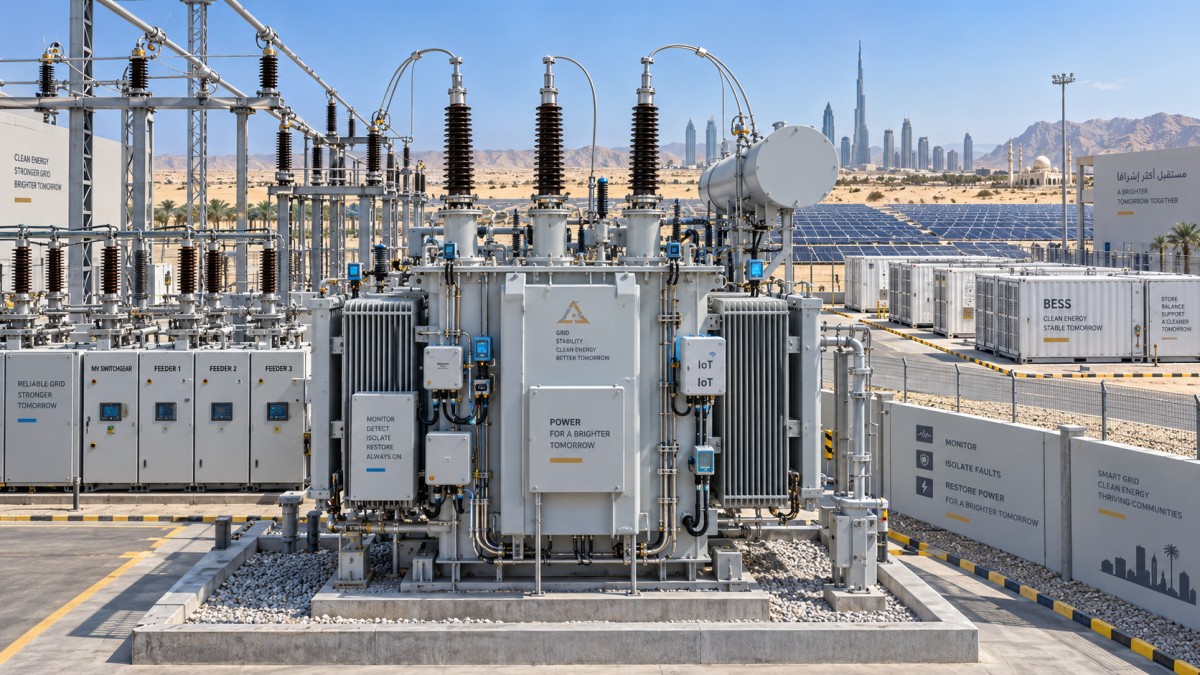
How grid monitoring systems improve outage response in the Middle East
auth.Dr. Hideo TanakaTime
Oct 04, 2026Click Count
At 2:00 a.m., an outage is rarely just an outage. For a project manager responsible for a utility corridor, industrial microgrid, or rapidly expanding urban distribution network, the first questions arrive immediately: Is the fault on the feeder, transformer, cable section, or inverter block? How many critical loads are affected? Can a healthy section be isolated and restored safely? Is the event linked to heat, overload, communications loss, or a protection-setting issue?
Across the region, grid monitoring systems Middle East projects deploy are changing the quality of those first decisions. Rather than waiting for field reports, manual switching confirmation, or customer complaints to build a picture of the event, engineering teams can use live operational data to identify abnormal conditions, prioritize response actions, and coordinate restoration with greater confidence.
This matters because the Middle East’s power networks are evolving quickly. Large solar plants, utility-scale battery energy storage systems, desalination loads, new urban districts, electrified transport, data centres, and interconnections are adding both capacity and operational complexity. The challenge is not merely to install more equipment. It is to understand what the equipment and the network are doing when conditions are least predictable.
Outage response begins before the fault occurs
The value of monitoring is often misunderstood as a control-room benefit that begins once an alarm appears. In practice, the most useful systems improve outage response well before a breaker trips. They establish a normal operating baseline: expected loading profiles, transformer temperatures, voltage behaviour, harmonic levels, inverter output patterns, battery state of charge, and communication availability.
When a deviation occurs, the team is no longer looking at an isolated alert. It can compare the event against the network’s normal behaviour and assess whether the issue is likely transient, localized, escalating, or already affecting upstream and downstream assets.
For example, a rising transformer hot-spot temperature does not automatically mean an imminent outage. Yet when it appears alongside higher-than-usual loading, degraded cooling performance, and a forecast heat event, it becomes a maintenance and operational decision that should not wait for the next routine inspection. Monitoring turns several weak signals into a clearer risk picture.
For project leaders, this changes the conversation from “How fast can we repair a failure?” to “What information do we need to prevent avoidable failures and restore the remainder of the network safely when one does happen?”
The regional operating environment makes visibility essential
Middle Eastern grids operate under conditions that can expose weaknesses in both physical assets and operating processes. Extreme ambient temperatures affect transformer cooling margins, cable performance, electronics, and battery thermal management. Dust, humidity, and coastal salinity can affect outdoor equipment and sensor reliability. Fast-growing demand centers may alter feeder loading patterns more quickly than planning assumptions anticipated.
At the same time, renewable integration introduces new operating dynamics. Solar PV output can change sharply with cloud movement, soiling conditions, curtailment instructions, or inverter availability. Battery storage may be called on for peak support, reserve, black-start capability, or renewable firming. EV charging clusters can introduce concentrated load growth at locations that once had modest demand. A conventional view of the network—periodic readings, isolated SCADA points, and post-event investigation—is often too slow for this environment.
The objective is not to monitor every possible data point. It is to select signals that support operational action. A system that produces thousands of unprioritized alarms can overwhelm the very people it is meant to assist. Effective grid monitoring systems connect asset condition, electrical performance, protection status, weather context, and network topology in a way that supports a practical response sequence.
What a response-ready monitoring architecture looks like
A useful architecture usually combines field sensing, communications, operational platforms, and defined response workflows. The precise design varies between transmission, distribution, renewable plants, and microgrids, but the governing principle is consistent: data must arrive with enough quality, context, and speed to influence a decision.
- Field-level visibility: Intelligent electronic devices, feeder sensors, transformer monitoring, power quality meters, fault passage indicators, weather stations, and condition sensors capture what is happening at the asset or circuit level.
- Reliable communications: Fibre, cellular, radio, private LTE, or hybrid networks carry data to supervisory platforms. Communication health must be monitored too; a silent device should not be mistaken for a healthy device.
- Operational integration: SCADA, distribution management systems, outage management systems, energy management platforms, and asset-management tools need a governed exchange of data rather than disconnected dashboards.
- Event interpretation: Alarm rationalization, time synchronization, topology awareness, and analytics help distinguish a local anomaly from a broader network event.
- Field execution: Control-room staff, protection engineers, maintenance crews, and contractors need clear roles, switching authority, and verified communication channels.
There is an important distinction between collecting data and creating operational visibility. A substation may have digital relays and a solar facility may have an inverter monitoring portal, but if their data cannot be correlated during an event, the project still has blind spots. Integration should be planned around decisions: fault location, isolation boundaries, load transfer options, equipment safety status, and restoration readiness.

From alarm flood to a restoration sequence
During a fault, operators do not need a longer alarm list; they need an ordered path through uncertainty. Grid monitoring helps create that path.
Consider a feeder trip serving a mixed load area that includes commercial customers, a water pumping station, and EV charging infrastructure. A conventional response may begin with calls to field personnel and a broad patrol of the route. With feeder measurements, breaker status, fault indicators, and network topology available in one operational view, the control room can narrow the likely faulted section, identify available isolation points, and determine which healthy sections may be back-fed.
The restoration process still requires authorized switching procedures, safety checks, and field verification. Monitoring does not remove engineering judgment. It makes that judgment better informed and reduces the time spent searching for basic facts.
For a transmission-connected solar-plus-storage site, the workflow may be different. The immediate question may be whether the disturbance originated within the plant, at the point of interconnection, or in the external grid. Event records from protection relays, inverter fault codes, battery management system status, transformer parameters, and grid frequency or voltage measurements can help the team separate cause from consequence. This is particularly valuable when several assets respond simultaneously to a grid disturbance.
Four decisions that should be faster after deployment
- Where is the fault likely located? Fault current signatures, fault passage indications, relay events, and topology data can reduce the search area.
- What must be isolated? Live breaker and switch status, combined with an accurate network model, supports safe sectionalizing decisions.
- Which loads can be restored first? Critical-load maps and available capacity information support controlled load transfer, especially for hospitals, water infrastructure, telecom sites, and industrial processes.
- What should be inspected before re-energization? Condition data can flag equipment that experienced abnormal thermal, electrical, or mechanical stress during the event.
Monitoring priorities differ by asset class
A common implementation mistake is to apply one monitoring specification across every asset. The better approach is to start with the outage consequences and failure modes of each part of the system.
Transformers deserve close attention because their failure can create long restoration windows and significant network constraints. Depending on criticality, teams may monitor loading, top-oil and winding temperatures, cooling status, dissolved gas trends, bushing condition, tap changer performance, and moisture indicators. The point is not to replace specialist diagnostics; it is to identify when deeper investigation or operating limits are warranted.
Distribution feeders benefit from fault location capability, load visibility, voltage measurements, switch status, and power quality data. In fast-developing areas, feeder-level information also provides evidence for reinforcement planning rather than relying solely on estimated load growth.
PV and energy storage systems require both plant-level and grid-interface visibility. Monitoring should capture inverter availability, DC and AC performance, weather context, curtailment states, battery thermal conditions, state of charge, state of health indicators, and protection events. Where storage supports resilience services, its usable capability during an outage must be visible—not assumed from nameplate capacity.
EV charging infrastructure introduces a different concern: localized demand concentration and power quality impacts. Monitoring transformer loading, charger utilization, voltage drop, and coincident peak patterns can prevent charging growth from becoming an unexpected feeder reliability issue.
Design the system around operational ownership, not only technology
Many monitoring projects underperform because the technical scope is defined without enough attention to who will act on the information. Project managers should establish ownership before procurement is finalized. Who validates alarms? Who maintains sensors and communications equipment? Who has authority to alter protection settings or remote-control devices? Which events trigger a site visit, and which are reviewed during planned maintenance?
These questions matter especially when responsibilities are split between the utility, EPC contractor, independent power producer, operations and maintenance provider, and equipment vendor. A dashboard does not resolve contractual boundaries. Clear operating procedures do.
Data governance also needs early attention. Timestamp consistency, naming conventions, device identities, cybersecurity controls, data retention, and interface standards can sound administrative during design. During a major event, they become operationally decisive. If event records from a relay, inverter controller, and SCADA platform cannot be aligned in time, root-cause analysis becomes slower and less reliable.
For cross-vendor projects, interoperability should be tested against recognized engineering practices and relevant IEC, IEEE, UL, and local utility requirements. Global Energy & Power Infrastructure (G-EPI) approaches this as an engineering integrity issue: technology selection should be grounded in verifiable device capabilities, applicable standards, lifecycle support, and the actual network use case—not a generic feature list.
A practical rollout path for project managers
Large, all-at-once digitization programs can delay benefits. A phased approach often gives teams a chance to validate data quality and refine operating workflows before expanding coverage.
Begin with a criticality map. Identify substations, feeders, generation blocks, storage assets, and load centers where an outage has the highest safety, economic, or public-service impact. Then review the dominant failure modes and current information gaps. A remote desert substation with limited access, for instance, may justify different sensing and communications priorities than an urban feeder with frequent switching options.
Next, define measurable operational use cases. “Improve visibility” is too broad. “Reduce the time required to confirm feeder fault location,” “verify transformer cooling alarms before dispatch,” or “identify available storage capacity for controlled islanding” gives design teams a clearer basis for selecting sensors, communications bandwidth, platforms, and integration points.
Before scale-up, run event simulations. A tabletop exercise can reveal whether operators can interpret the display, whether contact lists are current, whether data remains available during communications degradation, and whether switching workflows account for distributed generation and backfeed risk. These exercises are often more revealing than a successful factory acceptance test.
Questions to ask before selecting a grid monitoring solution
- Which outage decisions will this system improve, and who makes those decisions?
- Can the solution operate reliably under local heat, dust, humidity, and communications conditions?
- How will data from legacy relays, new sensors, PV inverters, ESS controls, and meters be time-aligned?
- Does the network model reflect actual field switching states and distributed energy resource connections?
- What happens when a sensor, gateway, or communications link fails?
- Are alarm thresholds based on asset criticality and operational limits rather than vendor defaults?
- Can the system support post-event analysis as well as real-time dispatch decisions?
- What cybersecurity, access-control, and patch-management responsibilities sit with each party?
Resilience is built from better decisions, repeated consistently
The strongest case for grid monitoring systems in the Middle East is not that they make every outage disappear. Power systems will still face faults, severe weather, equipment aging, construction incidents, and unexpected operating conditions. Their value lies in reducing uncertainty when time matters most.
For project managers and engineering leaders, the goal is a network that can detect abnormal behaviour early, locate and contain faults with confidence, restore priority loads in a disciplined sequence, and learn from every event. As solar PV, energy storage, EV charging, smart substations, and new industrial loads reshape regional power systems, that level of visibility becomes part of the infrastructure itself.
A well-designed monitoring program gives teams more than screens and sensors. It gives them a shared operational picture—one that supports safer field work, more credible maintenance planning, and a more resilient path through the next interruption.
Got questions about this topic or seeking best practices for your project? Drop us a line below, and let Hengda Engineering's experts help you out.
Recommended News
- 00
0000-00
Can AI solutions detect transformer faults before equipment fails?AI solutions can flag developing transformer faults before failure. Discover which warning signs matter, how to assess vendor claims, and what makes predictive maintenance actionable. - 00
0000-00
How to improve AMI cyber security for remote disconnect commandsStrengthen AMI cyber security for remote disconnect commands. Discover practical controls for authorization, replay protection, impact limits, and verified execution to reduce service risks. - 00
0000-00
How to assess synchrophasor data exchange under IEEE C37.118.2-2024Assess IEEE C37.118.2-2024 synchrophasor data exchange with practical checks for configuration, timing, and PMU–PDC interoperability. Learn how to make evidence-based acceptance decisions.
000000-00
{item.title}{item.description}Search News
Industry Portal
Hot Articles
- E3/DC Plans LG Battery Replacements After German Home Storage FireE3/DC plans LG battery replacements after a German home storage fire. Find out what the proposed batch-specific plan means for owners and installers.
- How does EV fleet load balancing prevent site power overloads?Discover how EV fleet load balancing prevents site power overloads, protects electrical equipment, and helps vehicles get the energy they need before departure.
- China Sets 300 GW Energy Storage Target for 2030 in New PlanChina’s 300 GW energy storage target for 2030 signals a market shift. Explore the plan’s implications for grid stability, renewables and project developers.
Popular Tags