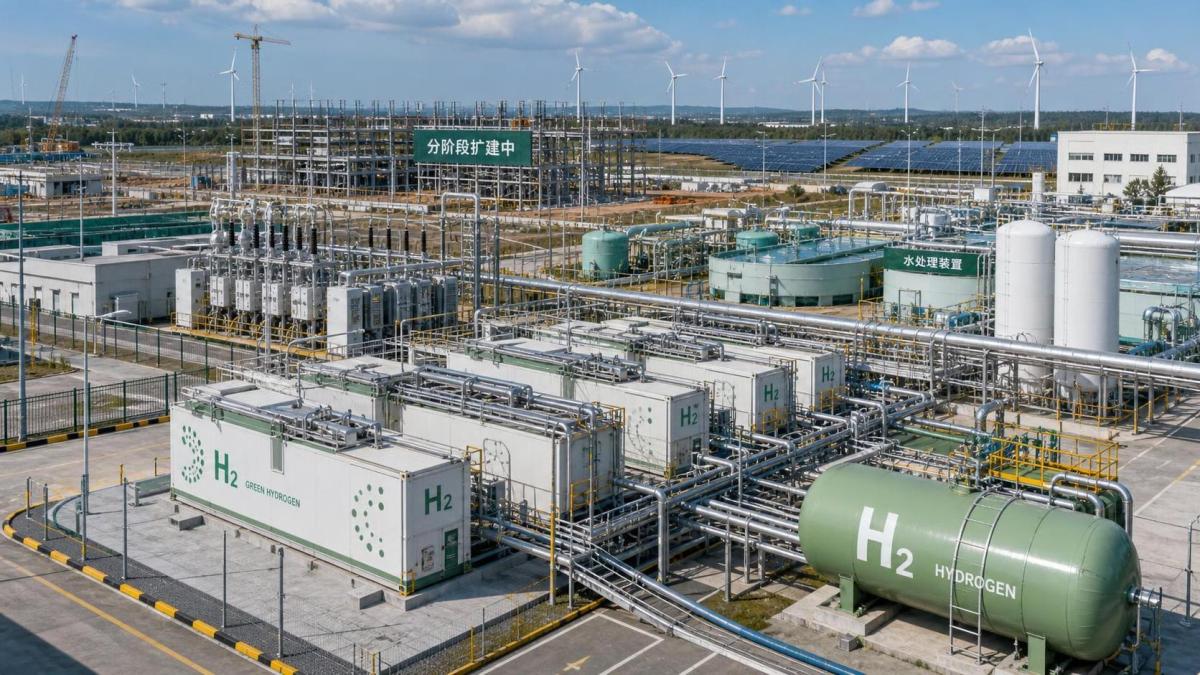
When modular electrolyzer systems make sense for phased hydrogen projects
auth.Robert GreenTime
Aug 21, 2026Click Count
For project teams planning hydrogen capacity in stages, modular electrolyzer systems are often presented as the obvious low-risk route. That is only partly true. Modularity can reduce early capital exposure and ease expansion planning, but it also introduces design, integration, and commercial trade-offs that become visible only once a project moves from concept to execution.
For phased hydrogen projects, the real question is not whether modularity is “better” than a large centralized plant. It is whether a modular architecture matches the project’s uncertainty profile: uncertain offtake, evolving grid access, water treatment constraints, site limitations, financing gates, or policy timing. When those variables are still moving, modular deployment can be a practical way to preserve schedule and avoid stranded capacity. When the fundamentals are already firm, it may add unnecessary balance-of-plant complexity and cost.
The strongest case for modular electrolyzer systems usually appears in projects where demand, infrastructure, and permitting do not arrive at the same pace.
Why phased hydrogen projects create a different design logic
Large hydrogen projects are rarely delayed because the electrolyzer stack alone is unavailable. More often, the bottlenecks sit elsewhere: interconnection upgrades, renewable generation buildout, substation reinforcement, raw water sourcing, demineralization systems, compression and storage scope, pipeline tie-ins, or confirmed offtake contracts. In many cases, the hydrogen plant is technically ready before the surrounding infrastructure is commercially or physically ready.
That matters because traditional single-build project logic assumes a relatively stable end-state. Capacity is designed around the full future output, and the project absorbs the cost of building for tomorrow on day one. In green hydrogen, that assumption is often weak. Power pricing may be uncertain. Renewable availability may improve over time. A downstream ammonia, methanol, refinery, mobility, or industrial user may ramp consumption in steps rather than at full nameplate. Regulatory support can also arrive in phases, especially where hydrogen incentives depend on carbon accounting rules or power sourcing criteria that are still evolving.
Under those conditions, a phased project structure is not just a financing preference. It becomes a way to align engineering scope with what is actually executable.
Where modular electrolyzer systems make the most sense
Modular systems are most compelling when a project has a credible long-term growth path but a staggered near-term reality. Several situations stand out.
Early-stage demand is real but not fully contracted. This is common in industrial decarbonization projects where an anchor offtaker is prepared to take initial volumes, but expansion depends on later process conversions or additional customers. A smaller first phase allows the developer to establish operating history and secure later demand without overcommitting capital.
Grid or renewable capacity will expand in tranches. Many hydrogen projects are constrained by initial interconnection capacity or by the staged buildout of solar, wind, and storage assets. Installing electrolyzer capacity in modules allows the plant to follow actual power availability rather than theoretical full build-out assumptions.
Water infrastructure needs time to scale. Electrolysis may be discussed primarily in power terms, but water treatment, wastewater handling, and local permitting can become hard constraints. A modular deployment can buy time to validate source reliability, pretreatment design, and discharge compliance before scaling.
Remote or infrastructure-limited sites need construction flexibility. In ports, mining zones, isolated industrial sites, and frontier markets, logistics and site-readiness often favor containerized or skid-based systems. Modularization can shorten onsite installation scope and reduce interface risk where heavy field construction is difficult.
Financing is milestone-based. Some projects can secure funding for a first commercial phase but not for full ultimate capacity. In that case, modularity is not just an engineering choice; it is a bankability tool. It can help match capex deployment to debt drawdowns, performance guarantees, and offtake maturity.
Technology risk is still being managed. In markets where developers want optionality between PEM, alkaline, or future stack improvements, phased procurement can prevent locking the full plant into one technology generation too early. That said, this is useful only if the balance-of-plant design preserves compatibility and does not create a patchwork of hard-to-integrate subsystems.

What project managers gain from modular deployment
The value of modularity is often described too loosely as “flexibility.” In practice, project managers benefit in a few very specific ways.
Lower initial exposure to wrong-size decisions. If hydrogen demand, power cost, or utilization profile is uncertain, building a smaller first phase reduces the penalty of being wrong. An oversized plant can sit underutilized while still carrying depreciation, maintenance obligations, and fixed balance-of-plant costs.
Better sequencing of permits and interfaces. Many hydrogen developments involve multiple counterparties: utilities, renewable developers, industrial offtakers, EPC firms, local authorities, water providers, and safety regulators. Phased deployment can simplify interface management by reducing what must be completed simultaneously.
Faster path to first hydrogen. A modular first phase can often reach mechanical completion and commissioning earlier than a large integrated build, especially if factory-assembled skids reduce field work. For projects under policy deadlines or seeking early operating data, time-to-first-production can be more valuable than full design capacity.
Operational learning before scale-up. Hydrogen projects still face a meaningful learning curve around transient operation, power quality response, water purity management, thermal control, degradation patterns, and maintenance planning. Running an initial phase creates site-specific data that improves later expansion decisions.
Procurement diversification. In some cases, modular deployment reduces concentration risk by spreading procurement across time rather than placing one large order under uncertain supply-chain conditions. This can be useful where stack lead times, power electronics availability, or local content rules are evolving.
Where modularity is overrated
Not every phased hydrogen project should default to modular electrolyzer systems. There are situations where a larger integrated design may be the more disciplined choice.
If the project already has secure long-term offtake, stable low-cost power, mature water infrastructure, and a clear permitting path, then excessive modularization can add unnecessary cost. Repeated package interfaces, duplicated auxiliaries, more complex controls, and incremental installation steps can erode the expected economic benefit.
It can also be misleading to compare modular systems purely on stack price or package price. The relevant comparison is whole-plant delivered hydrogen cost over the actual build sequence. A modular system may look cheaper in phase one but more expensive once later expansions require rework to utilities, civil scope, compression, or power distribution.
There is also a management illusion attached to modularity: the idea that future expansion will be simple because the first phase is modular. In reality, second-phase execution can become harder if the original site layout, pipe rack sizing, transformer capacity, water treatment footprint, control architecture, or safety zoning were not designed with the end-state in mind.
The key technical question: modular stacks or a modular plant?
This is one of the most important distinctions in project execution. Vendors may offer modular electrolyzer units, but the plant as a whole may not be truly expansion-ready.
A phased project only works smoothly if the original design intentionally separates what should be oversized on day one from what can be added later. Typical examples include:
- Site grading and access roads sized for final build-out
- Space allocation for future skids, transformers, rectifiers, and water systems
- Headers, manifolds, and utility corridors designed for expansion
- Control system architecture that can absorb later modules without major redesign
- Safety studies that consider future inventories and operating scenarios
- Electrical rooms, substations, and export interfaces evaluated for staged loading
If those items are ignored, modularity shifts cost into the future rather than reducing it. The first phase may look efficient on paper, but the second phase becomes a brownfield retrofit inside a live hydrogen facility. That usually means higher construction risk, more shutdown coordination, and more expensive tie-ins.
Commercial triggers that justify phased deployment
From a commercial standpoint, modular electrolyzer systems make the most sense when at least one of the following is true.
Revenue certainty lags construction readiness. If the project can be built before full offtake certainty exists, a smaller first phase can start monetization earlier while preserving upside.
Power economics are expected to improve. Where renewable capacity additions, grid tariff changes, or co-located storage will improve utilization later, building all electrolyzer capacity immediately may destroy economics in the early years.
Policy support is phased or conditional. Some subsidy frameworks, tax incentives, or clean fuel qualification rules depend on commissioning windows, emissions accounting, or domestic content thresholds. A first modular phase may secure timing advantages while allowing later phases to adapt to updated rules. Any project relying on such assumptions should flag them as jurisdiction-specific and verify current eligibility criteria.
Investors want proof before full commitment. In emerging hydrogen markets, lenders and boards often want operational evidence on efficiency, uptime, and offtake performance before backing expansion. A modular first phase can serve as a de-risking asset rather than just a production asset.
What to test before approving a modular strategy
For project managers, the decision should be stress-tested through execution questions, not only high-level business logic.
How much of the balance-of-plant must be installed upfront? If major electrical, water, compression, or safety infrastructure must be built almost to final scale from the start, the capex deferral benefit may be smaller than expected.
Will phase-two construction disrupt phase-one operations? If future tie-ins require shutdowns or safety restrictions that reduce production, expansion may be more disruptive than the business case assumes.
Does the control philosophy support mixed operating profiles? A staged plant may run modules differently based on power availability, maintenance cycles, and hydrogen demand. The control architecture must be designed for partial-load and incremental dispatch logic from the beginning.
Are vendor guarantees valid across staged expansions? Efficiency, degradation, and availability guarantees can become complicated when modules are added over time, particularly if later phases use updated equipment generations. Contract language needs careful review.
Is spare parts strategy still economical? Modularity can improve maintainability, but not if each phase introduces different stack versions, power electronics, or auxiliaries. Standardization across phases matters more than many developers initially expect.
Can the site support future hydrogen handling safely? Hazardous area classification, ventilation, vent stacks, fire protection, separation distances, and emergency response planning should reflect the ultimate build-out, not just phase one. Applicable codes and local authority requirements must be verified by jurisdiction and design basis; specific code selection is project-dependent and should be treated as 【待核实】 until confirmed for the site.
Common mistakes in phased hydrogen projects
One recurring mistake is assuming that modularity automatically lowers schedule risk. It can lower manufacturing and installation risk, but only if the project’s external interfaces are equally modular. If grid energization, water permits, or hydrogen offtake infrastructure remain on a single critical path, modular electrolyzer packages alone do not solve the real bottleneck.
Another mistake is underestimating the cost of future integration. Expansion-ready claims should be tested against real drawings, not brochure language. A project that saves money in phase one by undersizing pipe racks, cabling routes, drainage, or control room capacity may repay that “saving” several times over during expansion.
A third mistake is evaluating modularity only through capex optics. For hydrogen projects, utilization drives economics. If modularity allows the first phase to run at higher utilization with firmer demand and better power matching, it may outperform a larger plant with lower load factors—even if the unit capital cost is higher. That is the comparison worth making.
When the answer is yes
Modular electrolyzer systems are a strong fit when hydrogen production must grow with the surrounding ecosystem rather than ahead of it. They make sense when project timing is constrained by phased offtake, staged renewable power, uncertain infrastructure readiness, or financing that unlocks progressively. They are especially useful when a project team wants to get to first hydrogen without pretending that every long-term dependency is already settled.
They make less sense when the project fundamentals are already mature, scale is certain, and the plant can be built efficiently as an integrated asset from the outset.
For project managers, the practical decision test is straightforward: if phased deployment improves bankability and execution without creating expensive future rework, modularity is doing its job. If it merely postpones unresolved engineering decisions, it is not reducing risk—it is relocating it.
Recommended News
- 00
0000-00
When modular electrolyzer systems make sense for phased hydrogen projectsModular electrolyzer systems can cut early risk in phased hydrogen projects—but only when demand, power, and infrastructure remain uncertain. Learn when modularity drives smarter growth. - 00
0000-00
EN 50617:2026 Takes Effect for H2 Frontier ImportsEN 50617:2026 takes effect on H2 Frontier imports from 1 Nov 2026, requiring PEM electrolyzer dynamic load testing and third-party reports. See the EU compliance impact. - 00
0000-00
Australia Opens PEM Electrolyzer Dumping ProbeAustralia opens a PEM electrolyzer dumping probe targeting China, with a preliminary 18.7% margin. See what exporters, buyers, and supply chains should watch before the December 2026 ruling.
000000-00
{item.title}{item.description}Search News
Industry Portal
Hot Articles
- What determines the solar tracker price for utility-scale projects?Solar tracker price for utility-scale projects depends on steel, site conditions, controls, logistics, installation, and lifecycle value. Learn how to compare proposals wisely.
- Which machinery parts wear fastest in solar tracker drive systems?Machinery parts in solar tracker drive systems wear fastest at slew drives, bearings, motors, and couplings. Discover warning signs and maintenance tips.
- How grid monitoring systems improve outage response in the Middle EastDiscover how grid monitoring systems Middle East utilities use to locate faults faster, prioritize critical loads, and improve outage response across complex power networks.
Popular Tags