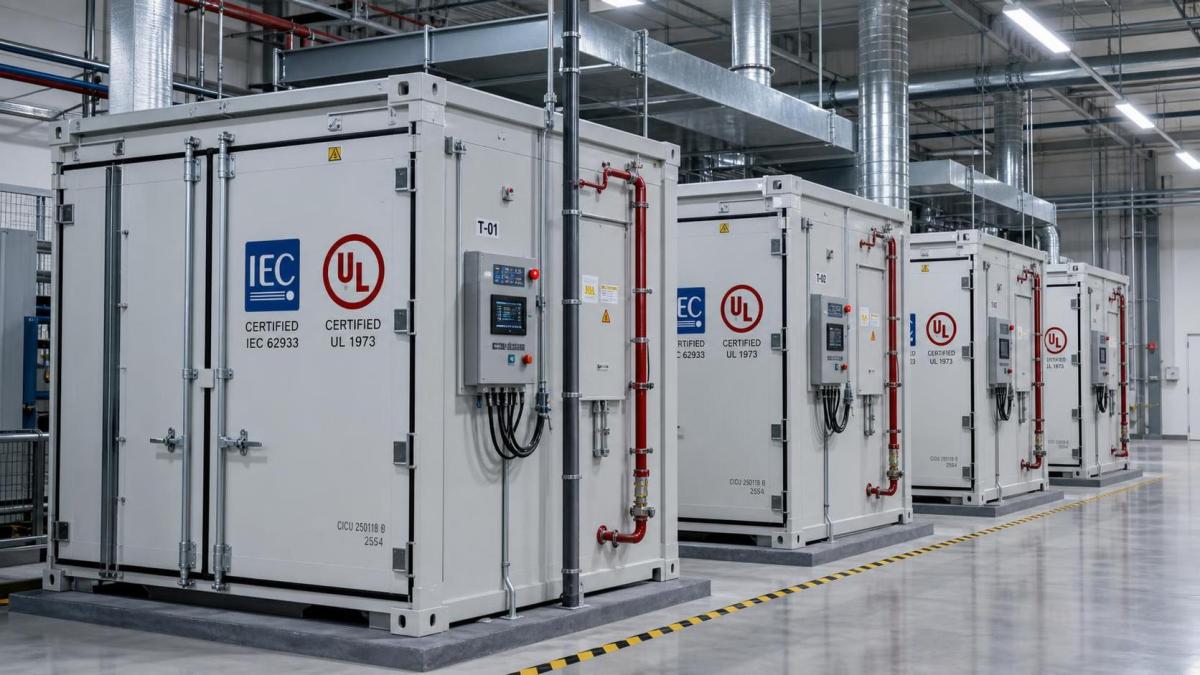
How to Evaluate a Containerized Energy Storage Exporter for Grid and C&I Projects
auth.Dr. Elena VoltTime
Aug 11, 2026Click Count
Choosing a containerized energy storage exporter for grid or commercial and industrial projects is rarely a simple sourcing exercise. For procurement teams, the supplier decision sits at the intersection of technical risk, logistics execution, project financing, and long-term serviceability. A low ex-works price can quickly lose its appeal if the system faces permitting delays, certification gaps, thermal derating, integration problems, or weak after-sales response after commissioning.
That is why serious buyers now evaluate exporters less as equipment traders and more as delivery partners for a regulated infrastructure asset. In utility-scale, microgrid, and C&I deployments, the container itself is only the visible layer. What matters underneath is battery architecture, fire safety design, controls integration, manufacturing discipline, export execution, and the exporter’s ability to support the project through acceptance testing and operation.
The key procurement question is not simply “Who can ship a battery container?” It is “Which exporter can deliver a compliant, bankable, operable system with manageable lifecycle risk?”
Start with project fit, not supplier brochures
Before comparing exporters, buyers need a clear internal definition of the project. Many sourcing mistakes happen because procurement launches an RFQ around headline capacity rather than the actual application profile.
A 20-foot or 40-foot battery container can be configured for very different use cases: peak shaving, renewable firming, demand charge reduction, backup power, frequency support, capacity services, or isolated microgrid stabilization. The right exporter for one use case may be a poor fit for another.

Procurement teams should align early with engineering, EPC, and asset management on a few practical points:
- Required energy duration and cycling profile
- Grid interconnection conditions and local code requirements
- Ambient temperature range and site altitude
- AC-coupled or DC-coupled integration approach
- Expected warranty throughput and project life
- SCADA, EMS, PCS, and transformer integration scope
- Fire suppression and emergency response expectations
- Delivery terms, installation sequence, and commissioning responsibility
Without this baseline, exporters can submit technically compliant-looking offers that are not commercially comparable. One may price a fully integrated system with PCS, HVAC, fire suppression, EMS support, FAT, and remote diagnostics, while another may quote battery containers only. On paper they are both “ESS suppliers.” In practice they represent very different project risks.
Certification is not a paperwork issue; it is a project viability issue
For grid and C&I projects, compliance is one of the first filters. Buyers should treat certification review as a technical and commercial gate, not a post-award formality.
The exact requirements depend on market and application, but typical review areas include battery cell certification, system-level safety testing, transport compliance, electrical conformity, and sometimes grid-code-related interfaces. Depending on destination market, references to IEC, UL, IEEE, NFPA, UN transport rules, and local interconnection requirements may all be relevant. The precise certification package must be verified against the project jurisdiction and utility requirements.
What procurement should check is not only whether certificates exist, but whether they match the offered configuration. A common risk in cross-border sourcing is that exporters present certificates tied to a different cell model, enclosure layout, PCS brand, or fire suppression arrangement than the actual offer. Another issue is reliance on test reports where the project actually requires formal certification or local approval.
Useful questions include:
- Are the certificates issued for the same system architecture being offered?
- Do they cover the installed components or only subassemblies?
- Who holds the certificates: the cell maker, integrator, or third-party OEM?
- Will any local recertification or AHJ review still be required?
- Can the exporter support technical submission during permitting and interconnection?
If an exporter answers these questions vaguely, the price advantage should be discounted immediately. Permitting delays and redesign costs can easily exceed the initial savings.
Battery cell sourcing tells you more than the nameplate capacity
In containerized ESS, many exporters are assemblers rather than cell manufacturers. That is not inherently a problem, but it changes what procurement must validate.
The exporter should disclose the battery cell supplier, chemistry, form factor, production traceability, and supply continuity plan. For most current projects, lithium iron phosphate remains the dominant chemistry in stationary storage because of its safety and cycle-life profile, but not all LFP supply is equivalent. Cell consistency, lot traceability, and quality control discipline materially affect field performance.
Procurement should look beyond advertised cycle life. Cycle-life figures are often based on specific temperature, depth-of-discharge, and charging conditions that may not reflect real project duty. A more meaningful review covers:
- Cell supplier tier and bankability
- Historical deployment record in stationary ESS
- Degradation assumptions under the proposed duty cycle
- Warranty structure based on years, throughput, retained capacity, or combinations
- Availability of replacement cells with matching characteristics over time
An exporter that cannot clearly explain its cell replacement strategy creates a future operations problem. In large projects, warranty replacement is not only a technical question but also a fleet management issue.
Thermal management is where many low-cost offers become expensive
For buyers comparing bids, thermal management is one of the most underpriced risks. A containerized battery system may look equivalent on paper while using very different cooling strategies and control logic.
Air-cooled systems may suit some moderate-climate C&I applications, but buyers should test whether the design can maintain cell temperature uniformity under expected load and ambient extremes. Liquid-cooled systems often carry a higher initial cost but may offer better thermal consistency, more stable performance, and improved lifecycle outcomes in demanding duty cycles or high-temperature locations.
The evaluation should not stop at the label “liquid cooling” or “HVAC included.” Ask for operating temperature envelopes, auxiliary power consumption, thermal runaway propagation mitigation, maintenance intervals, and derating behavior. In hot climates, poor HVAC design can materially reduce usable energy and accelerate degradation. In colder climates, heating strategy and startup behavior matter just as much.
Procurement teams should also verify whether the exporter has field references in comparable environmental conditions. A thermal design proven in coastal Europe does not automatically translate to the Middle East, Southeast Asia, inland mining sites, or high-altitude projects.
Safety architecture should be reviewed at system level
Battery safety is often discussed in broad terms, but purchasing decisions require system-level scrutiny. The relevant question is not whether the exporter claims the system is safe. It is how the safety architecture detects, isolates, suppresses, and communicates abnormal conditions.
Areas that deserve direct review include:
- Cell, module, rack, and container-level monitoring strategy
- Gas detection and early warning mechanisms
- Thermal runaway propagation resistance
- Fire suppression medium and activation logic
- Emergency shutdown and isolation design
- Ventilation and pressure relief approach
- Coordination with site-level fire systems and emergency procedures
Buyers should ask for failure mode documentation, protection logic descriptions, and lessons learned from prior incidents if applicable. Not every exporter will disclose everything, but the level of transparency is itself informative. Suppliers with mature designs tend to explain safety philosophy clearly. Weaker exporters often rely on generic assurances and broad references to compliance.
Integration capability often separates exporters from real solution providers
Many procurement problems emerge after the equipment arrives, when the project team discovers that integration responsibilities were never fully defined. For grid and C&I projects, containerized storage is not a standalone product. It must operate with PCS, transformer, EMS, SCADA, protection systems, utility communication layers, and often on-site generation.
An exporter should be evaluated on its ability to support this integration, whether directly or through a named technical partner. Key questions include:
- Which PCS brands and models has the exporter integrated before?
- What communication protocols are supported?
- Who owns EMS logic and dispatch control boundaries?
- Can the exporter support grid-code testing and commissioning documentation?
- Is there a clear single point of responsibility for controls issues?
For procurement, this matters because interface disputes can become costly claims. If the battery exporter, PCS vendor, EMS provider, and EPC each blame another party during commissioning, the buyer bears the schedule risk. Strong exporters reduce that risk by defining interfaces clearly, providing tested compatibility, and participating actively in FAT and site acceptance.
Manufacturing discipline matters more than factory size
Factory visits and audits still matter, but buyers should be careful not to equate large facilities with robust quality systems. In containerized ESS, the exporter’s process discipline is often more important than showroom scale.
Useful indicators include:
- Incoming inspection procedures for cells, BMS components, and electrical hardware
- Serial number traceability from cell to rack to container
- Documented assembly and torque control processes
- Insulation, high-voltage, and functional testing procedures
- Factory acceptance testing scope and witness options
- Nonconformance handling and corrective action records
If procurement cannot visit in person, a remote audit with a structured checklist is still better than relying on presentation decks. Ask for actual quality records, not just ISO certificates. ISO management certification may indicate process maturity, but it does not prove the exporter can build reliable ESS containers at consistent quality.
Export experience is a separate competency from product assembly
A technically capable supplier may still be a weak exporter. For overseas projects, documentation discipline, packaging, hazardous goods handling, customs coordination, and schedule communication all affect project success.
Procurement should review the exporter’s track record with international shipments of battery systems, including:
- Experience with destination-country customs and import documentation
- UN transport compliance and dangerous goods handling
- Marine packaging and corrosion protection measures
- Container securing, shock monitoring, and transit insurance coordination
- Spare parts packing strategy and replacement shipment lead times
This is particularly important for utility and remote industrial projects, where a missing document or damaged subcomponent can delay energization for weeks. The stronger exporters usually have standard export documentation packs, clear Incoterms capability, and internal teams that understand battery shipment requirements rather than treating them as routine cargo.
After-sales support should be priced into the decision, not appended to it
For procurement teams focused on capex, after-sales support is sometimes left as a secondary negotiation point. In practice, it is part of the real delivered cost.
A containerized ESS supplier should be able to explain the support model in operational terms: remote monitoring, alarm handling, spare parts strategy, firmware management, field service response, and warranty claim process. Time zone support and language capability also matter for cross-border projects.
Ask specific questions:
- What data can be accessed remotely, and by whom?
- What are the response commitments for critical faults?
- Which spare parts are recommended on day one?
- Can local technicians be trained and certified?
- How are software updates validated and deployed?
Some exporters quote aggressively because they assume minimal lifecycle service responsibility. That can work for buyers with strong in-house technical teams, but it is a poor fit for owners who need dependable long-term vendor support.
Bankability and references deserve a practical review
Procurement does not need to apply the same lens as project finance, but bankability still matters. If the exporter is financially weak, dependent on unstable upstream supply, or unable to honor long-duration warranties, the buyer inherits latent risk.
Useful evidence includes shipped project references, repeat customers, disclosed major component partners, and responsiveness during technical due diligence. Reference projects should be checked for similarity in scale, climate, application, and grid environment. A supplier with many small behind-the-meter installations is not automatically qualified for utility-scale dispatch applications.
Buyers should also distinguish between “installed,” “shipped,” and “commissioned” references. These are not the same. Where possible, request references that are operational for at least 12 months and ask about performance stability, service quality, and issue resolution.
Total cost of ownership is the only price comparison that matters
Procurement teams under budget pressure are often pushed toward the lowest upfront offer. That is understandable, but in energy storage the better comparison is total cost of ownership across contract term and expected operating life.
Relevant cost drivers include:
- Usable energy versus nominal energy
- Round-trip efficiency under actual operating conditions
- Auxiliary consumption from cooling and controls
- Expected degradation and augmentation needs
- Warranty coverage limitations
- Integration and commissioning scope exclusions
- Service contract cost and spare parts exposure
- Downtime risk and performance liquidated damages exposure
Two exporters with similar container prices can have very different lifecycle economics once efficiency, degradation, augmentation timing, and serviceability are modeled. A disciplined procurement process should ask engineering or an independent advisor to normalize these assumptions before final award.
What usually goes wrong in exporter selection
The most common buyer errors are not technical ignorance. They are process failures.
One is treating the RFQ as a simple equipment tender when the project actually requires integrated system responsibility. Another is evaluating compliance only after commercial ranking, by which point the cheapest bid has already shaped internal expectations. A third is accepting generic reference lists without checking whether the exporter delivered the same configuration being offered.
There is also a persistent misconception that containerized ESS is becoming fully commoditized. Prices have certainly become more competitive, and some hardware layers are increasingly standardized. But execution quality, controls integration, safety design, and service capability remain highly uneven across exporters. Procurement teams that ignore those differences often discover them during installation or in the first year of operation.
A practical decision standard for buyers
The most reliable containerized energy storage exporter is not necessarily the cheapest, the largest, or the one with the most polished presentation. It is the supplier that can demonstrate fit with the project duty cycle, valid compliance for the target market, disciplined manufacturing, proven integration capability, and credible long-term support.
For procurement, the job is to reduce avoidable risk before the purchase order is issued. That means forcing comparability across bids, verifying the exact offered configuration, and assigning commercial value to technical robustness. In grid and C&I storage, good sourcing is less about negotiating the lowest container price and more about buying a system that can be permitted, shipped, commissioned, and operated without unpleasant surprises.
In today’s market, that discipline is often the difference between a battery project that reaches stable revenue operation and one that spends its early life trapped in claims, delays, and underperformance.
Recommended News
- 00
0000-00
How containerized ESS can reduce diesel dependence in Latin AmericaContainerized ESS Latin America solutions reduce diesel use, improve resilience, optimize solar, and lower fuel costs for remote and weak-grid operations. - 00
0000-00
How to size utility-scale energy systems for battery storage projectsUtility-scale energy systems for battery storage: learn how to size power, energy, interconnection, and lifecycle performance for bankable projects. - 00
0000-00
How to Evaluate a Containerized Energy Storage Exporter for Grid and C&I ProjectsContainerized energy storage exporter evaluation made practical: compare certifications, safety, integration, export capability, and after-sales support to choose a bankable partner for grid and C&I projects.
000000-00
{item.title}{item.description}Search News
Industry Portal
Hot Articles
- What determines the solar tracker price for utility-scale projects?Solar tracker price for utility-scale projects depends on steel, site conditions, controls, logistics, installation, and lifecycle value. Learn how to compare proposals wisely.
- Which machinery parts wear fastest in solar tracker drive systems?Machinery parts in solar tracker drive systems wear fastest at slew drives, bearings, motors, and couplings. Discover warning signs and maintenance tips.
- How grid monitoring systems improve outage response in the Middle EastDiscover how grid monitoring systems Middle East utilities use to locate faults faster, prioritize critical loads, and improve outage response across complex power networks.
Popular Tags