What energy storage stability testing reveals about long-term battery safety
auth.Dr. Elena VoltTime
Aug 18, 2026Click Count
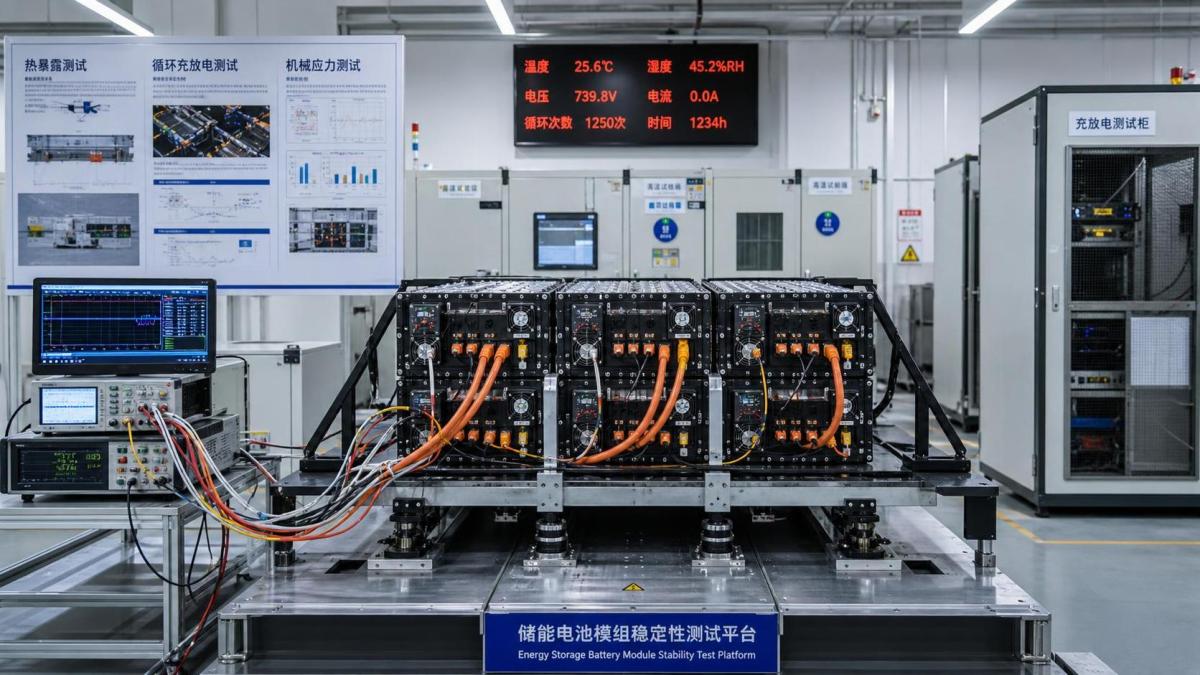
Energy storage stability testing reveals whether a battery remains predictable after thermal exposure, repeated charge-discharge cycling, mechanical stress, and long dwell periods at partial or full state of charge. For long-term safety, the most valuable result is rarely a single pass or fail. The deeper signal is the change in behavior across test stages: a widening temperature delta between cells, a delayed voltage recovery after rest, a rise in impedance after storage, or gas generation that appears only under combined stress. Each of those shifts can indicate that the system still operates, yet has started moving toward internal degradation pathways that may later produce swelling, leakage, isolation faults, nuisance shutdowns, or thermal runaway propagation.
In practice, energy storage stability testing sits between material qualification and field reliability. It translates laboratory measurements into a safety picture that can be used during procurement review, incoming inspection, assembly validation, transport release, commissioning, and maintenance planning. A cell chemistry may look stable in nominal electrical tests while still responding poorly to heat soak, overcharge margin, low-temperature charging, or vibration. That mismatch is where long-term battery safety problems often begin, because systems are installed and operated according to nameplate capability, while the real hazard is hidden in how aging changes the battery’s tolerance window.
Why stability matters after the first few months
Early-life battery performance can be deceptively clean. Fresh cells are balanced, electrolyte distribution is uniform, separator integrity has not yet been challenged, and interface films are still within expected thickness. Over time, side reactions alter that condition. Lithium plating may occur under cold charging or high current pulses. Electrolyte may decompose faster in local hot spots. Mechanical expansion and contraction can stress tabs, current collectors, welds, busbars, and interconnects. In large stationary systems, even a minor mismatch among parallel strings can create persistent current imbalance, causing one group to age faster and run warmer. Stability testing is useful because it exposes these trends before they mature into field incidents.
A common misread is to treat capacity retention as the main safety indicator. Capacity loss matters, but a battery can retain a large share of usable energy and still become less safe. Internal resistance growth, self-heating during cycling, drift in open-circuit voltage during storage, and increased venting tendency under abuse are often more relevant to incident prevention than remaining ampere-hours alone. A stable system is one whose degradation remains bounded and observable. An unstable one may still pass routine performance checks while accumulating hidden defect energy.
What the core test categories actually reveal
Thermal stability tests show whether the cell and pack architecture can tolerate expected and off-normal temperature exposure without entering self-accelerating reactions. Differential scanning calorimetry, accelerating rate calorimetry, oven exposure, and thermal ramp tests do not serve the same purpose. Some identify exothermic onset temperature in active materials; others reveal whether module spacing, insulation, vent paths, and cooling design can delay or limit event propagation. When onset behavior shifts lower after aging, that is a serious warning sign. It suggests the battery may have developed internal conditions that reduce thermal margin even if routine cycling data still appears acceptable.
Cycle-life stability testing is often interpreted only through end-of-test capacity. The more revealing output is the shape of degradation during the run. A gradual, smooth fade suggests one kind of aging. Step changes after a storage interval, rapid heat rise during a specific state-of-charge band, or sudden divergence between matched channels suggest another. Those patterns can point to electrode cracking, loss of electrolyte wetting, unstable solid-electrolyte interphase growth, or contact resistance changes at welded joints. At pack level, abnormal divergence may indicate balancing logic that masks deeper mismatch rather than correcting it.
Calendar aging tests matter because many stationary systems spend long periods at elevated state of charge while waiting for dispatch. High SOC storage can amplify parasitic reactions and gas generation, especially when enclosure temperatures rise above design assumptions. A battery may show acceptable cycling endurance yet age poorly in standby-heavy duty profiles. Stability testing under realistic storage conditions reveals whether the risk lies in operation, inactivity, or the transition between the two.
Mechanical and environmental tests fill another gap. Vibration, shock, altitude, humidity, salt exposure, dust ingress, and condensation can all change the electrical safety picture without immediately damaging output performance. A vent that functions in a clean chamber may clog in a dusty enclosure. A connector that passes continuity checks at room conditions may loosen after transport shock and thermal expansion. Water ingress may not trigger an immediate fault but can lower insulation resistance enough to create intermittent leakage current and tracking risk.

Signals that deserve more attention than the headline result
Several low-level findings are easy to dismiss during qualification because they do not always fail a specification line. They still matter.
- A repeating increase in cell-to-cell temperature spread during identical cycle segments often means thermal coupling or internal resistance mismatch is worsening.
- Rest voltage that recovers more slowly after high-rate discharge can indicate elevated polarization or transport limitations inside the cell.
- Pressure rise, swelling, or subtle dimensional growth after storage suggests gas generation, which may later compromise compression conditions and current distribution.
- Drift in insulation resistance after humidity or condensation exposure can point to seal weakness, contamination, or assembly residue rather than a single random defect.
- BMS logs showing frequent balancing intervention may hide underlying dispersion that should be investigated at cell and module level instead of accepted as normal control activity.
When those signals appear together, the concern is not simply reduced service life. The concern is loss of predictability. Safety management depends on knowing that failure thresholds remain distant under credible operating and fault conditions. Stability testing is where that confidence is either supported or weakened.
Material and design factors behind unstable results
Different cathode and anode systems age differently, but the practical question is how the material behavior interacts with assembly and thermal management. Electrode loading, coating uniformity, binder distribution, residual moisture, electrolyte formulation, separator shutdown behavior, and tab placement all influence stability outcomes. In pouch and prismatic formats, stack pressure and gas accommodation become part of the safety equation. In cylindrical assemblies, vent reliability and radial heat transfer deserve close attention. A design that is electrically strong may still create uneven cooling or local compression gradients that only become visible after extended testing.
Manufacturing variation can produce the same symptom as an unsuitable material choice. Trace metal contamination, burr formation during slitting, incomplete drying before electrolyte filling, poor wetting time, or inconsistent weld quality may remain dormant until the battery experiences a combination of high SOC, elevated temperature, and cycling stress. Stability testing is valuable because it tends to expose interaction effects. A single defect source might not trigger failure on its own, but layered with another variable it changes the degradation rate sharply.
Packaging and transport also influence the interpretation of test data. Cells or modules that pass factory acceptance may later arrive with altered compression, connector stress, or minor casing deformation after handling and long-haul shipping. If incoming inspection looks only for visible damage and open-circuit voltage, early warning evidence can be missed. Dimensional checks, insulation measurements, thermal imaging during controlled low-rate cycling, and comparison against shipping logger data can reveal whether stability was compromised before installation.
Where standard compliance ends and engineering judgment begins
Standards define important abuse, electrical, environmental, and fire-related test methods, but long-term battery safety cannot be inferred from certificate status alone. The pass criteria in a standard are usually designed to establish a minimum safety threshold under defined conditions. Real projects layer additional realities on top of that: enclosure heat recirculation, intermittent HVAC loss, site dust, unequal string loading, delayed maintenance, seasonal low-temperature charging, partial retrofit work, and software updates that modify control logic. Stability testing becomes more useful when the standard sequence is supplemented with application-specific stress combinations rather than treated as a complete representation of field life.
That is particularly relevant for liquid-cooled ESS configurations, where cooling performance depends not only on cell chemistry but also on flow balance, pump behavior, coolant quality, manifold cleanliness, and sensor placement. A thermal test that assumes uniform coolant delivery may overstate the margin if actual field conditions allow partial blockage or trapped air. Likewise, a module can pass propagation resistance testing in a fresh, well-assembled state and still become more vulnerable after years of seal aging, insulation embrittlement, or maintenance errors during replacement work.
Interpreting test results across the asset life cycle
The same test result means different things depending on timing. During supplier qualification, the goal is to identify stable design behavior and narrow process variation. During incoming acceptance, the focus shifts toward transport damage, storage condition drift, and lot-to-lot consistency. At commissioning, the important question becomes whether the installed system behaves like the tested reference after cabling, torqueing, coolant fill, software configuration, and site ambient exposure. Later in service, trend monitoring matters more than absolute numbers. A moderate impedance rise may be manageable if it is uniform; the same rise concentrated in one rack or one thermal zone is a different risk category.
This is where test method continuity matters. If pre-shipment, commissioning, and maintenance diagnostics use unrelated procedures, trend comparison becomes weak. Temperature probes located differently, current rates changed without normalization, or rest times shortened for convenience can blur the very signs that indicate emerging safety issues. Stability testing should therefore be treated as a controlled data chain, not as isolated events performed by different teams with different assumptions.
Common false confidence traps
One trap is accepting a stable average while ignoring distribution. Pack averages can look healthy even when a small subset of cells is drifting into a much narrower safety margin. Another is assuming that the absence of visible swelling or alarms means the system is stable. Many degradation mechanisms stay electrically quiet until a threshold is crossed. A third is over-relying on room-temperature data. Cold-charge behavior and high-ambient dwell can expose failure modes that never appear in standard indoor test windows.
There is also a tendency to separate safety data from maintenance records. That split hides useful correlations. A repeated coolant refill, a fan replacement pattern, unexplained communication dropouts, or recurring contactor replacement can all add context to stability findings. None of those signals proves a battery hazard on its own, but together they may show that thermal control, power electronics, and cell aging are interacting in a way that shortens the safe operating envelope.
Ultimately, energy storage stability testing reveals whether long-term battery safety remains robust after the battery has been exposed to realistic combinations of time, temperature, state of charge, current demand, and physical disturbance. The most important output is not reassurance; it is visibility into where margins are narrowing, where assumptions stop holding, and where a system that still functions has started to become harder to trust.
Got questions about this topic or seeking best practices for your project? Drop us a line below, and let Hengda Engineering's experts help you out.
Recommended News
- 00
0000-00
E3/DC Plans LG Battery Replacements After German Home Storage FireE3/DC plans LG battery replacements after a German home storage fire. Find out what the proposed batch-specific plan means for owners and installers. - 00
0000-00
China’s Planning and Energy Authorities Issue 15th Five-Year Energy Storage PlanChina’s 15th Five-Year Energy Storage Plan outlines a 2030 capacity target and pricing mechanism. Explore potential impacts on projects and procurement. - 00
0000-00
China Extends Suspension of Lithium Battery and Energy Storage Export ControlsChina extends its suspension of lithium battery and energy storage export controls through January 10, 2027. Explore what this means for trade planning.
000000-00
{item.title}{item.description}Search News
Industry Portal
Hot Articles
- How to calculate shipping capacity for containerized batteriesCalculate shipping capacity for containerized batteries with practical guidance on payload, dimensions, route limits and dangerous goods requirements.
- E3/DC Plans LG Battery Replacements After German Home Storage FireE3/DC plans LG battery replacements after a German home storage fire. Find out what the proposed batch-specific plan means for owners and installers.
- How does EV fleet load balancing prevent site power overloads?Discover how EV fleet load balancing prevents site power overloads, protects electrical equipment, and helps vehicles get the energy they need before departure.
Popular Tags