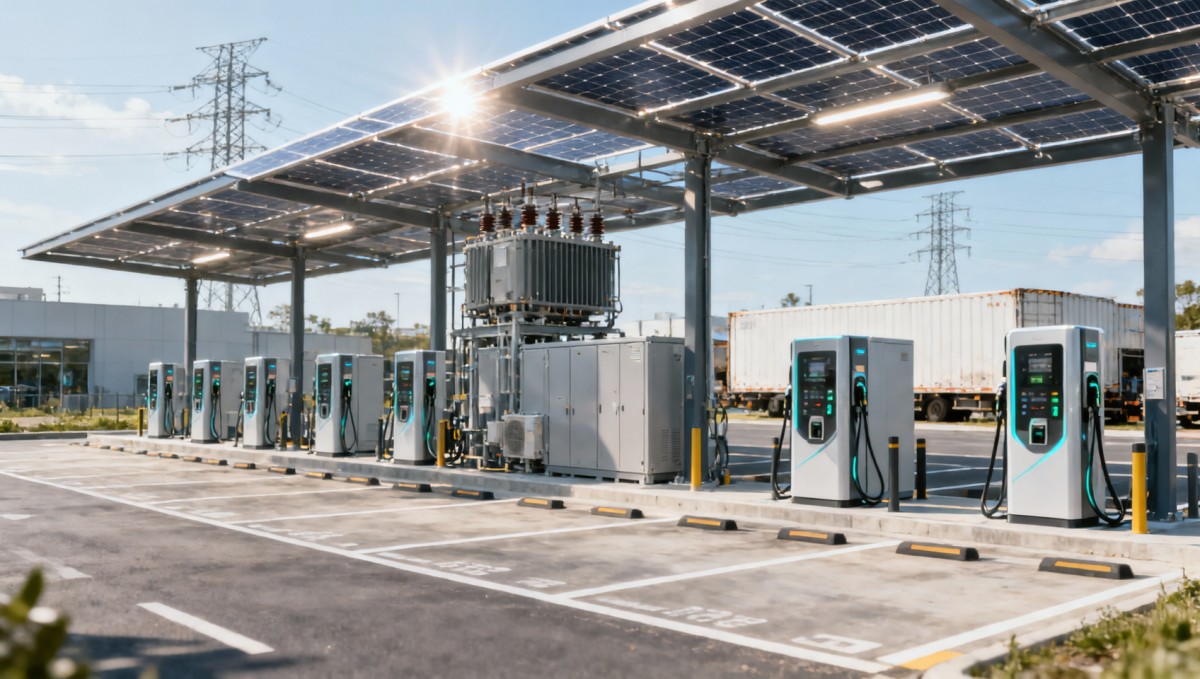
What Is Slowing the Energy Transition in Commercial Charging?
auth.Marcus WattTime
Apr 17, 2026Click Count
Commercial charging is a critical link in the Energy Transition, yet progress is often slowed by gaps in IEEE Compliance, UL Certification, and IEC Standards. As Electrification and Decarbonization accelerate, stakeholders must balance PV Efficiency, ESS Benchmarking, Energy Resilience, and Grid Modernization to build reliable, scalable infrastructure. Understanding these barriers is essential for operators and decision-makers seeking faster deployment and long-term performance.
For commercial site operators, fleet managers, EPC teams, and infrastructure planners, the challenge is no longer whether EV charging demand will grow, but how to deploy charging assets that remain technically compliant, financially viable, and grid-compatible over the next 5–10 years. In practice, delays often come from permitting complexity, transformer constraints, unclear load growth assumptions, and fragmented equipment standards rather than from charger hardware alone.
This article examines what is slowing the energy transition in commercial charging, with a focus on engineering, compliance, procurement, and operational realities. It also outlines practical selection criteria for buyers and operators who need scalable charging infrastructure aligned with modern power systems, distributed energy resources, and resilient commercial operations.
Why Commercial Charging Has Become a Critical Infrastructure Layer

Commercial charging is no longer a niche facility upgrade. It now sits at the intersection of transportation electrification, building energy management, and grid modernization. A depot with 20 vans, a retail center with 12 public chargers, or a logistics yard with 6 high-power DC units can materially change a site’s load profile, peak demand, and backup power strategy.
Unlike residential charging, commercial charging usually involves higher utilization, more demanding uptime targets, and a more complex approval path. A single AC charger in the 7 kW–22 kW range may be easy to install, but a multi-port DC fast charging site at 150 kW–350 kW per dispenser can trigger transformer upgrades, utility coordination, civil redesign, and additional protection studies.
The energy transition depends on commercial charging because fleets, workplaces, logistics hubs, parking operators, and mixed-use developments represent a large share of daily charging demand. These sites are also where charging can be integrated with solar PV, energy storage systems, and demand management software to reduce carbon intensity and improve operational flexibility.
However, the path from planning to commissioning often stretches from 6 months to 18 months, depending on grid access, permitting, equipment lead time, and inspection requirements. That timeline can undermine decarbonization goals, delay fleet conversion, and increase capital risk if site assumptions change before energization.
The difference between adding chargers and building infrastructure
Many project teams initially view charging as a hardware purchase. In reality, commercial charging is an infrastructure system involving switchgear, protection coordination, communications, billing logic, user authentication, cybersecurity, and long-term maintenance. If any one of these layers is under-specified, deployment slows down.
This distinction matters because a charging project that appears simple at procurement stage can become complex when utility fault current limits, cable routing, grounding methods, or interoperability requirements are reviewed. A site that expects 4 chargers today may need capacity planning for 12 chargers within 24–36 months.
Common commercial charging scenarios
- Fleet depots with overnight AC charging and limited daytime DC top-up needs.
- Public or semi-public parking sites requiring 99%+ service availability and payment integration.
- Logistics and delivery hubs needing 150 kW–350 kW fast charging under constrained grid capacity.
- Commercial buildings pairing chargers with rooftop PV and 250 kWh–2 MWh ESS for peak shaving.
The Main Barriers Slowing Deployment
The first major barrier is grid capacity. Many commercial sites were not designed for large, coincident charging loads. A site with a 500 kVA service may discover that only 120 kW–180 kW of spare practical capacity exists once HVAC, refrigeration, process equipment, and seasonal peaks are accounted for. That shortfall pushes projects into expensive utility upgrades.
The second barrier is standards and certification alignment. Buyers may focus on charger output and connector type, but deployment can be delayed if equipment documentation does not clearly support IEC standards, UL certification pathways, local code compliance, and IEEE-related grid interconnection expectations. This is particularly relevant when chargers are paired with transformers, ESS, or microgrid controls.
The third barrier is fragmented project ownership. In many organizations, facilities teams, sustainability leaders, fleet operators, finance, and IT all influence the purchase. Without a defined decision sequence, technical scope drifts. Network features are procured without checking cybersecurity requirements, or charger quantities are approved before site load studies are complete.
The fourth barrier is economics. A charger’s purchase price is only one part of total installed cost. Civil work, trenching, transformer upgrades, switchgear, communications, software subscriptions, and ongoing maintenance can add 40%–200% beyond equipment cost depending on site conditions. This makes under-scoped budgets one of the most common causes of delay.
Barrier comparison for operators and planners
The table below summarizes how the most common deployment barriers affect schedule, cost, and operational risk in commercial charging projects.
A key takeaway is that the slowest factor is often upstream design maturity, not charger assembly. Sites that complete utility screening, standards review, and capacity planning before final vendor selection usually move faster and face fewer change orders during construction.
Typical sources of hidden delay
- Permit packages submitted without finalized single-line diagrams or grounding details.
- Load forecasts based on current fleet size instead of 2-year or 3-year expansion plans.
- Charging software selected before payment, roaming, and access-control requirements are defined.
- Failure to account for ambient temperature, cable management, and enclosure ratings in outdoor sites.
Why Standards, Certification, and Interoperability Matter More Than Many Buyers Expect
Commercial charging infrastructure only scales when equipment, power systems, and operating procedures align. Standards are not a paperwork exercise; they shape safety, interoperability, maintainability, and bankability. When a charger, transformer, ESS, and monitoring platform come from different vendors, lack of standards alignment increases integration risk and slows energization.
IEC standards often influence design expectations in international projects, while UL certification can be central for equipment acceptance in many North American contexts. IEEE-related considerations become important when interconnection, power quality, grounding, communications, and grid behavior are involved. The more complex the site, the more these frameworks overlap.
Interoperability is equally important. A charger may technically deliver 180 kW, but if it cannot communicate cleanly with site energy management software, dynamic load balancing may fail. That can lead to nuisance tripping, uneven utilization, poor user experience, or stranded capacity. These issues are especially costly on sites with 10 or more ports sharing limited supply.
From a buyer’s perspective, the right question is not simply whether a component is compliant, but whether the entire system can be commissioned, monitored, and serviced without creating dependency on custom engineering every time the site expands.
What technical teams should verify before purchase
Before issuing a purchase order, operators should verify not only nameplate performance but also documentation quality, communication protocol support, environmental suitability, and commissioning requirements. The matrix below helps structure those checks.
For many operators, the most overlooked category is serviceability. If field replacement parts require 8–12 weeks, even a certified charger can become an operational bottleneck. Service SLAs, remote diagnostics, and modular repair paths should be part of the initial technical review rather than an afterthought.
A practical compliance checklist
- Confirm whether the charger, switchgear interface, and transformer arrangement fit the site’s voltage architecture.
- Review safety labeling, installation instructions, and field inspection expectations before civil work begins.
- Check whether firmware updates, metering, and remote access functions are supported over the full asset life cycle.
- Validate how the charger behaves under derating conditions, especially above 40°C ambient temperature.
The Role of PV, ESS, and Smart Grid Integration in Faster Charging Rollout
One reason the energy transition slows in commercial charging is that projects are still too often designed as standalone electrical loads. A more resilient approach is to treat charging as part of a distributed energy architecture that may include rooftop or carport PV, on-site ESS, smart transformers, and load orchestration software.
This integrated model can reduce grid upgrade pressure. For example, a site planning 600 kW of peak charging may use a 300 kWh–1 MWh battery system to smooth short-duration peaks and defer some infrastructure expansion. It does not eliminate the need for grid coordination, but it can improve deployment feasibility where utility timelines are long.
PV also changes the commercial equation, especially for daytime charging at workplaces, campuses, or retail destinations. Although solar output is variable, pairing PV with managed charging can reduce imported energy during sunlight hours and support decarbonization targets. In many practical designs, the biggest value is not full energy self-sufficiency but reduced peak demand and better asset utilization.
Smart grid integration adds another layer of value. Charging systems that can respond to tariffs, demand limits, and site energy priorities are better positioned for long-term scale. Operators should think in terms of 3 interacting layers: power equipment, control logic, and operating policy. If one layer is missing, infrastructure may be installed but not optimized.
When on-site energy systems make the most sense
Not every site needs PV or ESS from day one. The strongest use cases generally combine high utilization, constrained grid capacity, and clear operating windows. The following scenarios are often good candidates for integrated energy design.
- Fleet depots with predictable overnight charging and recurring utility demand charges.
- Commercial campuses that already have rooftop PV and need to electrify employee or service vehicles.
- Remote or resilience-sensitive facilities where backup capability matters as much as charging throughput.
- Urban sites where service upgrades are slow, costly, or physically constrained.
Integration priorities for operators
- Model 12-month load behavior, not just one-day peak snapshots.
- Separate critical charging demand from flexible charging demand.
- Define whether ESS is intended for peak shaving, resilience, or tariff optimization.
- Ensure controls can coordinate chargers, PV inverters, and site loads in near real time.
For decision-makers, the strategic point is clear: integrated design improves resilience and can accelerate feasible deployment, but only if engineering assumptions are tested against real site operations. Data-driven benchmarking across charger performance, ESS cycling, and PV contribution is often the difference between a scalable system and a costly pilot that cannot expand.
How to Procure Commercial Charging Infrastructure Without Creating Long-Term Risk
Procurement has a direct effect on deployment speed. Buyers that issue generic requests for “fast chargers” often receive proposals that are difficult to compare and even harder to integrate. A stronger process starts with site constraints, usage profile, compliance requirements, and expansion targets. Only then should charger rating, topology, and vendor scope be finalized.
A useful procurement framework includes at least 6 evaluation dimensions: electrical compatibility, certification readiness, software interoperability, service response, environmental durability, and total installed cost. For high-use sites, mean time to repair and parts availability can be just as important as charger efficiency or connector count.
Operators should also separate pilot logic from scale logic. A 2-port pilot can validate user behavior, but it may not reveal transformer loading patterns, queuing effects, software limitations, or maintenance burden seen at 10 ports or 20 ports. Procurement decisions should therefore include an expansion pathway, not only a first-phase bill of materials.
At the contract stage, practical clarity matters. Acceptance testing, training, spare parts, software licensing, remote diagnostics, and warranty boundaries should all be documented. Ambiguity in these areas frequently leads to disputes after commissioning, especially when multiple subcontractors are involved.
Buyer-side decision table
The table below provides a structured way to compare commercial charging offers beyond headline power rating or upfront equipment price.
A disciplined procurement process usually lowers total risk even if initial engineering effort is higher. For B2B operators, the goal is not simply to buy chargers quickly, but to buy an expandable charging system that performs reliably under real commercial duty cycles.
A 5-step procurement sequence
- Complete site load assessment and utility interface review.
- Define charging use case by vehicle dwell time, throughput, and growth horizon.
- Prequalify vendors on compliance, documentation, and service capability.
- Compare total installed cost, not just equipment quote.
- Lock commissioning, training, and support obligations into the contract.
Implementation Priorities, Common Mistakes, and Questions Operators Ask
Even well-specified projects can stall during implementation if operational realities are overlooked. Site traffic flow, charger accessibility, cable reach, weather protection, user authorization, and maintenance access all affect daily performance. A charger that looks ideal in a drawing set may create queuing or safety conflicts once vehicles begin circulating.
Another common mistake is optimizing for peak power while neglecting utilization strategy. In many fleet and workplace settings, managed charging at lower average power can deliver better economics than oversizing every port. The right mix depends on dwell time, fleet schedule, and service-level expectations rather than on nameplate output alone.
Operators should also plan for maintenance from day one. Preventive inspection intervals of 3 months, 6 months, or 12 months may be appropriate depending on use intensity, climate exposure, and equipment design. Dust ingress, connector wear, thermal derating, and communication faults are all manageable when monitored early.
For organizations seeking to accelerate deployment without sacrificing quality, the best approach is to combine engineering rigor with phased execution. That means designing infrastructure to scale, validating standards up front, and using operational data to refine later buildouts rather than treating every site as a one-off installation.
FAQ: What operators and researchers usually ask
How long does a commercial charging project usually take?
For smaller AC deployments, the timeline can be 8–16 weeks if utility capacity already exists. For larger DC fast charging projects, 6–12 months is common, and complex sites may take 12–18 months when transformer upgrades, permitting, and civil work are extensive.
What is the most overlooked factor in site planning?
Future load growth is often underestimated. A site designed for today’s 4 chargers may need 8 or 12 within 2 years. If conduits, switchgear space, and transformer planning are not sized for expansion, the second phase becomes slower and more expensive.
When should ESS be considered with commercial charging?
ESS becomes especially relevant when grid upgrades are slow, demand charges are material, or resilience is important. Typical commercial concepts range from a few hundred kWh to multi-MWh depending on charge cycles, duty profile, and site economics.
What should buyers focus on besides charger power rating?
Priority items include certification readiness, electrical compatibility, software interoperability, maintenance model, spare parts availability, and commissioning support. In high-use environments, uptime and response capability often create more value than a modest increase in peak charger output.
Commercial charging will continue to play a central role in the energy transition, but progress depends on more than installing more chargers. Grid constraints, compliance gaps, fragmented procurement, and weak integration planning remain the main reasons projects stall. The most resilient deployments are those built around verified engineering data, realistic load modeling, standards-aware equipment selection, and a clear expansion pathway.
For organizations evaluating EV charging infrastructure alongside PV, ESS, smart grid assets, or broader electrification plans, a data-driven technical approach reduces deployment risk and improves long-term performance. G-EPI supports this process by helping stakeholders benchmark hardware, interpret standards, and align charging projects with modern power infrastructure realities.
If you are planning a commercial charging rollout, upgrading an existing site, or comparing integrated energy solutions, now is the right time to assess technical fit before capital is committed. Contact us to get a tailored infrastructure perspective, explore system-level benchmarks, and learn more solutions for faster, more reliable deployment.
Recommended News
- 00
0000-00
Next-Gen Wireless Charging for Smartphones: What Improvements Matter Most?Next-gen wireless charging for smartphones: discover which upgrades truly matter most, from faster stable charging and lower heat to better efficiency, alignment, and battery protection. - 00
0000-00
What export trends signal for pricing in 2026?Export trends reveal 2026 pricing signals for solar PV, storage, EV charging, smart grids and hydrogen—helping buyers spot risks, value and timing. - 00
0000-00
Brent Crude Futures Surge Past $106/bbl, Raising DC Fast-Charging OpEx OutlookBrent Crude Futures surge to $106.38/bbl — what it means for DC fast-charging OpEx, solar+storage adoption, and high-power EV infrastructure planning.
000000-00
{item.title}{item.description}Search News
Industry Portal
Hot Articles
- What determines the solar tracker price for utility-scale projects?Solar tracker price for utility-scale projects depends on steel, site conditions, controls, logistics, installation, and lifecycle value. Learn how to compare proposals wisely.
- Which machinery parts wear fastest in solar tracker drive systems?Machinery parts in solar tracker drive systems wear fastest at slew drives, bearings, motors, and couplings. Discover warning signs and maintenance tips.
- How grid monitoring systems improve outage response in the Middle EastDiscover how grid monitoring systems Middle East utilities use to locate faults faster, prioritize critical loads, and improve outage response across complex power networks.
Popular Tags