Which connector do you need for a level 2 charger in North America?
auth.Marcus WattTime
Oct 13, 2026Click Count
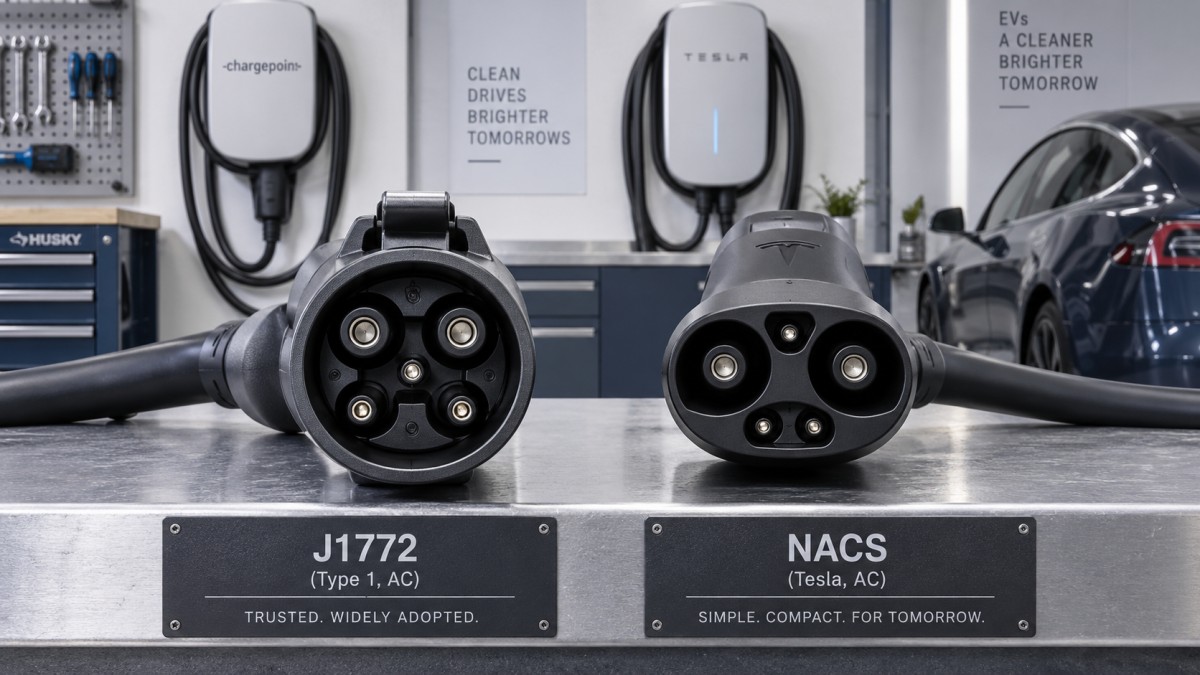
Choose a J1772 connector for a vehicle with a J1772 or CCS1 charging inlet, and a NACS connector for a vehicle with a NACS inlet. NACS is standardized as SAE J3400. If the charger and vehicle use different connectors, an adapter approved for that vehicle and for AC charging can bridge the connection. Identify the port on your exact vehicle before ordering: a manufacturer’s broader connector plans do not establish what is fitted to a particular model.
The vehicle connector and the charger’s household power plug are separate choices. J1772 and NACS describe the connection to the car. A designation such as NEMA 14-50 describes a receptacle supplying electricity to the charging equipment. Getting one right does not resolve the other.
Start with the charging inlet on your vehicle
The most reliable starting point is the charging section of the owner’s manual, supported by a look inside the charge-port door. Use documentation for the correct model year and market. Imported vehicles and vehicles sold during a connector transition deserve particular attention because a model name alone might not identify the inlet.
A J1772 inlet has five contact positions within a roughly round opening. A CCS1 inlet adds two large DC contacts below the J1772 section, giving the full inlet a taller outline. For Level 2 AC charging, a J1772 connector plugs into the upper section; the lower DC contacts remain unused.
A NACS inlet has a compact, five-contact layout. The same inlet accommodates AC charging and compatible DC fast charging, with the large power contacts serving different electrical functions in those modes. That shared shape makes it especially important to distinguish AC adapters from DC adapters.

A CCS1-equipped vehicle does not need a CCS1 cable for Level 2 charging. CCS1 describes the combined AC and DC inlet. Searching for a “CCS home charger” can lead to equipment outside the intended application when a conventional J1772 AC charger is the appropriate choice.
Choose native compatibility when the parking setup is predictable
For a home serving one vehicle, a charger with the matching connector gives the simplest daily routine. There is no separate adapter to retrieve, attach, or leave behind, and fewer connection points need inspection. This matters when the cable is handled frequently, exposed to weather, or used in a tight parking space.
A mixed-vehicle household creates a different decision. If one vehicle uses J1772 and another uses NACS, a single charger can serve both through an approved AC adapter, provided the charger permits that use and supports both vehicles. Choose the native connector around the vehicle charged most often, then confirm the adapter arrangement for the other car.
Some charging equipment offers interchangeable cable assemblies or an integrated adapter arrangement. Assess the actual product configuration: the permitted conversion method, replacement parts, connector storage, and electrical rating. A claim that equipment is “future-ready” does not establish that its cable can be changed safely or economically.
Public and workplace charging add another variable: access. A connector that fits does not guarantee that a station will authorize a session. Payment, account requirements, site restrictions, and equipment compatibility remain relevant. For a regularly used location, establish both the connector type and whether that station accepts your vehicle before relying on an adapter.
An AC adapter needs the right direction and rating
Adapter descriptions are easy to misread because sellers sometimes name the vehicle side first and sometimes the charger side. Read the connection diagram or compatibility instructions. The adapter must accept the connector on the charging cable and present the correct connection to the vehicle inlet.
For example, connecting a J1772 cable to a NACS vehicle requires an adapter with a J1772 receiving side and a NACS vehicle side. Reversing that arrangement requires a different adapter. Similar product names do not make the two interchangeable.
Approval for DC fast charging does not establish suitability for Level 2 AC charging. AC charging sends power to the vehicle’s onboard charger. DC fast charging supplies the battery through a different electrical path and uses different communication arrangements. An adapter supplied for access to a DC charging network should not be assumed to work with an AC station.
The adapter’s continuous AC current rating must support the intended charging current. If an adapter is rated below the charging equipment’s maximum output, use it only where the manufacturers permit the arrangement and provide a reliable way to enforce the lower limit. Do not assume an adapter automatically tells every charger to reduce current.
Vehicle approval and charger instructions should identify the permitted combination. A broad marketplace claim such as “fits all EVs” is weaker evidence than documentation naming the vehicle, charging mode, and electrical rating. Avoid stacking adapters: additional joints increase mechanical strain and create more opportunities for a loose or overheating connection.
The garage outlet is a separate selection
Level 2 charging uses AC power, commonly from a nominal 240-volt residential supply or a 208-volt supply in commercial and multifamily buildings. The wall connection feeds the charging equipment; the vehicle connector delivers controlled power to the car. A charger can therefore have a NEMA power plug at one end and either J1772 or NACS at the other.
Common plug-in arrangements include NEMA 14-50 and NEMA 6-50, but their names do not prove an existing outlet is suitable for EV charging. The circuit, conductors, receptacle condition, grounding, and installation requirements all need to support the sustained load. An outlet previously used for another appliance is not sufficient evidence by itself.
A hardwired charger connects directly to the electrical installation without a removable household plug. It still needs the correct vehicle connector. Hardwiring can also avoid a heavily loaded receptacle connection, although the appropriate installation method depends on the equipment instructions and local electrical requirements.
Have the proposed installation assessed before choosing the charger’s power-input version. Discovering that the available circuit cannot support the intended setting can mean changing equipment, reducing charging current, or revising the installation. Travel plug adapters and extension cords are not a substitute for a properly matched supply arrangement.
Connector shape does not determine charging speed
J1772 and NACS both support Level 2 AC charging. Switching between them does not inherently make a vehicle charge faster. Available power is limited by the supply, the charging equipment’s configured output, the cable and any adapter, and the vehicle’s onboard AC charger. Battery temperature and charging controls can further affect what the vehicle accepts.
The equipment commonly called a home “charger” is technically electric vehicle supply equipment, or EVSE. It controls the connection and signals the available current; the vehicle’s onboard charger converts incoming AC electricity for the battery. A higher-output wall unit cannot force the vehicle to exceed its onboard charging limit.
As a simple example, 240 volts at 32 amps provides approximately 7.7 kilowatts of AC input before conversion losses. At 208 volts, the same current provides approximately 6.7 kilowatts. These are electrical calculations, not promised battery charging rates. They explain why the same connector and current setting can deliver different power at home and at a workplace.
Also distinguish the branch-circuit rating from the permitted continuous charging current. A receptacle or breaker label is not automatically the charger’s operating setting. EV charging is a sustained load, and allowable current must follow the applicable installation rules and equipment instructions. An adjustable charger should be configured for the installed circuit before regular use.
When comparing equipment, read the vehicle’s maximum AC charging specification alongside the charger’s output. A large power figure in a vehicle brochure might describe DC fast charging, which does not establish how quickly it will charge from a Level 2 station.
Fit includes cable reach, latching, and everyday handling
A compatible connector still needs to reach the inlet without pulling sideways on it. Measure the cable route from the proposed mounting position to the charge port with the vehicle parked normally. Account for the port’s location, the cable’s usable length, and any route around the vehicle. A cable stretched across a walkway creates a different problem from a cable that is simply too short.
Adapters add length and weight at the inlet. In a confined garage, that extra projection can interfere with a wall, door, or normal access around the car. The connector and adapter should seat fully and latch as specified, with enough cable slack to avoid using the inlet as a support point.
For outdoor charging, examine the environmental suitability of the charging equipment and adapter separately. An outdoor-rated wall unit does not establish that every accessory has equivalent protection. Use the supplied holster or storage arrangement to keep disconnected contacts away from dirt and standing water.
Stop using a connection that shows melted plastic, discoloration, a burning smell, or unexpected heating. Damage can originate at the household receptacle, an adapter joint, or the vehicle connection, so inspection should cover the full power path. Forcing a connector into place or repeatedly retrying a damaged connection can worsen the fault.
Turn the port identification into a purchase specification
A useful equipment specification is concrete: “Level 2 AC EVSE with a J1772 vehicle connector,” or “Level 2 AC EVSE with a NACS vehicle connector,” followed by the installation method and permitted output. If an adapter is needed, identify its exact direction, AC suitability, continuous rating, and approval for the vehicle and charging equipment.
Before ordering, resolve any mismatch between the owner’s manual, the visible inlet, and the product listing. A statement that a vehicle can access a particular fast-charging network does not identify its native Level 2 connector. Likewise, a charger advertised as broadly compatible still needs a clearly specified cable end and any required adapter.
For a vehicle already in the driveway, its fitted inlet is the strongest basis for the decision. For a replacement vehicle on order, confirm the connector specified for that exact configuration. Choosing from those details keeps the charger, adapter, and electrical installation aligned with the car that will actually use them.
Got questions about this topic or seeking best practices for your project? Drop us a line below, and let Hengda Engineering's experts help you out.
Recommended News
- 00
0000-00
How does EV fleet load balancing prevent site power overloads?Discover how EV fleet load balancing prevents site power overloads, protects electrical equipment, and helps vehicles get the energy they need before departure. - 00
0000-00
Which connector do you need for a level 2 charger in North America?Level 2 charger North America guide: choose the right J1772 or NACS connector, check AC adapter compatibility, and avoid costly mistakes before you buy. - 00
0000-00
How many EV chargers does a hotel need for its parking capacity?EV Charging for hotels: discover how to size active ports, plan EV-ready spaces, manage electrical capacity, and create a scalable guest-friendly charging strategy.
000000-00
{item.title}{item.description}Search News
Industry Portal
Hot Articles
- E3/DC Plans LG Battery Replacements After German Home Storage FireE3/DC plans LG battery replacements after a German home storage fire. Find out what the proposed batch-specific plan means for owners and installers.
- How does EV fleet load balancing prevent site power overloads?Discover how EV fleet load balancing prevents site power overloads, protects electrical equipment, and helps vehicles get the energy they need before departure.
- China Sets 300 GW Energy Storage Target for 2030 in New PlanChina’s 300 GW energy storage target for 2030 signals a market shift. Explore the plan’s implications for grid stability, renewables and project developers.
Popular Tags