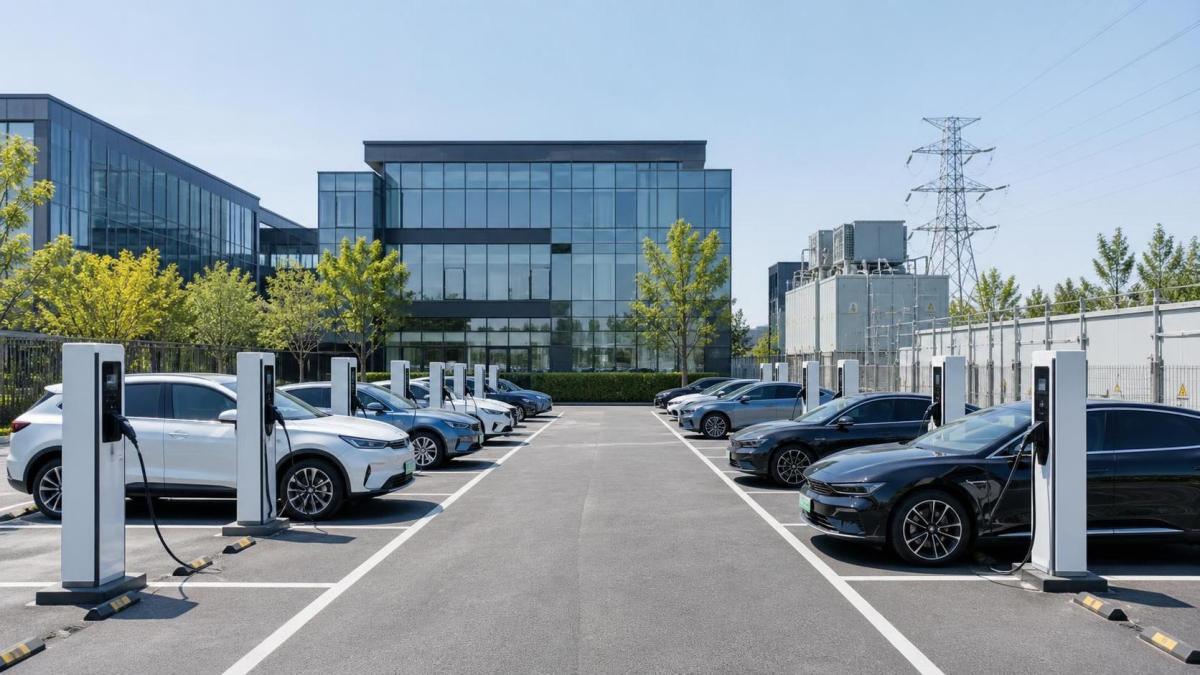
When does an AC charging station make more sense than DC fast charging?
auth.Marcus WattTime
Aug 26, 2026Click Count
For enterprise decision-makers planning EV infrastructure, choosing between an ac charging station and DC fast charging is not simply a matter of speed. It depends on vehicle dwell time, site power capacity, installation cost, grid impact, and long-term return on investment. In many commercial, fleet, workplace, and mixed-use scenarios, AC charging can deliver a more practical and scalable solution. This article explains when an ac charging station makes better operational and financial sense.
The most common mistake in EV charging planning is to treat charging speed as the primary decision criterion. In practice, infrastructure performance is measured less by peak power and more by how well charging behavior matches site behavior. If vehicles remain parked for hours, paying for high-power DC equipment often solves the wrong problem. The better question is not “How fast can the charger be?” but “How much usable energy must be delivered during the vehicle’s actual dwell window, and at what total system cost?”
That distinction matters because DC fast charging carries a very different cost structure. Beyond charger hardware, it often requires heavier electrical upgrades, more complex protection design, utility coordination, potential transformer expansion, demand charge exposure, and stricter thermal and maintenance planning. AC charging is usually far easier to deploy at scale, especially where the business objective is dependable energy replenishment rather than rapid turnover.
Where AC charging usually makes the stronger business case
An ac charging station tends to make more sense in environments where vehicles are stationary long enough to recover daily energy needs without high-power delivery. For passenger EVs used in commuting, staff parking, hotel stays, residential developments, corporate campuses, and overnight fleet depots, this is often the norm rather than the exception.
Consider a workplace parking facility where employees stay for eight to ten hours. In that setting, even relatively modest AC power can add meaningful range over a full workday. The enterprise gains broad access coverage across many parking spaces instead of concentrating capital into a small number of fast-charge points. For office owners, industrial parks, and commercial real estate operators, this can improve user satisfaction while keeping electrical infrastructure expansion more manageable.
Fleet operations show the same pattern when vehicles return to base on predictable schedules. Last-mile vans, municipal vehicles, service fleets, and company cars frequently do not require mid-route fast charging if overnight or shift-based charging is properly designed. If route planning allows sufficient dwell time, AC can support daily energy replenishment at a lower installed cost and with less operational stress on the site.
Hospitality and mixed-use destinations are another strong fit. Hotels, apartment complexes, hospitals, airports with long-stay parking, and conference venues generally benefit more from offering more charging ports at moderate power than a few expensive DC dispensers. In these settings, user value is based on charge availability during the stay, not on minimizing every minute spent connected.

The real decision variable is dwell time, not charger type
From a planning perspective, dwell time is the anchor variable. If the parking duration naturally exceeds the time required to replenish expected daily consumption, AC charging is often economically superior. This is especially true when utilization is distributed across many vehicles with moderate daily mileage.
Decision-makers should compare three numbers:
- the vehicle’s average daily energy use,
- the typical time it remains parked and available for charging,
- the site’s practical electrical capacity per parking space.
If those three align, an ac charging station can meet operational requirements without the capital burden of DC fast charging. For example, a fleet vehicle consuming moderate daily energy but parked overnight for 10 to 12 hours does not usually need a high-power charger. The value of DC is limited if the vehicle is idle anyway.
By contrast, DC fast charging becomes more justifiable when dwell times are short, asset utilization is high, and every hour of vehicle availability has measurable economic value. Public highway corridors, high-turnover retail sites, ride-hailing hubs, and time-sensitive logistics operations fall into that category. In those cases, charging speed is monetizable. In many enterprise sites, it is not.
Why AC often wins on total installed cost
Hardware price differences are only part of the picture. The larger financial advantage of AC often appears in the balance of system.
DC fast charging can trigger:
- larger service connection requirements,
- distribution board upgrades,
- transformer upsizing,
- civil works for dedicated equipment pads and cable routing,
- utility review and interconnection delays,
- higher commissioning complexity.
These costs can exceed the charger price differential itself, especially on legacy commercial sites not designed for high coincident EV loads. For enterprises operating across multiple locations, this becomes a scaling problem. A strategy that looks acceptable for one flagship site may become uneconomic when replicated across a portfolio.
AC charging usually allows more phased deployment. A business can start with a limited number of ports, observe usage patterns, and expand with lower incremental risk. This matters in markets where EV adoption is still growing unevenly. Overbuilding DC capacity too early can lock capital into underutilized assets.
For CFOs and infrastructure planners, the better comparison is not charger-versus-charger. It is cost per useful kWh delivered over the asset life, adjusted for expected utilization and upgrade requirements. In many low-to-medium utilization environments, AC compares very favorably on that basis.
Grid impact is often the hidden differentiator
Power availability is becoming a strategic constraint in many regions. Even where enterprises are willing to invest, utilities may not be able to provide rapid capacity expansion on the desired timeline. This is one reason AC charging remains highly relevant despite the market visibility of ultra-fast DC systems.
Lower-power, distributed AC installations are generally easier to integrate into existing site loads. They reduce peak demand pressure and can be managed through load balancing software, scheduled charging, and tariff-aware operation. That gives site operators more flexibility in controlling energy cost and avoiding unnecessary infrastructure reinforcement.
DC fast charging, particularly in multi-port configurations, creates concentrated load events. Without careful design, this can increase demand charges and complicate on-site energy management. Enterprises pairing charging with rooftop PV, battery storage, or microgrid controls may still justify DC, but the business case depends on how those systems interact. A fast charger should never be evaluated in isolation from the site’s broader electrical architecture.
This is where engineering discipline matters. Standards and local code compliance differ by jurisdiction, and technical planning should align with applicable frameworks such as IEC, UL, IEEE, and local utility requirements where relevant. The exact design path is site-specific, and details such as earthing, protection coordination, connector standards, and metering obligations should be verified during project development rather than assumed.
AC is often better for scaling access, not just reducing cost
Many decision-makers initially focus on how much power one charger can deliver. End users often care more about whether a charger is available when needed. In a workplace or residential-commercial setting, a larger number of AC ports can outperform a smaller number of DC chargers from the user’s perspective, even if each individual session is slower.
This is a capacity distribution issue. If twenty vehicles need routine top-up charging during the same business day, installing more AC ports may reduce queueing more effectively than installing one or two DC fast chargers. The network becomes more democratic: more vehicles can plug in, energy can be allocated over longer dwell windows, and the operator can use software to optimize load sharing.
For enterprise campuses and property portfolios, that can also create a more future-proof layout. As EV penetration rises, usage tends to broaden before it intensifies. Early demand usually comes from a growing number of occasional or moderate users, not only from drivers demanding the fastest possible session. AC infrastructure is well suited to that expansion curve.
When DC fast charging clearly has the advantage
AC is not the default answer in every case. There are situations where choosing AC would be a false economy.
DC fast charging is often the better choice when:
- vehicle turnaround time is operationally critical,
- vehicles run multiple shifts with little idle time,
- public charging revenue depends on throughput,
- drivers cannot reliably access charging elsewhere,
- commercial value is created by minimizing stop duration.
Intercity corridors are the obvious example, but there are enterprise cases as well. High-utilization fleets such as taxis, ride-hailing vehicles, some logistics fleets, and emergency-response vehicles may not have sufficient dwell windows for AC charging alone. Some depots also need a mix: AC for overnight base charging and DC for contingency recovery, peak-day support, or shift overlap.
That hybrid approach is frequently more rational than choosing only one technology. It prevents overinvestment in DC while preserving operational resilience.
The most expensive mistake: designing for edge cases
In charging infrastructure planning, edge cases can distort investment decisions. A company may observe occasional days when a few vehicles need rapid turnaround and then design the entire site around that rare event. The result is often underused DC hardware with high fixed costs.
A better method is to size for normal operations and solve exceptions separately. That may mean a predominantly AC deployment supported by one DC charger, access to nearby public fast charging, route scheduling adjustments, or smart charging controls that prioritize vehicles with earlier departure times. This approach usually produces a stronger return on capital than treating every parking bay as a potential high-power event.
Enterprises should also be careful not to conflate brand signaling with operational need. DC fast chargers are highly visible and may appear more future-ready, but visibility is not the same as asset efficiency. In many commercial settings, the most future-ready solution is the one that can be replicated affordably across more locations and upgraded gradually as utilization rises.
Questions that should be answered before choosing an AC charging station
The right decision usually becomes clear when a few operational questions are answered honestly:
- How many vehicles need charging per day, and what is their actual daily energy demand?
- How long are those vehicles parked and available to charge?
- Is the site constrained by transformer capacity, interconnection lead time, or demand charges?
- Does the business need broad charging access or rapid vehicle turnover?
- Can charging be managed through scheduling, load balancing, or overnight operation?
- Is portfolio-wide replication more important than showcase speed at one location?
If the answers point toward long dwell times, moderate energy demand, grid constraints, and a need for scalable deployment, an ac charging station is often the more disciplined choice.
What the market trend suggests
The charging market is maturing beyond the simplistic “faster is better” narrative. As EV adoption expands into workplaces, depots, residential-commercial projects, and distributed enterprise sites, infrastructure strategy is becoming more use-case specific. That favors AC in a large share of installations because it aligns better with everyday charging behavior and realistic power availability.
DC fast charging will remain essential where time compression creates economic value. But for many enterprise decision-makers, especially those responsible for cost control, rollout speed, grid coordination, and long-term asset utilization, AC is not a compromise technology. It is often the commercially correct one.
The strongest projects are usually built around charging demand profiles, not around charger prestige. When vehicles are parked long enough, when grid capacity is limited, and when scaling across multiple spaces matters more than maximum instantaneous power, an ac charging station makes more sense than DC fast charging—not because it is cheaper in theory, but because it fits the operational reality of the site.
Recommended News
- 00
0000-00
How to choose POS terminals that support contactless paymentsPOS terminals for contactless payments: learn how to compare security, connectivity, integration, durability, and user experience to choose a reliable solution. - 00
0000-00
When is a 32 amp commercial charger enough for workplace EV charging?32 amp commercial charger: discover when it delivers the right workplace EV charging balance, from dwell time and capacity to scalable, cost-effective deployment. - 00
0000-00
When does an AC charging station make more sense than DC fast charging?Learn when an ac charging station outperforms DC fast charging for fleets, workplaces, and commercial sites—cut costs, ease grid strain, and scale EV infrastructure smarter.
000000-00
{item.title}{item.description}Search News
Industry Portal
Hot Articles
- What determines the solar tracker price for utility-scale projects?Solar tracker price for utility-scale projects depends on steel, site conditions, controls, logistics, installation, and lifecycle value. Learn how to compare proposals wisely.
- Which machinery parts wear fastest in solar tracker drive systems?Machinery parts in solar tracker drive systems wear fastest at slew drives, bearings, motors, and couplings. Discover warning signs and maintenance tips.
- How grid monitoring systems improve outage response in the Middle EastDiscover how grid monitoring systems Middle East utilities use to locate faults faster, prioritize critical loads, and improve outage response across complex power networks.
Popular Tags