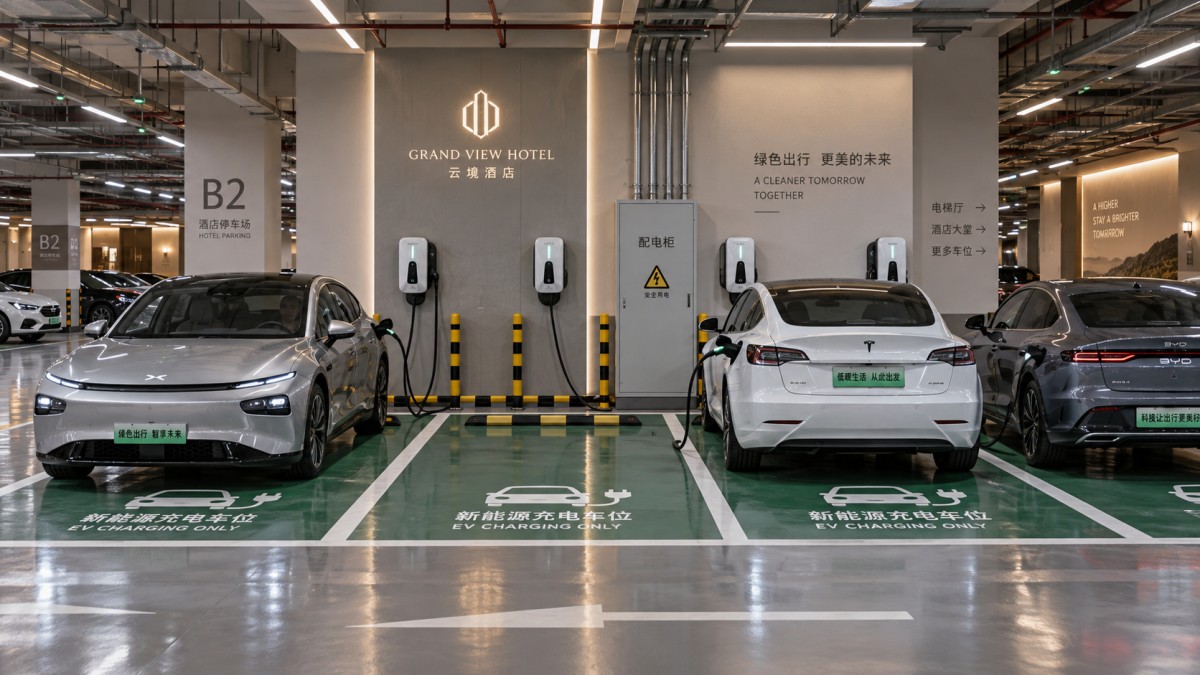
How many EV chargers does a hotel need for its parking capacity?
auth.Marcus WattTime
Oct 11, 2026Click Count
Determining how many EV chargers a hotel needs is no longer a simple parking-space ratio. A property with 200 parking spaces may need only a modest initial bank of chargers, while a smaller airport hotel could face heavier charging demand because guests arrive late, stay overnight, and expect to leave with meaningful range. The right answer depends on guest behavior, dwell time, electrical capacity, local requirements, operating model, and the ability to expand without rebuilding the site later.
For project managers, effective EV Charging for hotels is a sizing exercise before it is an equipment decision. Installing too few active ports can create guest frustration and front-desk disputes. Installing too many high-power chargers without load management can create avoidable transformer, switchgear, and utility-upgrade costs. The practical goal is to match usable charging capacity to real parking demand while preserving a clear, economical expansion path.
Start with charging demand, not the parking-space count
Parking capacity is a useful reference point, but it is not the primary sizing input. Two hotels with the same number of spaces can require very different charging layouts. A resort where guests remain parked for several days has long charging windows and can serve many vehicles with lower-power AC charging. A city-centre hotel with valet operations, frequent turnover, events, and short stays may need more active ports or a small number of faster chargers to keep vehicles moving.
A sound forecast begins with the hotel’s operating profile:
- Average and peak occupancy, separated by weekday, weekend, and seasonal patterns.
- Typical length of stay and vehicle arrival/departure windows.
- The proportion of overnight guests, event visitors, fleet vehicles, taxis, and staff using the car park.
- Whether parking is self-service, valet-managed, gated, or shared with retail or conference facilities.
- The expected EV adoption profile of the hotel’s local and international guest base.
The question is not simply, “What percentage of parking bays should be electrified?” It is, “How many vehicles are likely to request energy during the busiest charging period, and how much energy can each receive before departure?” That distinction prevents projects from treating a charger as a static amenity rather than part of a managed electrical system.
Use a staged sizing model
For most hotel developments, the sensible approach is to distinguish between installed charging ports, EV-ready parking spaces, and future electrical capacity. These are related but should not be treated as the same commitment.
This layered approach lets a project deploy a reasonable initial quantity while preparing a larger share of parking spaces for future chargers. The exact percentages should be validated against local building rules, accessibility requirements, utility conditions, and the hotel’s demand forecast. In many projects, civil works and cable containment are far cheaper to include during construction than to add once landscaping, paving, waterproofing, and guest circulation are complete.
A useful early-stage calculation is to estimate peak simultaneous charging demand rather than multiplying every charger’s nameplate power. If a hotel plans several AC chargers, not every unit will necessarily draw full power at the same moment. Smart load management can allocate a defined site power limit across connected vehicles, prioritize departures, or reduce charging output during building peak demand. The resulting design demand must still be reviewed by the electrical engineer and accepted within the applicable electrical and utility framework.

Choose charger types around dwell time and service expectations
Hotels are usually well suited to AC destination charging because vehicles often remain parked for hours. An overnight guest does not necessarily need ultra-fast charging; dependable access to a correctly functioning AC port may be more valuable than a high-power unit that is expensive to install and poorly utilized. AC charging also tends to be easier to distribute across a larger parking area when feeder capacity is constrained.
DC fast charging can still make sense, but its role should be specific. Properties near highways, airports, or major intercity routes may attract drivers who need a shorter stop. Conference venues with high daytime turnover can also benefit from faster charging for visitors. In those cases, the project team should review utility demand charges where applicable, transformer loading, cable routing, ventilation and clearances, equipment service access, and whether the parking circulation pattern supports a short-stay charging bay.
A mixed approach is often more practical than choosing one technology for every space: AC charging for overnight guests and staff, with limited DC capacity only where fast turnaround is a credible operational need. The mix should not be selected from charger power alone. It should reflect how the hotel intends to manage parking, reservations, charging fees, idle time, and guest communication.
Electrical capacity is usually the real constraint
The hotel’s existing electrical system can turn an apparently small charging project into a broader infrastructure decision. A property may have adequate transformer capacity on paper but little spare capacity during summer cooling peaks, kitchen operations, laundry cycles, or major events. Conversely, a new-build hotel may be able to reserve EV capacity efficiently if the distribution architecture is planned before procurement.
The engineering review should examine the incoming service, transformer rating, main distribution board, feeder loading, available fault capacity, protective-device coordination, earthing arrangement, and physical routes to the car park. For underground garages, project teams should also account for fire strategy, ventilation design, drainage, communications coverage, equipment impact resistance, and maintainable access. These are site-specific matters; no charger count is reliable until they have been considered.
Dynamic load management is particularly useful in hospitality settings because hotel loads fluctuate. It does not create new utility capacity, but it can make existing capacity serve more vehicles by limiting EV demand when the building approaches a predefined threshold. The controls strategy needs clear rules. A system that repeatedly reduces charging to very low output may protect the electrical network while failing the guest promise. Departure-time prioritization, where supported by the operating platform and guest process, can be more meaningful than equal power sharing.
Do not overlook the operating model
The number of chargers needed changes when valet staff control the vehicles. With a trained valet process, one charger may serve multiple cars during the night if staff move vehicles after sufficient charging. That can improve asset utilization, but it introduces labor, key-control, liability, and after-hours coordination issues. It should not be assumed without a workable operating procedure.
For self-parking hotels, guests need simple instructions: where chargers are located, whether they are reserved, how payment works, what connector is available, whom to contact if a session fails, and whether idle fees or parking restrictions apply. A technically sound installation can still underperform if guests find occupied bays, blocked chargers, poor mobile signal, or unclear access rules.
Networked chargers provide useful operational data, including session duration, energy delivered, availability, faults, and utilization patterns. After commissioning, those records should inform the next expansion phase. A hotel should avoid treating the initial installation as a one-time forecast that cannot be corrected. Utilization data can show whether the limitation is too few connectors, insufficient power, poor bay enforcement, unsuitable pricing, or a mismatch between charging speed and dwell time.
Common planning mistakes that inflate cost or reduce usability
One frequent mistake is installing only the minimum number of chargers required for opening day while omitting conduits and spare pathways. Future expansion then requires excavation, garage closures, or disruptive work around guests. Another is sizing every charger at its maximum power without a diversified demand analysis or load-management plan. This can oversize upstream equipment unnecessarily.
Projects also run into trouble when they place chargers in the most visible bays without considering cable reach, vehicle geometry, accessibility, snow or water exposure, bollard protection, and traffic flow. In a valet operation, charger location must support staff movement rather than creating a bottleneck at check-in. In a public-facing car park, a DC charger may require a different bay layout and queue-management approach than overnight AC units.
Procurement should include more than the charger enclosure. Teams need to verify compatibility with applicable local requirements and relevant standards, the communications protocol and backend arrangements, cybersecurity responsibilities, warranty boundaries, spare-parts availability, remote fault support, and the division of responsibility between the hotel, installer, network operator, and electrical contractor. Standards such as IEC, UL, and IEEE may be relevant depending on equipment and market, but compliance needs to be reviewed against the specific jurisdiction and project scope.
A practical decision path for hotel projects
A defensible charging plan usually starts with a parking and occupancy study, followed by a site electrical assessment and a forecast of peak charging demand. The team can then define an initial active-port count, the proportion of spaces made EV-ready, the site power limit, and conditions that trigger the next deployment phase. Those triggers might include sustained port utilization, recurring guest requests, planned fleet adoption, or a forthcoming renovation that makes expansion easier.
For new developments, EV charging should be coordinated with PV, energy storage, transformer selection, and smart-building controls rather than designed in isolation. Solar generation may reduce purchased energy at certain times, while storage can potentially support peak management depending on the project economics and control design. Neither should be assumed to eliminate the need for proper grid-capacity analysis.
This cross-system perspective is central to the work examined by Global Energy & Power Infrastructure (G-EPI). By looking across EV charging infrastructure, energy storage, photovoltaic systems, smart grids, and transformer considerations, G-EPI emphasizes verifiable engineering inputs over isolated equipment comparisons. For hotel projects, that means asking whether a charger plan works with the actual building electrical system and operating pattern—not merely whether a selected unit has an attractive power rating.
The best answer to “How many EV chargers does a hotel need?” is therefore a phased one: enough active charging to serve expected near-term demand reliably, enough prepared infrastructure to expand without major disruption, and enough electrical intelligence to keep the hotel’s wider load stable. Before finalizing quantities, confirm the parking profile, utility constraints, local obligations, equipment interoperability, and who will manage the chargers after opening. Those details determine whether the installation remains a guest amenity or becomes an avoidable operational burden.
Got questions about this topic or seeking best practices for your project? Drop us a line below, and let Hengda Engineering's experts help you out.
Recommended News
- 00
0000-00
How does EV fleet load balancing prevent site power overloads?Discover how EV fleet load balancing prevents site power overloads, protects electrical equipment, and helps vehicles get the energy they need before departure. - 00
0000-00
Which connector do you need for a level 2 charger in North America?Level 2 charger North America guide: choose the right J1772 or NACS connector, check AC adapter compatibility, and avoid costly mistakes before you buy. - 00
0000-00
How many EV chargers does a hotel need for its parking capacity?EV Charging for hotels: discover how to size active ports, plan EV-ready spaces, manage electrical capacity, and create a scalable guest-friendly charging strategy.
000000-00
{item.title}{item.description}Search News
Industry Portal
Hot Articles
- How to calculate shipping capacity for containerized batteriesCalculate shipping capacity for containerized batteries with practical guidance on payload, dimensions, route limits and dangerous goods requirements.
- E3/DC Plans LG Battery Replacements After German Home Storage FireE3/DC plans LG battery replacements after a German home storage fire. Find out what the proposed batch-specific plan means for owners and installers.
- How does EV fleet load balancing prevent site power overloads?Discover how EV fleet load balancing prevents site power overloads, protects electrical equipment, and helps vehicles get the energy they need before departure.
Popular Tags